





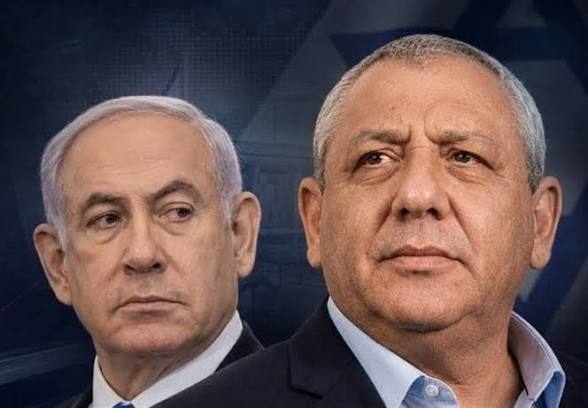


Alwaght- Amid the critical marathon of government formation consultations between the ruling coalition led by Benjamin Netanyahu and the opposition camp led by former army chief Gadi Eisenkot, while the two sides say that forming a national unity government is a top priority of talks, in practice their remarks about the principal policies of the future government do not give such prospects.
In one of the most significant clashes to grip the regime's media landscape in recent days, Eisenkot and Netanyahu have staked out markedly different, and at times directly confrontational, positions on the necessity of confronting the so-called Iranian threat and rushing headlong into war. While Netanyahu claims that to so-called Iran nuclear threat should be Israel's top agenda and be prepared for a new military campaign against Tehran as soon as possible, Eisenkot denied that such an immediate threat is posed by Iran to the Israeli national security and that he is opposed to a new war in the term.
From this perspective, we can put his remarks about a new war and even use of "Jewish terrorism" in commenting on settler actions in the West Bank in four key areas and in connection to his competition over power.
1. Moving closer to Arab parties: Eisenkot pushing to broaden coalition base
The first and perhaps most obvious aim of Eisenkot's recent remarks is to reach out to Arab political parties and lay the groundwork for their support in forming a government to replace Netanyahu. Eisenkot has lately warned that if negotiations with Netanyahu and the Likud-led political bloc fail to produce results within the next two weeks, he will activate the option of forming a minority government with the participation and backing of Arab parties, including the Joint List and Ra'am.
This political threat comes as Arab parties remain fiercely opposed to Netanyahu's aggressive policies in Gaza, Lebanon, and Iran, and condemn settler actions in the West Bank. Organized attacks on Palestinian villages, farms, orchards, and grazing lands, along with the expansion of settlements, are among the grievances that have inflamed Arab political currents and driven them to demand a halt to the process.
Against this backdrop, Eisenkot's use of the phrase "Jewish terrorism" to describe settler violence serves a purpose beyond moral or security condemnation. By deploying such language, he positions himself squarely against the Netanyahu government's permissive approach to settler violence while also seeking to signal to Arab parties that, should they join or support an alternative government, they would be dealing with a different political current.
This stance should therefore be seen as part of Eisenkot's effort to win the political trust of Arab parties and pave the way for a minority government under the leadership of the Yesh Atid current, a government that needs Arab lawmakers' support to break the parliamentary deadlock and sideline Netanyahu.
2. Taking advantage of the society’s frustration with Iran fall promise
The second point is the transformation of public opinion inside Israel and loss of trust in Netanyahu's promises regarding Iran. Over the years, the Israeli PM has sought to cast himself as the savior of Israelis and cling to power by securitizing the Zionist public sphere and stoking regional warfare, while simultaneously whitewashing and papering over his government's monumental failure in the October 7 operation. Within this framework, the idea of toppling the Islamic Republic through military action had become a centerpiece of Netanyahu's political and security propaganda.
Through pipe dreams and inflated claims about the achievements of military aggression in the 12-day and 40-day wars, Netanyahu tried to project an imminent picture of his strategic objectives against Iran and the allied Axis of Resistance.
However, the persistence of confrontation and the failure to achieve his declared goals have gradually exposed the gap between Netanyahu's political promises and the realities on the ground. Iran's resistance and the Israeli regime's failure to impose its will, particularly at the strategic level, have reinforced the perception in parts of Israeli society that a direct showdown with Tehran not only offers no guarantee of achieving the stated objectives but could impose even heavier security and economic costs on the regime.
Under these circumstances, Israeli society, which had once heard Netanyahu's promise to end the purported Iranian threat and weaken the Axis of Resistance, now views the repetition of those same slogans with greater skepticism. Some of Netanyahu's critics even hold him responsible for rising security and military costs, citing his miscalculations and his dragging of the regime into a direct confrontation with Iran.
Reading this shift in the public mood, Eisenkot has turned opposition to Netanyahu's portrayal of an imminent Iranian threat and the push for a rapid new war into one of the tools of his political competition. He is, in effect, trying to cast himself as a realist politician attuned to the limits of the regime's military power; one who, unlike Netanyahu, is unwilling to steer Israeli society toward another military misadventure just to preserve his own political standing.
So, Eisenkot's opposition should not be seen as a personal view regarding Iran; it is a standing meant to maintain and broaden public support and attract vote of discontent part of the society who no longer have faith in Netanyahu’s big promises about causing fundamental regional equations.
3. Concerns of military, security and economic apparatuses about costs of a new Iran war
The third point concerns structural worries within the Israeli regime about its capacity to withstand a new military confrontation with Iran. As Netanyahu continues to insist on the necessity of military confrontation with the Iranian threat, a serious question is being raised in military, security, and economic circles: does Tel Aviv, in its current condition, have the capacity to enter another large-scale war, especially one waged without direct American participation?
The experience of the 40-day war and its aftermath laid bare before public opinion the regime's limitations in managing a war of attrition and coping with Iranian missile attacks. Economic shutdowns or disruptions, the suspension of parts of daily life, settlers spending prolonged periods in shelters, airports closed for extended stretches, ports shuttered, businesses frozen, and the psychological strain of missile attacks are among the experiences Israeli society has no desire to repeat.
These concerns are not confined to public opinion; they are also visible in the regime's military and social structures. One telling example is the long-running dispute over Haredi exemption from military service. In recent months, the issue has become one of the major crises in the political sphere of the occupied territories, a crisis that at its core reflects the pressure of successive wars, manpower shortages, and the growing burden of military service on various segments of Israeli society.
Reports of 22 suicides among Israeli regime soldiers this year, alongside a rising trend of settlers seeking mental health treatment, reveal further dimensions of the strain imposed by the war footing. These indicators, together with economic and social problems, suggest that the persistent state of military confrontation has imposed costs on the regime extending well beyond the battlefield.
Under such circumstances, Eisenkot is seeking to echo the concerns of military and security institutions about re-entering a large-scale war—and, at the same time, to convert those concerns into political capital for weakening Netanyahu's position.
4. Preventing formation of a national unity government: Eisenkot's strategy to oust Netanyahu
But the most important point in analyzing the recent remarks and standings of Eisenkot is the direct bond of them with the government formation dynamics and push to put an end to Netanyahu premiership. Actually, his opposition to Netanyahu's remarks about the urgent necessity for a new war can be part of the political strategy to prevent reconstruction of power coalition around Netanyahu.
Should a new military crisis erupt, Netanyahu is well positioned to thrust the question of forming a national unity government back to the center of the political equation by spotlighting the need to confront an external threat. Under such circumstances, even parties and currents that in normal times oppose his continued premiership might yield to pressure from security considerations and the imperative of preserving internal cohesion, agreeing to join an emergency or national unity government.
A scenario like this could deal a direct blow to Eisenkot's plan to form a minority government with Arab party support. Once war begins, the regime's political and media landscape will pivot from competition over forming a government and sidelining Netanyahu toward the imperative of confronting an external threat. In this situation, the prime minister can exploit wartime conditions to rebuild his political standing and to delay or neutralize his opponents' efforts.
On another front, Netanyahu's continued hold on power is not merely a matter of party competition. His political future is also bound up with legal cases and the possibility of prosecution. Leaving power could therefore carry consequences for him extending well beyond surrendering the premiership. Eisenkot and his allies, for their part, know that any shift in the political equation and the formation of a new government would mean curtailing Netanyahu's ability to manage those cases and preserve his political position.
Eisenkot's opposition to Netanyahu's warmongering should, therefore, also be examined through the lens of the contest over the future of power in the Israeli regime. By opposing the launch of a new war, he is in practice trying to prevent Netanyahu from using emergency and security conditions to shatter the opponents' political coalition and foreclose the possibility of forming an alternative government.