










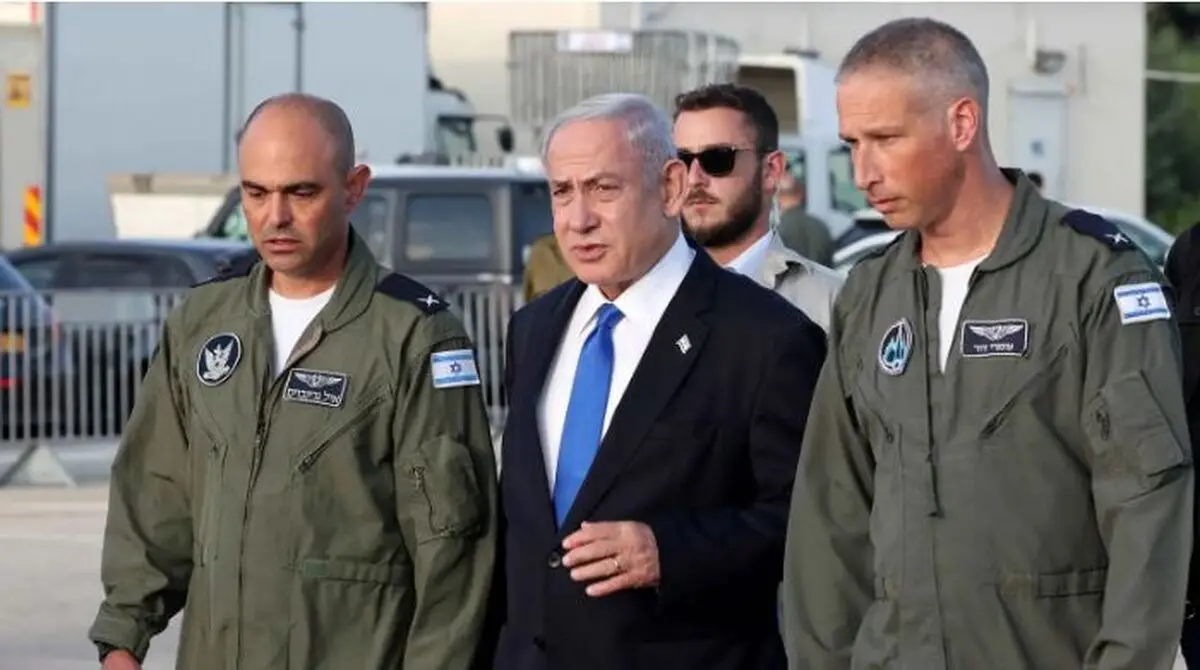


Alwaght- A week to the parliamentary elections, the Israeli Prime Minister Benjamin Netanyahu has unveiled the regime's new national security doctrine.
Unveiled during a press conference, the document includes 10 principles, putting Iran and resistance movements in the region at the top of security threats the Israeli regime is facing. Emphasizing on settlement projects and boosting Jewish identity across the world, maintaining Israeli military superiority in the region, increasing arms production, taking preemptive actions countering cyber attacks and terrorism, and investing in AI are among the matters highlighted in the new document.
But in the eyes of the analysts and experts, Netanyahu's move to review the national security doctrine ahead of elections is more about a struggle to stay in power than about a strategic necessity.
Netanyahu's goals and motivations
In the Israeli politics, Netanyahu has long been cast as a man who can conjure defeat into victory at the eleventh hour with surprise maneuvers and sleight of hand. Now, many analysts believe, he is unveiling a new security doctrine to shore up his standing as Israel's "Mr. Security," repair his sagging poll numbers ahead of elections, and shift the contest's center of gravity from his record to the security threat. He wants to tell Israeli society that, among the available choices, only he can keep the regime safe and steer it through the major security challenges ahead, challenges that Netanyahu claims will come from Iran and the resistance groups.
Mohanad Haj Ali, deputy director of research at the Middle East Center, told Al Jazeera that this framework "cultivates existential fears in society, making Israeli voters feel they need a decisive leader."
The timing of the doctrine's rollout carries particular political weight: Netanyahu is fighting to stay in power amid widespread domestic criticism of his government's performance and while entangled in corruption cases that could be revived in court if he loses the coming election.
His government's handling of the October 7 attacks and the wars that followed has also become a central line of attack against him. Under such conditions, shifting the electoral battlefield from his political record to future threats offers Netanyahu a chance to ease the pressure of criticism.
As the parliamentary election nears, Netanyahu is trying to revive his credibility as the guarantor of Israel's security by playing up security threats and stressing the need for forceful leadership at the top of Tel Aviv's power pyramid. He hopes to convince even voters dissatisfied with his policies and conduct that, under current conditions, he remains the most reliable option for confronting security threats against the Israelis. In this context, Trump's open support can also be read as part of the effort to rebuild his faltering political standing on the eve of the election.
Setting up Netanyahu's doctrine
Now the question is this: How does publication of the new national security doctrine help Netanyahu reach his goals?
Since Israel is a security regime, Netanyahu believes that after nearly 8 decades of foundation of this entity, it is necessary to fundamentally review the security approaches of Tel Aviv.
One of the key aspects of this move is moving past the "Ben-Gurion doctrine" as one of the most determining strategic figures in the Israeli history towards "Netanyahu doctrine," a shift that is meant to elevate Netanyahu on a par with Ben-Gurion. That is why Netanyahu, pushing forward his own principles and vision as the foundation of the new Israeli security doctrine, wants to take the credit for start of a new era in the Israeli security strategy.
The key difference between the two doctrines lies in their priorities and their approach to threats.
The Ben-Gurion doctrine rested on "deterrence, early warning, and decisive victory," placing the preservation of military superiority at its core, whereas Netanyahu's strategy emphasizes "preemptive action, confronting threats directly before they become serious dangers, and strengthening military and technological capabilities."
By redefining Israel's security principles, Netanyahu aims not only to answer the challenges ahead but to place his name alongside the founders of the regime's security strategy. Netanyahu has recorded the longest stint as prime minister in the history of the occupying regime and is now seeking to leave a lasting legacy in the security realm as well.
Projecting powerful Israel image
Netanyahu is trying to use the new security doctrine to paint Israel as a stronger regime with more solid security foundations, a picture that directly contradicts his critics' view. His opponents not only hold him responsible for the October 7 attacks but argue that his government's policies have weakened Tel Aviv's security foundations and eroded its legitimacy among foreign allies.
Hence, opposition leaders moved swiftly to condemn the move right after the document was unveiled. Gadi Eisenkot, a serious rival to Netanyahu, called the document "blank pages full of slogans." Former PM Yair Lapid said the new doctrine amounted to vague generalities and failed to address Netanyahu's responsibility for Israel's past security failures.
Against this backdrop, spotlighting internal threats has become a central plank of the security doctrine, one that allows opponents and critics to be cast as threats to Israel's security and sets the stage for deepening social rifts.
As a result, securitizing the social sphere not only expands the role of security institutions in running society but can become a tool to justify and advance hardline policies against opponents, something observers say could, over the long run, create new challenges to internal cohesion in the occupied territories.
Self-sufficiency in arms production
Emphasis on maximum independence in military production is one of the pillars of the new doctrine which Netanyahu can use to draw an alerting picture of the security future of the rgime and warn about foreign military aid to Tel Aviv being reduced or cut off.
Under this document, the military dependence on allies can be presented as a strategic vulnerability, something encouraging boosting home defense and military capabilities.
Netanyahu is trying to use this argument to cast himself as the guarantor of the Israeli regime's passage through future threats and to justify heavy military spending, even if that path deepens economic pressure on Israelis, drives up public costs, and further isolates the regime internationally.
Netanyahu's security-related move is, at bottom, a kind of escape forward in the face of his cabinet critics' anger over rising antisemitism worldwide, a wave critics trace to the hawkish policies of Netanyahu and his hardline allies. Therefore, Netanyahu aims to reframe criticism of his government's performance as security threats and antisemitism by playing up threats against Tel Aviv and stressing the need to strengthen defensive capabilities. That way, he can divert public attention from his own political responsibilities while rallying domestic support around the need to safeguard national security.