














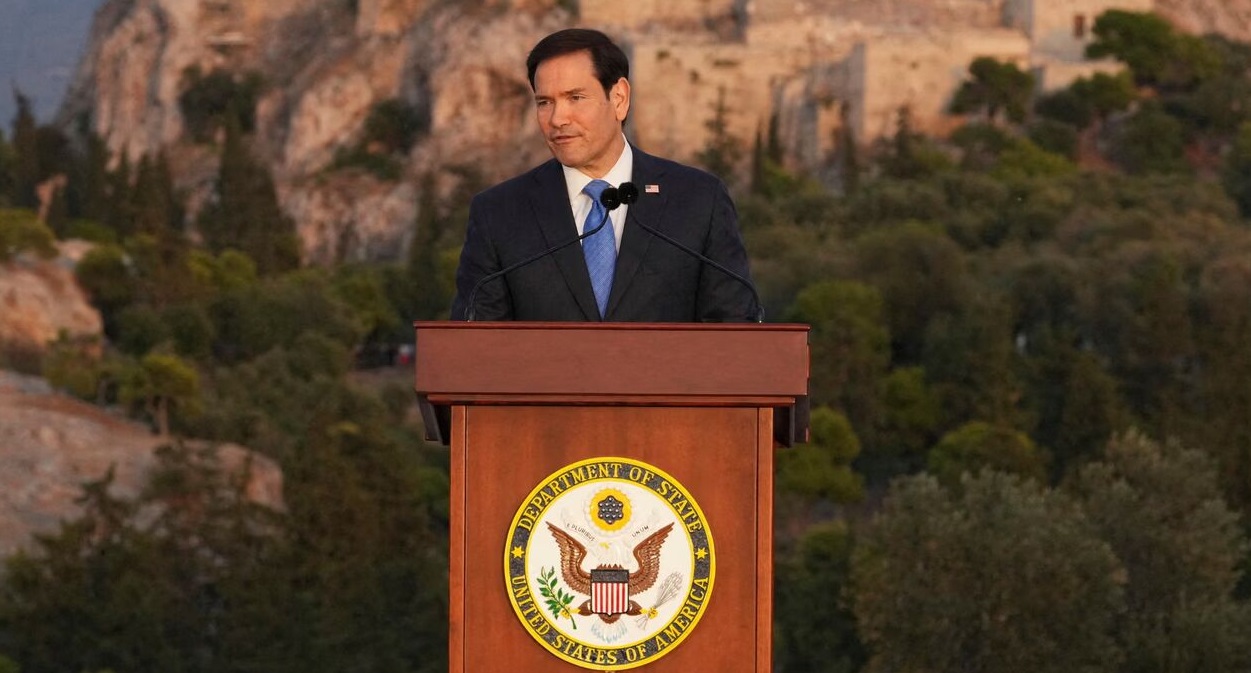


Alwaght- Recent remarks by US Secretary of State Marco Rubio in Greece addressed the Greeks, but in their heart they carried anti-Iranian allegations that with distortion of reality and history demonstrated both the depth of the White House's vendetta and enemity to Iranian culture and civilization and generally the powerful Iran of the past and present and at the same time were driven by political and ideological purposes, something that has not remained hidden from the eyes of observers and analysts.
Rubio's inadvertent admission to Iranian power
The top American diplomat actually made anti-Iranian claims, but at the same time he inadvertently pointed to Iranian historical power. In this regard, he said that in 480 BC, the army of Persian King Xerxes arrived in Athens and the people of Athens for several days kept behind the gates the biggest empire of that time.
Rubio’s remark about Iran’s standing as the greatest empire of its time slipped out unwittingly, but it laid bare a deeper truth: Washington’s objection is not merely to the Islamic Republic, but to a powerful Iran, period. The US will tolerate no restoration of Iran’s historic prominence on the world stage. And two strikes on Iran in under a year, sold as a bid to curb a peaceful nuclear program, betray a simpler fear, which is that Iran is becoming a rising power in the new global order, and that this momentum must be stopped.
War against rebels, not a civilizational war
Rubio, in his anti-Iran tirade, has conjured up a clash of civilizations, claiming Iranians looted temples, burned sanctuaries, and leveled the Acropolis. But many experts say Xerxes' war with the Greeks was a response to the Athenian revolt and the burning of the Achaemenid city of Sardis, and there is no evidence Iran ever sought to annihilate Greek culture. Casting the Greco-Persian Wars as a civilizational clash is a flat distortion of history. Those wars, fought some 2,500 years ago, had their own specific historical and political context and cannot be grafted onto today's US-Iran confrontation without explaining the fundamental differences. By invoking Xerxes' destruction of Athens in 480 BC as a cautionary tale of a threat to Western civilization, Rubio is rewriting the past to serve the present.
Seeking to sell confrontation with Iran as a civilizational clash
Not only did Rubio in Athens try to paint war against Iran as a civilizational conflict, but also the rhetoric of the Trump administration against Iran is itself a kind of push for a civilizational confrontation with Iran. Trump himself has already several times made remarks against Iranian civilization. In the closing days of the 40-day war, he threatened "a whole civilization will die." His threats, however, have so far failed to intimidate Iranian leaders.
Rubio's claims questioned inside the US
Meanwhile, even inside the US, civilizational distortions of Rubio were heavily questioned by some academics and researchers.
Rubio wants to cast Iran as common enemy of the US and Europe: Vali Nasr, a professor of international relations and Middle East studies at Johns Hopkins University, told Al Jazeera that Rubio's speech was aimed at casting Iran as a common enemy that could once again rally the US and Europe around a single axis. Washington, he said, wants to put the Iran threat at the center of Western cooperation, displacing the trans-Atlantic disputes over Russia and Ukraine.
Lust for power has replaced justice: Joseph Loconte, an American historian, author and scholar of Western civilization, argued in an essay for the conservative National Review that Rubio's speech was riddled with historical and conceptual errors. His central criticism is that Rubio emphasized ambition, rivalry and national power while ignoring the place of justice and the moral limits of power. Loconte warned that such a narrative could produce a misleading picture of American history and Western civilization.
Rubio exploited philosophy to justify MAGA ideology: A critical article published by the Financial Times has labeled Rubio's Athens speech as an effort to ideologically justify MAGA movement through referring to history and philosophy. This article sheds light on Rubio's selective use of Plato, Alexander of Macedonia, and historical conquerers, arguing that he emphasizes on military and national power but turns a blind eye to Enlightenment thoughts and some other parts of the Western philosophical legacy. The author also interprets the speech as driven by Rubio's political ambitions and his push to transform into a Trump political heir.










