
















Alwaght- After months of clashes, talks, and inconclusive agreements between Syrian government led by Ahmad al-Sharaa and the Syrian Democratic Forces (SDF), the two sides finally struck a deal on the country's most controversial issue, namely the fate of Kurdish militia structure and arms, ushering in a new stage in the Syrian developments.
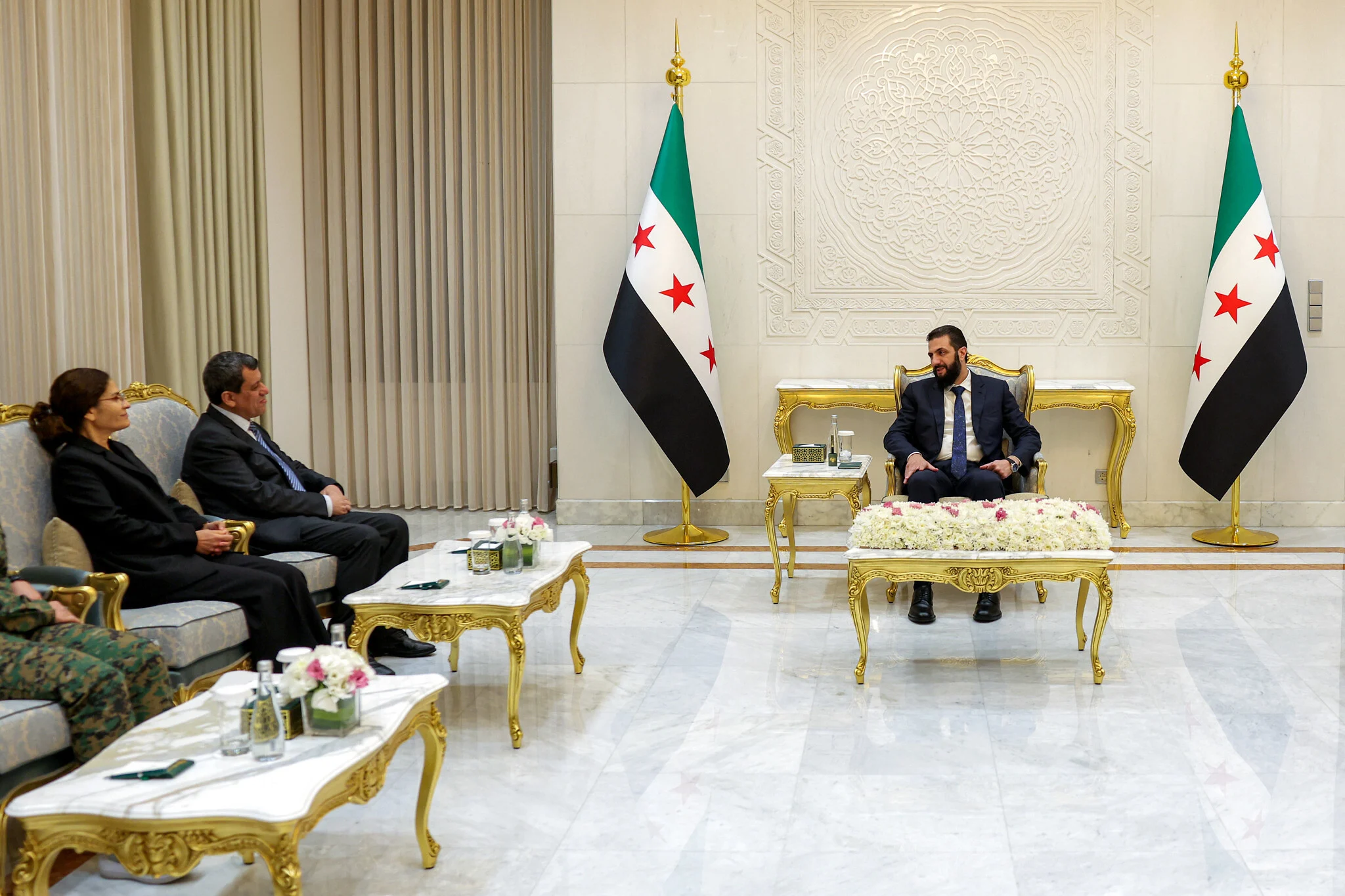
Mazloum Abdi, the chief of the Kurdish militia, on Tuesday met al-Sharaa and announced that the SDF have completed the process of integration into the regular Syrian army and will not act as an independent force anymore.
Abdi acknowledged that his militia had shouldered grave responsibilities during the country’s darkest hours, but said Syria has now entered a phase of peace and shared nation-building. He conceded that the Autonomous Administration of North and East Syria would be dissolved, with its military and civilian institutions folded into the Syrian government’s authority.
A source told Al-Quds Al-Arabi that the meeting between Abdi and Syria’s interim president focused on the future of the SDF and arrangements for the next phase, wrapping up with a series of understandings and decisions aimed at recalibrating ties between Damascus and the autonomous bodies and forces affiliated with the Kurdish-led group.
Under the deal, Damascus agreed to recognize the cultural and linguistic rights of the Kurdish community and to address their status within the framework of Syria’s new constitution. One of the accord’s most significant outcomes is the end of the SDF’s independent chain of command, with state news agency SANA stressing that after integration, all security and military responsibilities must fall under “a single national command structure.”
Following the announcement of the SDF’s dissolution, al-Sharaa appointed Abdi as an adviser to the president, and another granting Ilham Ahmed, the co-chair of the autonomous administration’s foreign relations office, a seat in parliament.
The Syrian government and the SDF had already reached a framework understanding last January on a phased integration of their military and administrative structures. That agreement included the withdrawal of both sides’ forces from contact zones, the deployment of Interior Ministry security personnel to the city centers of Hasakah and Qamishli to bolster stability, and the launch of a security-force integration process. It also envisioned a military division comprising three SDF brigades and one brigade from Kobani, organized under Aleppo province’s command.
The January deal further covered the merger of autonomous administration institutions into Syrian state bodies, with provisions to stabilize civilian staff status, and included agreements on resolving civil and educational rights for the Kurdish community and ensuring the return of displaced persons to their places of origin.
How were SDF formed?
The SDF were formed in 2015 amid Syrian civil war, when Bashar al-Assad was in power. The militant coalition was a multi-sectarian bloc consisted of People's Protection Units (YPG) and Women's Protection Units (YPJ), as well as other Kurdish, Arab, and Asyrian groups.
Supported by the US, the group joined fighting for liberation of vast regions of the north and east from ISIS terrorist group, including Raqqa. After defeating the terrorists, the Kurdish fighters held much of the liberated region.
While the SDF command had previously put its troop strength at around 100,000, the Financial Times, following the dissolution announcement, placed the number closer to 60,000.
But the SDF’s significance was never just about manpower. For years, the force held sway over a vast stretch of northern and eastern Syria, regions that harbor a large share of the country’s oil and gas reserves. That made the SDF, in effect, a military force, a political authority, and an economic actor all rolled into one.
Alongside its military structure, the Autonomous Administration of North and East Syria had built up its own separate administrative, security, and economic institutions. That complexity meant the SDF issue was never simply about disarming a militant group, but it had become a question of Syria’s future political architecture itself.
Why was SDF dissolved?
The answer to the question that why the SDF was resolved should be sought in the shifting balance of power, both inside Syria and across the region. When the SDF first sat down with Damascus in March 2025, its leaders calculated that territorial control, US backing, and military muscle would give them a strong negotiating hand. But the events of 2026 upended that equation.
In January, Syrian government forces swept through large swaths of SDF-held territory in a rapid offensive. By January 18, according to a European Union asylum agency report, the SDF had lost roughly 80 percent of the ground it had held at the start of the month, with its presence largely reduced to the Kurdish-majority areas of Hasakah, Qamishli, Al-Malikiyah, and the outskirts of Kobani. That military collapse gutted the SDF's leverage, and ultimately paved the way for the January 18 framework agreement, followed by the January 29 deal, which laid out a new blueprint for integrating SDF forces into the Syrian state.
Under those circumstances, accepting integration into the Syrian army was less a free choice for Kurdish leaders than a calculation among grim alternatives: strike a deal with Damascus and try to salvage some political and cultural gains, or plunge into a new war with a government that was steadily consolidating its position.
The second factor was Turkish pressure. Ankara has long branded the SDF as the Syrian wing of the Kurdistan Workers' Party (PKK), and views a large armed Kurdish force on its southern border as an existential security threat. That concern only intensified after PKK leader Abdullah Ocalan moved to end the group's armed struggle.
In February 2025, the jailed Kurdish leader called for the PKK to dissolve and disarm, and the militant group later announced its decision to cease armed operations and disband. Though the SDF initially insisted that Ocalan's call did not directly apply to them, politically speaking, it became much harder to sustain a military force in Syria tied to PKK-affiliated structures after the group itself had been formally dissolved.
Turkey made clear that a mere rebranding or cosmetic change by the SDF would not suffice and the force had to sever its ties to the PKK outright. Turkish pressure, then, was not just about military threats; it was part of a regional push to wind down PKK-linked armed structures altogether. President Recep Tayyip Erdogan had warned repeatedly: either the SDF forces lay down their weapons, or they would be buried with them.
Washington's pressures
Perhaps the most important development in the SDF's posture was driven by the shift in the American policy. Washington for years called the SDF its main partner in Syria to meet its interests. However, after al-Assad's fall in December 2024, which tipped the scales of power, the Americans pushed for a deal between the Kurds and Damascus thar will both ensure the Kurdish rights and prevent further Syria partition.
After Bashar al-Assad's fall, Washington shifted its focus away from preserving an autonomous Kurdish enclave and toward building a stable central government in Damascus, while simultaneously trying to manage Turkey's security concerns. By March 2025, the US was steering SDF commanders toward a deal with the Syrian government, leading to the first Abdi-al-Sharaa agreement. Washington, Reuters reported, feared that continued confrontation among the SDF, Damascus, and Ankara could spiral into a wider war, one that would complicate Washington's plans to draw down its military footprint in Syria.
In securing the final deal, US Special Envoy for Syria Thomas Barrack played a pivotal role. In January 2026, after Damascus's rapid advance, Barrack declared that the SDF's primary mission, namely fighting ISIS, had largely run its course, and that Washington's new objective was integrating the Kurds into Syria's central government. He framed the moment as a "historic opportunity" for the Kurds, signaling that the US would no longer back a military autonomous zone in northeastern Syria.
Barrack doubled down in June, meeting with Abdi and demanding a complete severance of ties with the PKK, the removal of PKK cadres from Kurdish areas in Syria, and the full completion of military and administrative integration with Damascus by year's end. He made continued US support for Syria's Kurds conditional on meeting those terms.
When Barrack's blueprint ultimately led to the SDF's dissolution, he hailed it as a "historic transformation", adding: "This is real integration. There is no winner and no loser. Parties that once held divergent views are building a diplomatic solution to strengthen Syrian sovereignty: one army, one government, one country."
Yet despite Washington's pressure to end the SDF's independent structure, Kurdish leaders were not eager to comply. Their insistence on retaining arms and autonomy was never purely military ; it was about the political and economic future of Kurdish-majority regions. Militarily, they feared that disarming would strip them of their ability to defend their territory and their leverage vis-à-vis both Damascus and Ankara; hence their push to preserve some local command structures and forces.
Economically, control over oil and gas fields, border crossings, and regional resources was the SDF's single most important bargaining chip, funding their administration and giving them leverage in talks with Damascus. After a decade of control, they were loath to surrender that revenue stream. Politically, the SDF sought decentralization, local governance, and guarantees for Kurdish cultural and linguistic rights, while Damascus insisted on centralized sovereignty and a unified army. That fundamental clash delayed implementation of the agreement for months.
Barzani of Iraqi Kurdish the linking ring of Kurds and Damascus
The role of the Kurdistan region of Iraq and particularly its President Nechirvan Barzani in this deal is considerable. He on the one hand holds close ties to the Syrian Kurds leadership and on the other hand talks to Ankara, Washington, and Damascus. This has turned him into a key mediator in Syria case.
His talks with Abdi and Barrack and then his visit to Damascus and meeting al-Sharaa fall under these efforts. His overarching aim was to prevent the Kurdish-Damascus standoff from devolving into a protracted war, and to find a formula that preserved Kurdish rights within the framework of a unified Syria. In Damascus, he simultaneously pressed for the protection of Kurdish and minority rights while reaffirming his commitment to a united Syria, using Erbil's unique position to bridge the gap between Damascus and Syria's Kurdish leaders.
In effect, Barzani was sending a blunt message to Syria's Kurds: the regional calculus has shifted, and holding onto political gains no longer hinges on maintaining an independent army. With international and regional backing eroding, the SDF's leverage over Damascus had shrunk, leaving them with little choice but to accept a deal.
Murky prospect of the agreement
Yet for all the agreements signed, significant friction points remain, and they could easily challenge implementation. There is a fundamental gap between "dissolving the SDF" and "fully dismantling Kurdish military and political structures," and no final deal has been reached on that front.
On paper, the SDF as an independent military force appears to be winding down, with a substantial portion of its fighters already folded into the national army. But the thorniest issue remains command and control. The EU asylum agency has reported that talks in recent months have circled around chain-of-command structures, the ranks to be given to former SDF commanders, and the fate of various units. Still, it seems unlikely that the Kurds, even after the SDF's formal dissolution, will fully implement all the military arrangements Damascus and Ankara demand. They remain deeply anxious about losing influence and security guarantees, and will likely try to preserve some command structures and local forces to retain a measure of leverage. The integration of the YPJ has also remained a sticking point.
Furthermore, the core problem in northeastern Syria is no longer just about weapons, it is about trust. The Kurds fear that once they lay down their arms and integrate into the Syrian army, al-Sharaa's government may renege on its commitments and ignore the political, cultural, and legal guarantees it has promised. They carry decades of experience with discrimination and betrayal by Syria's central governments, and their skepticism toward Damascus's political pledges is entirely understandable.
For its part, Damascus worries that even after the SDF's formal dissolution, local Kurdish structures will effectively persist in another guise, creating a "state within a state."
Ibrahim al-Halabi, an Arab journalist, told Khaleej Online that "the SDF's announcement is not merely the end of a military organization; it could be one of the most significant steps in reshaping the Syrian state after years of war. If the integration process succeeds in preserving Kurdish rights and ensuring their participation in state institutions, it could become a model for resolving other internal issues. But if the arrangements falter, or if disputes over power and rights resurface, the end of the SDF could mark the beginning of a new phase of tension."










