
















Alwaght- In a widely circulated video interview on social media, Iran's deputy ambassador to Kabul, Seyed Hassan Mortazavi, has declared that the Islamic Republic does not recognize the "resistance" groups opposing the Taliban government and offers them no support. He stressed that the term "resistance" is reserved for Gaza, Lebanon, and the fight against the US, and, therefore, has no place in Afghanistan. Mortazavi added that helping to topple the Taliban government "has no religious justification," and Iran's advice to the opposition is to sit down at the negotiating table with the Taliban. The remarks come as the Taliban government, despite its pledges to form an inclusive government, is in practice run exclusively by a single ethnic group, marginalizing others, including the Shiite Hazaras, Tajiks, and Uzbeks.
The stance reflects a pragmatic strategy by Tehran, rooted in several key factors:
1. Prioritizing national security and stability on the borders
Iran's main concern is security of its eastern borders and preventing large-scale instabilities that can spill into the country. Tehran's policy regarding Afghanistan has shifted, like other neighbors, from internal reforms to management of crisis and curbing insecurity. Such measures as preventing cross-border terrorist attacks, managing flow of migrants, and controlling drugs trafficking have become top priorities of the Islamic Republic of Iran.
2. Trade ties
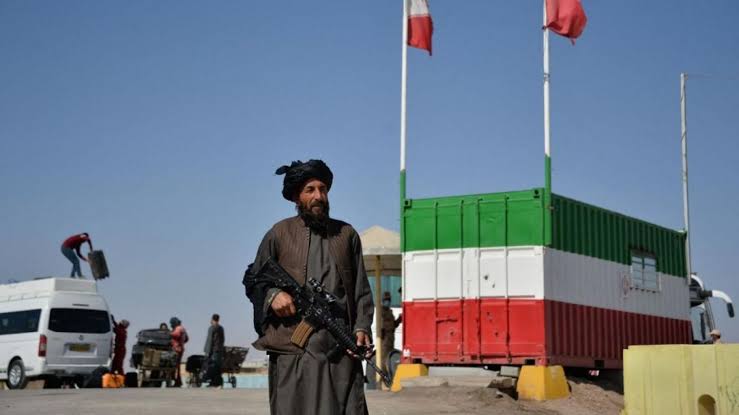
Annual trade between Iran and Afghanistan is estimated at roughly $4 billion, with a significant portion flowing through land crossings such as Islam Qala in Herat and the border posts of Nimroz Province. Despite regional tensions, commerce between the two countries has continued with little interruption, keeping Iran as Afghanistan's largest trading partner. Maintaining this level of exchange is vital for Iran's economy, which is already grappling with sanctions and regional crises.
3. Existence of relatively responsive government in Kabul
Though Iran has not yet recognized the Taliban's government, it finds interaction with a centralized government in Kabul, regardless of its nature, for managing the interests and settling bilateral issues like water resources, borders, and security works better than dealing with a country with power vacuum or fragmented. By keeping its embassy in Kabul open and continuing dialogue with the Taliban, Iran has kept its communication channels open and somehow embarked on practical recognition.
4. Taliban opposition fragmented, not aligned with Iran's policies
The opposition factions, including the National Resistance Front and various other ones remain fragmented, lacking cohesion and a unified command. The previous republican government, during its tenure, was heavily reliant on the US, which eroded Iran's trust and led Tehran to prefer engaging with the new dominant player on the ground, the Taliban. This pragmatic calculus has steered Iran toward backing the status quo.
5. People not aligned with Taliban opposition in real sense
Taliban’s armed opponents are majorly concentrated in mountainous regions and northeast of the country and have no massive, national-scale support. Despite their monopolization of power, the Taliban have managed to restore relative peace in many parts of the country. Meanwhile, people of Afghanistan, who are war-exhausted, are not willing to see rejuvenated armed clashes. Indeed, non-Pashtuns are not contented with the Taliban's performance, but they have no confidence in opposition groups.
6. US and West help Pakistan fot destabilizing Afghanistan
Afghanistan has once again become an setting for rivalry of great powers. According to strategic analyses, the US and its Western allies, operating largely through Pakistan, are pursuing a policy of "controlled instability" in the country, using it as a lever to pressure rivals including Russia, China, and Iran. Tehran sees this game for what it is and, by maintaining engagement with the Taliban, is trying to prevent Afghanistan from turning into a new front against its own interests.
7. Formation of inclusive government; refusing to recognize the Taliban
This is a key point showing that Iran's interaction with the Taliban is not strategic, but pragmatic. Senior Iranian officials, including the late President Sayyed Ibrahim Raisi, repeatedly underscored the need to form an "inclusive government" in Afghanistan. Iran has practically not recognized the Taliban and this standing allows Tehran to stay away from a hurried legitimization of this group and remain a valid mediator.
8. Meditation role and preventing proxy confrontation with regional rivals
Tehran wants to position itself as a key player and mediator in Afghanistan's complex equations, while preventing the country from becoming a staging ground for proxy conflict with its regional rivals, particularly Pakistan. Any backing of anti-Taliban factions would not only fuel further instability but also put Iran on a direct collision course with Islamabad, given that Pakistan still holds considerable sway over segments of the Taliban, especially the Haqqani network and the Kabul-based faction within the movement. Pakistan remains intent on preserving Afghanistan as its "strategic depth."
Conclusion
International developments and the US moves in the region should not be disregarded. The US still seeks to find a loophole for return to the strategically important Bagram airbase via a proxy mode and using terrorist groups like ISIS-Khorasan. Actually, its intelligence services are active in that region for this end. Knowing this, Tehran is trying, through boosting ties with the Taliban, to prevent any security vacuum that will pave the way for Western return to Afghanistan.










