














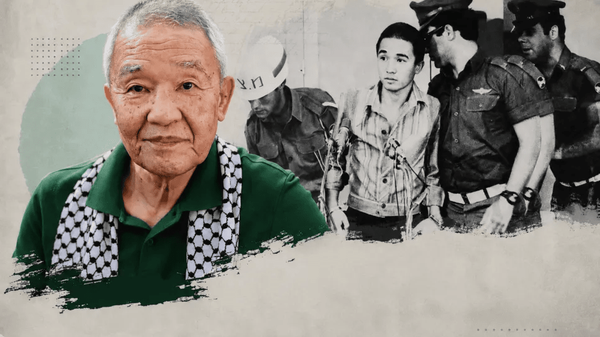


Alwaght- Kozo Okamoto who was known as Ahmad the Japanese in the Arab world is one of the most controversial figure of the leftist armed militias in the 1970s and 1980s. He was a member of the Japanese Red Army group and after attack on the Lod Airport in Israel in 1972, he became a symbol of anti-Israeli occupation struggle. He was hailed among some Palestinian and Lebanese groups as a man having fought for the Palestinian cause.
Kozo Okamoto was born on December 7, 1947, into a middle-class family in Japan’s Kumamoto Prefecture, according to Al Jazeera. His father was a school principal, and Kozo was the youngest child. He studied botany at Kagoshima University, leading a quiet life —, until Japan’s turbulent political climate in the 1960s rerouted his future.
That decade, Japan erupted in mass student protests against the Vietnam War, US military bases, and capitalism. Out of that ferment emerged a radical faction calling itself the Japanese Red Army, bent on “world revolution.” Okamoto’s older brother, already a left-wing activist, had taken part in the 1970 hijacking of Japan Airlines Flight 351, the so-called Yodo-go incident. That family history, combined with the radical campus atmosphere, pulled Kozo into the Red Army’s ranks.
Connections to Palestinians
The JRA established close ties to the Palestinian Front for Liberation of Palestine (PFLP) in early 1970s. The Japanese fighters relocated to Palestinian camps in Lebanon and other regional states, receiving military training. The driver behind this cooperation was a recognition of themselves as part of the global camp against imperialism and Israel's ally the US.
On May 30, 1972, three JRA members flew into Tel Aviv's Lod Airport on an Air France flight. After retrieving their luggage, they pulled out automatic rifles and grenades and opened fire on Zionists. The attack left 26 dead and dozens wounded. Two of the attackers were killed, but Okamoto was wounded and taken into custody. The assault became one of the most infamous armed operations of the 1970s, carried out by three Japanese nationals against Zionist targets.
Trial in Israel
At his trial in Tel Aviv, he accepted responsibility for the operation and was sentenced to life in prison. During his incarceration, prison officials reported erratic behavior, and Okamoto later confirmed that he had been tortured while in custody.
In 1985, as part of a prisoner-exchange deal between Israel and Palestinian factions, known as the Jibril Agreement, he was released after roughly 13 years behind bars.
Following his release, he first went to Libya and Syria, and eventually settled in Lebanon.
Life in Lebanon and Ahmad the Japanese nickname
In Lebanon, he came to be known as "Ahmed al-Yabani", Ahmed the Japanese. He lived in areas under the influence of Palestinian factions and rarely appeared in public. In 1997, he was detained by Lebanese security forces along with several other Japanese Red Army members.
Four of his comrades were extradited to Japan, but Lebanon granted Okamoto political asylum and rejected Japan's repeated extradition requests. According to the Associated Press, he was the first person ever to receive political asylum in Lebanon.
The Lebanese government argued that if he were handed over to Japan, he might eventually be transferred to the Israeli regime or face serious security risks.
For Palestine
Among some Palestinian factions, particularly the PFLP, Ahmed the Japanese was seen as a man who had fought for their cause without any ethnic or national tie to Palestine.
In his later years, he led a quiet, low-profile life in Lebanon, appearing mostly only at Palestinian memorial events. Ob July 23, he died in Beirut at age 78 following an illness. The PFLP announced his death, hailing him as one of their own fighters.
What did make Palestinian cause attractive to Okamoto?
Okamoto's attraction to the Palestinian cause was driven by personal grounds and factors. Some suggest that his tendency to the Palestinian cause had its roots in the grounds related to the contemporary Japanese society atmosphere.
Reports indicate that in the 1960s, Japanese universities had become major hubs of protest against the US-Japan security treaty, the Vietnam War, and capitalism, and it was only natural that in this climate, Japanese activists gravitated toward anti-capitalist and anti-American stances. Patricia Steinhoff, an American sociologist and the preeminent scholar of the Japanese Red Army, wrote in her famous essay "Portrait of a Terrorist" that Okamoto concluded within this milieu that political reform was futile, and that only armed revolution could overturn the global order. In Steinhoff's telling, Okamoto saw himself as part of a global revolution, not merely as a Japanese activist.
At the same time, Okamoto's family background cannot be overlooked in drawing him to the Palestinian cause. His older brother, Tsuyoshi, was a member of Japan's radical left-wing groups, and Steinhoff argues that this familial connection pulled Kozo into anti-American circles early on, steering him toward a faction of the Japanese Red Army that was deeply aligned with the Palestinian struggle. According to reports, JRA members viewed Palestine not just as a national issue, but as the "vanguard front of world revolution." In their eyes, Palestine held the same role that Vietnam played in confronting the US, the primary theater for battle against global imperialism. From that perspective, fighting for Palestine was not merely an act of solidarity with its people, but an integral part of a worldwide project to dismantle the capitalist order.
A report by the Asia Studies Center in the US examined the JRA's embrace of the Palestinian cause, noting that after some members left Japan, they made their way to Lebanon and Jordan, where they received military training in camps linked to the PFLP. The Lod Airport operation, the report found, was a product of that organizational collaboration, and was in fact designed by the Popular Front's external operations wing.
After his release from an Israeli prison, Okamoto repeatedly insisted that he considered himself an "Arab resistance fighter." During his trial in Lebanon, he told the court, "I am an Arab resistance fighter," according to the AP. The declaration underscored how thoroughly he had fused his political identity with the Palestinian and Arab resistance cause, severing it from his Japanese nationality.
For many in the JRA, Palestine was never just a regional conflict. It was bound up with a larger struggle against capitalism and American imperialism, and Okamoto was one of those who pursued the Palestinian cause as part of that broader, global confrontation with the imperialism.










