




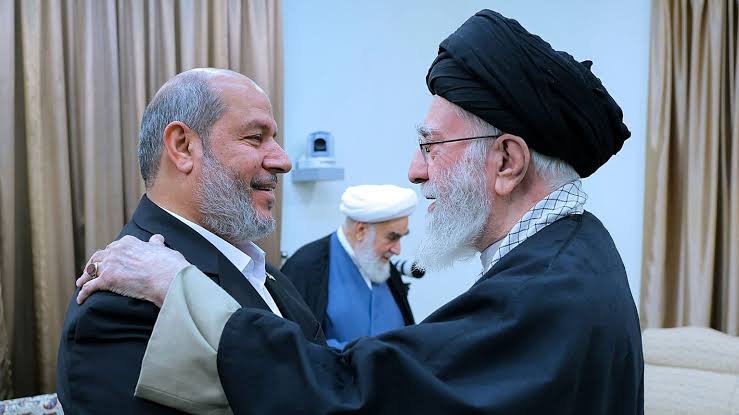


Alwaght- After a several month temporary administration of Hamas political bureau, the Palestinian movement announced on Monday its new leader, naming a figure familiar to the Israeli political calculations and concerns about the future of the resistance in Gaza.
According to the movement's statute, every four years it holds an internal election to pick a new leader. After assassination of Ismail Haniyeh and Yahya Sinwar the election was postponed due to war conditions, with the movement forming an "interim leadership council" comprised of 5 members: Mohammad Darwish, Khalil al- Hayya, Zaher Jabarin, Khaled Mashal, and Nizar Awadallah.
This week and at a sensitive time that the Gaza ceasefire deal is entering its second stage and the broader region is witnessing escalated conflict, the resistance movement decided to hold its internal election. According to Saudi-funded Al-Shargh news network, the last round of competition was a close one between al-Hayya and Mashal, with the latter finally securing the post 35 votes against 34.
Political and struggle record of al-Hayya
Al-Hayya was born on November 5, 1960, in Gaza City, during Egypt’s administrative control over the strip. He has seven children; four have been killed in the struggle for the Palestinian cause. Osama and Hamza in previous Gaza wars, Homam in an Israeli airstrike on the group’s Doha office on Sept. 9, 2025, and Azzam in May.
A rare intellectual within Hamas’s ranks, al-Hayya earned his bachelor’s degree in Islamic theology from the Islamic University of Gaza in 1983, followed by a master’s in Hadith sciences from the University of Jordan in 1989. He completed his PhD in the same field at Sudan’s International University of the Quran and Islamic Sciences in 1997.
He entered the resistance ranks against Israeli occupation in the early 1990s and spent three years in Israeli prisons. Since his release, he has remained a fixture in the militant landscape, steadily climbing Hamas’s leadership ladder for over three decades.
In 2006 Palestinian parliamentary elections, al-Hayya registered within Change and Reform list of Hamas, becoming one of the influential and prominent figures of the movement. In 2021 elections that was called off by Palestinian Authority President Mahmoud Abbas, he led Hamas’s list.
Al-Hayya was among the handful of Hamas political bureau members in Gaza whom Sinwar urged to leave the strip before the October 7, 2023, attack. But none of them knew what Sinwar was truly holding in mind.
For years, he has been a prime target on Israeli intelligence and military hit lists. In 2007, he survived an assassination attempt that killed seven family members, including brothers and several of his children, though he was not on the premises at the time. In 2014, during Israel's war on Gaza, occupiers again tried to eliminate him. That effort also failed, but shelling of a house in the Shujaiya neighborhood east of Gaza City killed his son Osama, along with Osama's wife and children, and 19 other relatives.
On September 9, 2025, al-Hayya and other Hamas leaders were targeted in an Israeli airstrike on the group's leadership compound in Doha. He and his entourage survived, but his son Homam and his office director, Jihad Labad, were killed in the strike.
Transition from interim administration: reinforcing Hamas’s organizational structure
Moving past the interim administration to a political leadership with broader powers for decision-making is coming in a period of time that is described as the most complex one in the history of this Palestinian movement. With this election, the movement fills the vacuum existed since the martyrdom of Sinwar amid complicated regional and political circumstances. Additionally, a united leadership helps Hamas simultaneously manage foreign and home cases better.
Holding internal elections and choosing one of the occupation's most unyielding foes sends a clear signal: Hamas's organizational machinery is intact, and its command is unbowed.
For all of Israel's declared war aims to collapse the movement and expunge Gaza from the Palestinian equation, and for all the military might it has thrown at that goal, the leadership vote and al-Hayya's rise underscore a stubborn reality. The movement still holds institutional heft, and it remains an immovable force in shaping Gaza's future and the broader Palestinian trajectory.
Pro-resistance approach to continue powerfully under al-Hayya
Al-Hayya's selection as Hamas's new political bureau chief for a four-year term carries weight beyond the internal vote, a point that has not been lost on analysts tracking Palestinian affairs.
Observers peg al-Hayya as a figure firmly aligned with Yahya Sinwar and the Al-Qassam Brigades. As Asharq Al-Awsat has reported, he enjoys steady backing from the movement's military leaders in Gaza, including Ahmed al-Jaabari and Ezzedine al-Haddad, throughout his rise.
Throughout the war, both inside Gaza and abroad, al-Hayya remained a staunch defender of Sinwar's decision and that of other Qassam commanders to launch Operation Al-Aqsa Storm on October 7. In 2022, he was the movement's representative in a meeting with former Syrian President Bashar al-Assad, though the meeting ultimately failed to fully restore ties between the two sides.
On that basis, al-Hayya is expected to stick with the Axis of Resistance's playbook, which is confronting the occupation, holding onto militant arms, and rejecting normalization with Israeli regime.
In an October 27, 2025, interview with Al Jazeera, he said: "We are a people under occupation, and under international law, resisting occupation is our right." He added: "The weapons we and all factions carry exist because of the occupation and aggression. If that occupation ends and a Palestinian state is established for us, these weapons and those who bear them will become part of the state."
On that point, Bilal Sa'lameh, a researcher and lecturer at the Graduate Institute of International Studies in Geneva, told Al Jazeera that elevating a figure who had led ceasefire negotiations in recent months and carries organizational weight in Gaza signaled less a new chapter than a continuation of existing policies.
Dr. Mtanes Shehadeh, director of the Israel Studies Program at the Mada al-Carmel Center, dismissed the notion that al-Hayya's selection would shift Israel's stance, explaining that Israel frames the choice as evidence of al-Hayya's closeness to Iran.
What do Israeli circles say about al-Hayya's presidency over Hamas?
Since al-Hayya's election as Hamas's new political bureau chief this week, Israeli media and political circles have been poring over his anti-occupation struggle and ideological kinship with Yahya Sinwar. Their consensus? The ascendance of the movement's hardline wing. One prominent Israeli journalist, Elmog Boker, put it bluntly: "Khalil al-Hayya should be the next assassination target."
Israel's Channel 7 described al-Hayya as one of the "most extreme and influential" figures in the movement, placing him firmly in the hardline camp. Though he serves on the political track, they noted, his ties to the military wing run deep.
The Jerusalem Post opened its coverage with the Doha compound, the site of Israel's September 2025 airstrike against Hamas leaders in Qatar and framed the election as effectively crowning al-Hayya as Sinwar's heir.
The paper cast him as a figure from the movement's founding generation: born in Gaza in 1960, raised among its early leaders, and formally joining upon the group's launch during the First Intifada in 1987. It also noted that he was arrested by Israel in the 1990s and left Gaza before October 7 to take up residence in Doha alongside other Hamas leaders.
Haaretz, meanwhile, underscored that while al-Hayya is based in Qatar, his ties to the Gaza leadership are deeply rooted. As Sinwar's deputy, they wrote, he played a pivotal role throughout the war, managing the relationship between the political leadership and the field command, and bridging political objectives with the military wing's operational stances.
Haaretz frames the rivalry between al-Hayya and Mashal as a contest between two distinct paths. But al-Hayya, the paper argues, leans firmly toward sustained armed action and reliance on allies within the Axis of Resistance. Quoting movement representatives, it reports that the two figures agree on the goal of confronting Israeli occupation, but their difference is over means, not ends.
Al-Hayya's rise, the newspaper reports, signals a continuation of Hamas's hardline posture in negotiations, particularly regarding the movement's arsenal and the dismantling of its military wing, issues that lie at the heart of the American proposal for Gaza's future in its second phase.
Israel Hayom, meanwhile, views al-Hayya's victory as evidence of the enduring dominance of the Gaza-based leadership faction. The paper acknowledges that his ascent confirms the political and military trajectory set by Sinwar, stressing that the new leadership does not mark a rupture with the previous era, but rather its extension.
The newspaper also predicts that under al-Hayya, Hamas will pursue reorganization and seek to recover its military and organizational capabilities, all while maintaining an unyielding stance at the negotiating table.