

















Alwaght- The Israeli regime that in recent years through expansion into Lebanon, Syria, and Gaza has tried to move its security belt beyond its borders now is looking to the eastern front and is starting new activities in the West Bank and near the Jordanian borders.
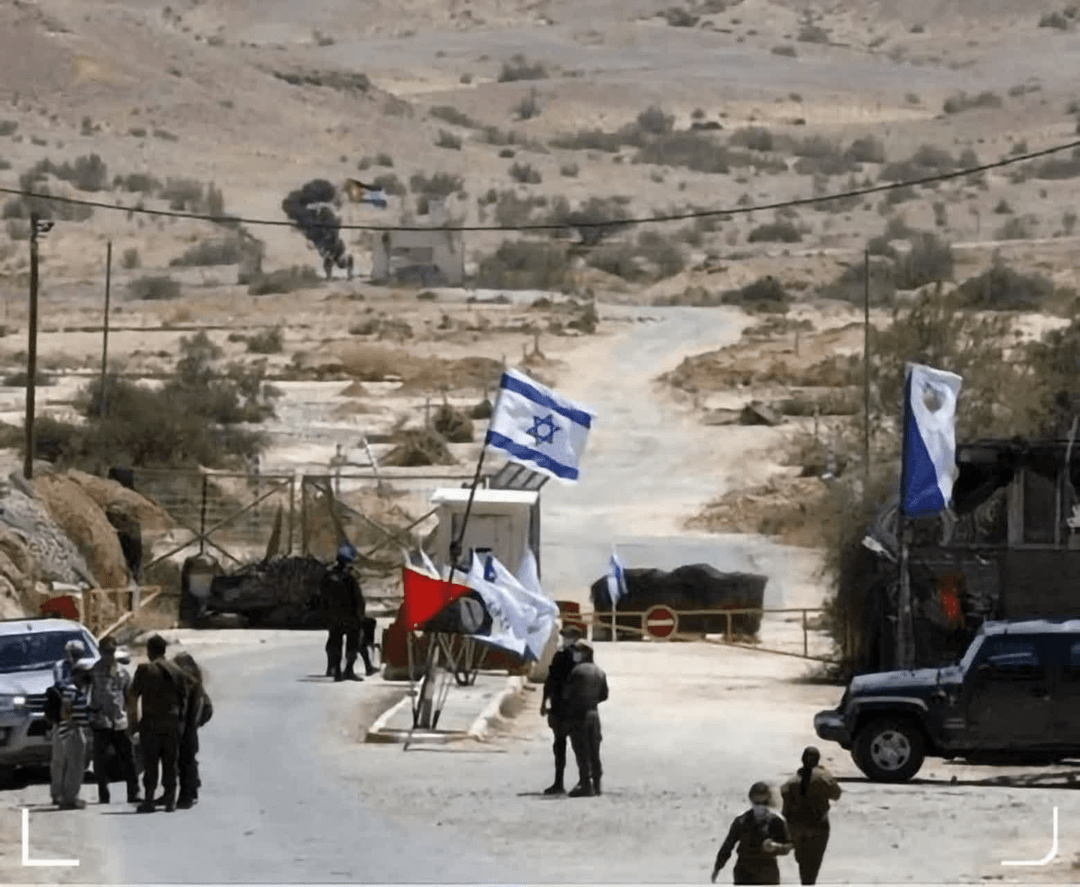
In this relation, the Israeli Army Radio reported that the Israeli military has established permanent posts and bases in the buffer zone between the border wall and Jordan River. Suggesting that establishing military bases on the borders of the occupied Palestine and Jordan is "unusual", the media outlet said that units of military are set to run these outposts.
According to Israeli security officials, these outposts have been set up in an area opposite the Tomer and Peza’el settlements in the Jordan Valley. Unlike previous arrangements with farmers, who were allowed to operate in the area only during limited hours, the new agreements now include the permanent presence of reserve soldiers who live on-site and protect the area.
The Israeli army stated in this regard that several military positions have been established along the eastern border zone in the form of security outposts, operated by regional defense soldiers. Israeli army forces have been deployed along the eastern border and are working to strengthen border defense and ensure the safety of local residents.
Although Israeli officials have not released precise details regarding the number of troops stationed at these outposts or their operational mission, the return of a permanent military presence in this area carries significant implications.
Doron Kadush, a military reporter for Israeli army radio, described the move as highly significant, saying that this move marks a return to the model of security outposts along the borders. This initiative is part of a broader effort to strengthen Israel’s control over the eastern border in light of emerging security challenges in the region.
The move is important because, since the signing of the “Wadi Araba” peace treaty between Israel and Jordan in 1994, the area had been largely devoid of any organized, permanent Israeli military presence, with most previous active bases closed down. But now, Tel Aviv appears to be returning to a model it had abandoned decades ago. Israeli security officials stressed that in the past, this initiative was rejected by commanders of Central Command, but in the past year, Major General Avi Bluth, head of Central Command, approved the establishment of several new sites.
Preventing repeat of October 7 attack
On the surface, the Israelis argue that they are doing so for countering the military threats. After October 7 operation and collapse of a number of Israeli security theories, Tel Aviv’s view to "safe border" has underwent fundamental changes. A new notion has run through the military circles that says mere border walls, surveillance systems, or political agreements are insufficient to protect security and permanent physical presence of the military forces is needed in sensitive positions.
Preventing arms smuggling to the West Bank is one of the reasons with which the Israeli army is justifying its presence and on the Jordanian border. In this connection, the army and police of Israel on Friday in a joint statement said that in this week they have neutralized several efforts to smuggle tens of arms in the Jordan Valley and arrested a suspect in this regard.
The statement reads: “Security forces are continuing the fight against weapons smuggling that could end up in the hands of terrorists and criminal elements, and are deploying along the eastern border to ensure the safety of Israeli civilians.”
According to their claims, some of the weaponry used by Palestinian groups in the West Bank entered the area through this very route. Additionally, several security incidents along the Jordan-occupied territories border, including armed attacks at border crossings, have been cited as indicators of the eastern front’s vulnerability.
The formation of the “Gilad” Division, also known as the 96th Division, to protect the eastern border, an increase in military patrols, and the reinforcement of security infrastructure along the Jordan River over the past year are all part of this new strategy.
According to Breaking Defense, one of the 96th Division’s first missions has been to fortify positions along the Jordan River, a river that cuts through agricultural land spread across both sides north of the Dead Sea.
Israeli commanders have openly stated that one of the lessons learned from Operation Al-Aqsa Storm by Hamas on October 7, 2023 is that military forces must maintain a permanent presence along borders. The Israeli army has previously announced that the deployment of the Gilad Division in the Jordan Valley is part of the lessons learned from the attack.
Army Chief of Staff Eyal Zamir elaborated on this stance several months ago, saying: “We must take action and neutralize threats before they reach our gates. We will reinforce our forces wherever necessary to continue fighting terrorism and prevent the next threat from emerging.”
Furthermore, the September 2024 incident at King Hussein Bridge, in which three Israeli officers were killed, has been cited in Israeli security circles as a sign that the eastern front is becoming active.
Notably, Israeli regime officials are deeply afraid of the resistance front becoming active in the West Bank, and worry that in the current volatile and highly tense regional situation, where Israel is already fighting on several fronts, activation of the West Bank front could deliver a heavy blow to the security of settlers.
Strategic significance of Jordan Valley
Limiting Tel Aviv’s aims to fighting arms smuggling and security concerns does not give us a complete picture of this move. The true importance of these measures should be sought in the geopolitical significance of the Jordan Valley which since occupation of the West Bank in 1967 has been one of the core factors of the Israeli national security doctrine.
The Jordan Valley accounts for about one-third of the West Bank’s territory and is viewed by most political and security factions within the Israeli regime as the regime’s “natural defensive border” against the Arab world. For decades, many Israeli strategists have believed that any withdrawal from this area would reduce the regime’s strategic depth and pave the way for infiltration into the West Bank. For this reason, even during periods when peace talks between Tel Aviv and the Palestinians were underway, control over the Jordan Valley consistently remained one of Tel Aviv’s primary red lines.
Israeli Prime Minister Benjamin Netanyahu has repeatedly stressed that in any future agreement, Israel must retain security control over the Jordan Valley. From this perspective, the new outposts can be seen as part of Tel Aviv’s effort to reassert its on-the-ground presence in an area that holds not only security value but also special political and territorial significance for the regime.
This issue gains further importance when viewed alongside the accelerating settlement expansion in the West Bank. In recent years, Tel Aviv’s right-wing governments have pursued a policy of expanding Jewish settlements at a faster pace, and the Jordan Valley has been one of the primary targets of this policy.
Some analysts argue that the establishment of new security infrastructure, the construction of military bases, and the deployment of permanent forces in the area could pave the way for solidifying settler presence and advancing future projects. In this context, Israeli media reported on Saturday that the Netanyahu government has begun building new settlements in 60 vacant areas of the West Bank.
The experience of the past few decades shows a complementary relationship between expanding security presence and settlement growth. The military presence provides the security necessary for settlement expansion, while settlement growth in turn creates a pretext for further military buildup. For this reason, some observers believe the new outposts are not merely a response to security threats but rather part of Tel Aviv’s long-term project to gradually change on-the-ground realities in the eastern West Bank.
On the other hand, the intensifying violence by extremist settlers in recent months, which is occurring simultaneously with large-scale Israeli army operations in the West Bank, can be analyzed within the broader strategy of altering the demographic and geographic fabric of the area.
Security consequences to Jordan
The consequences of these Israeli moves are considerable for Jordan. Over the past few decades, Jordan has been one of the primary supporters of saving the status quo in the Jordan Valley and it follows with sensitivity any shift in the geopolitical balance of this region.
Aman leaders think that Israel full control over the Jordan Valley not only dims the prospects of formation of an independent state of Palestine but also can bring forth direct security and political repercussions to Jordan itself. Expanded Israeli military presence near Jordan borders restrcis the Jordanian strategic depth and weakens Aman's role in the Palestinian equations.
So, the Jordan Valley is not just a geographical border but, in all of the plans pertaining to the formation of a Palestinian state, it is the natural crossing of the West Bank to the Arab world. So, any Israeli military entrenchnent in this region will mean broader Israeli control on the Palestinian communication route with the east.
One of the biggest concerns is the likelihood of escalating pressure on Palestinians and the emergence of new waves of migration toward Jordan, an issue that could disrupt the country’s demographic and social balance. For this reason, many observers believe that continued Israeli expansionist policies in the West Bank will pose serious threats not only to the future of the Palestinian issue but also to Jordan’s stability and strategic interests.










