















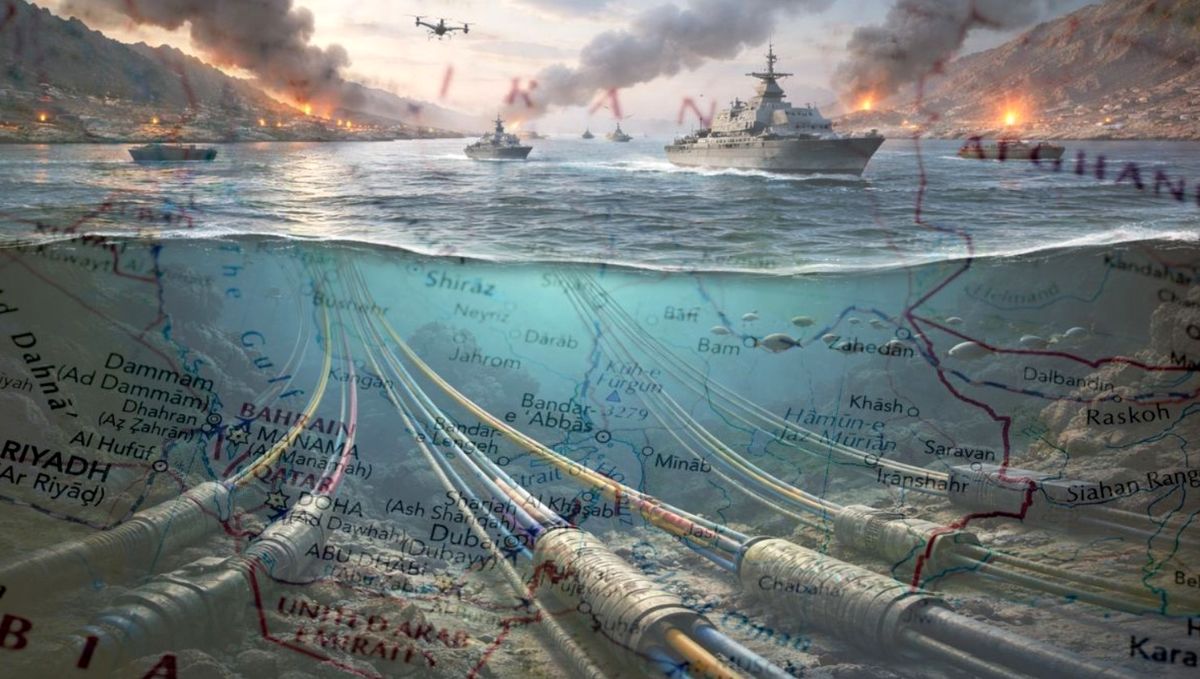


Alwaght- The recent Israeli-American war on Iran more than ever gave the world awareness about the Iranian defense and strategic capabilities to defend their national interests and territorial security. One of these strategic capabilities unveiled by Tehran in the 40-day war was its will and capability to fully take control of the Strait of Hormuz and the broader Persian Gulf region, so much so that obvious defeat of the US and other international and regional powers in this area sent the world into a surprise.
Meanwhile, the dependence on the energy security to the Strait of Hormuz is not the whole story. Now the world media are talking about a hidden weapon in the depth of the Persian Gulf waters that is buried in the debate over the surging gasoline prices. However, its significance is not less than empty tanks of cars, when the global internet connection faces massive disruption.
Western media have recently turned their attention to the fate of internet cables lying dormant at the bottom of the Persian Gulf, warning of the potential costs if these cables are damaged amid the current tense situation in the Strait of Hormuz and the Persian Gulf.
In fact, contrary to popular belief, the global internet network relies far less on satellite signals, like Starlink, than on fiber-optic cables sprawled across ocean floors. Submarine cables form the backbone of global connectivity, carrying the vast majority of the world’s internet traffic and data.
These thin but highly advanced fiber-optic cables use lasers and glass fibers. Nearly 99 percent of international internet traffic, including phone calls, streaming services, bank transactions, emails, and cloud-based data, travels through these cables because they offer far greater speed, capacity, and much lower latency than satellite internet. A single cable can transfer hundreds of terabits of data per second. According to the International Cable Protection Committee, one modern fiber in a submarine cable can transmit data equivalent to nearly 150 million simultaneous phone calls at the speed of light.
The capable are home to several layers of fibers covered by metal, polymer, and even water-resistant gel to resist hydro pressure, quakes and even sea beasts. To boost their safety, they are not simply left exposed on the seabed. First, crews dig about three meters into the ocean floor, lay the cable inside, then pull a protective cover over it to shield it from harm. This covering stops fishing nets or ship anchors from snagging and damaging the line. Companies like Google, Meta, Microsoft, and major telecom operators lay these cables at costs running into the hundreds of millions of dollars all to connect continents. Without them, the modern global internet would effectively grind to a halt.
Most of the world’s most popular content, including YouTube, Google, Amazon, and more, is stored on massive data centers, located in regions like the US, Europe (especially Frankfurt, Amsterdam, London, and Marseille), and East Asia (Singapore). These data centers are linked together by the same submarine cables.
Given the world’s near-total dependence on these cables for data flow, any large-scale damage today could have devastating and even unpredictable consequences. Targeting them would go far beyond slowing down internet speeds, it would threaten everything from banking systems, military communications, and AI cloud infrastructure to remote work, online gaming, and streaming services.
Meanwhile, according to credible TeleGeography and Submarine Networks, there are at least 5-7 main cable lines cross the Strait of Hormuz that can be damaged if war shifts to striking infrastructures amid Trump’s threats against Iran.
This is of precedent in modern day wars and earlier examples date back to two centuries ago when first telegraph line was laid in the English Channel in 1850. When WWI broke out, Britain cut off the key Germany’s telegraph cables, paralyzing connection with its military forces.
According to a report by Hong Kong-based HGC Global Communications, in 2024 three submarine cables already targeted by Yemen’s Ansarullah movement were cut by an anchor, leaving 25 percent of the Middle East’s internet connection disrupted.
If this happens in Strait of Hormuz and Persian Gulf, Arab countries may face connectivity disruptions that can potentially affect oil and gas exports as well as banking operations.
Also, any disruption could also slow down financial trading and cross-border transactions between Europe and Asia, while parts of East Africa could face outright internet blackouts.
Experts warn that in case of serious damage to the submarine internet cables in the Persian Gulf, the conditions are difficult for their repair since the maintenance vessels need to remain stationary for a long period of time. Reports say that from 5 repair ships used to operate in the Persian Gulf and the Sea of Oman only one has remained in the region, something doubling the challenge.










