










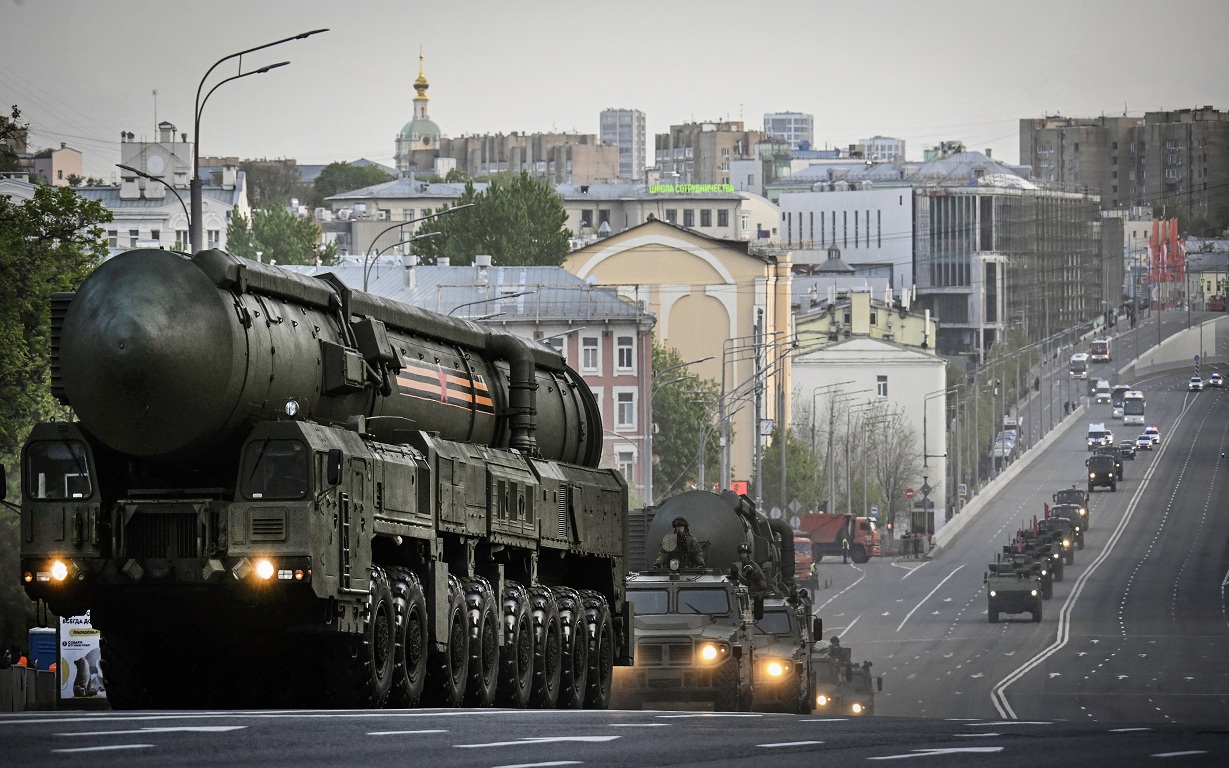


Alwaght- With the expiration of the New Start treaty on nuclear arms between the US and Russia, the world is on the eve of entry to a period that can be regarded the most dangerous in the international nuclear order since the Cold War. Signed between the two nuclear powers in April 2010, the agreement is the last binding nuclear deal between the two countries to contain the nuclear arms race and with its expiration on February 5, for the first time since 1972, there will be no official and legal restrictions on the strategic nuclear forces of Washington and Moscow.
What was New Start and why did it matter?
The New START treaty capped each country’s strategic deployed nuclear warheads at 1,550. This agreement continued a decades-long trend that saw the US nuclear arsenal shrink from its Cold War peak of over 30,000 warheads in the 1980s to far lower levels. It was the eighth strategic arms control pact between the US and the Soviet Union since the Cold War and the last one that remained in force.
Article 14 of the treaty allowed for a single five-year extension, a provision that had already been exercised. Now, with that extension expired, not only is there no new agreement to replace it, but serious negotiations to craft a fresh framework have also ground to a virtual halt.
Return of nightmare of arms race
To understand the significance of New START’s expiration, one must look back to the nature of the arms race during the Cold War’s early years. In that era, the US and the Soviet Union relentlessly spent billions to outpace each other, amassing arsenals that ultimately swelled to tens of thousands of nuclear weapons. Every move by one side to bolster its deterrence provoked a countermove from the other, a cycle that produced no lasting advantage, only novel threats and crushing military costs.
The signing of the first treaty limiting nuclear arms in 1972 marked a pivotal moment in breaking this cycle. Since then, strategic arms control has led to a tangible reduction in the two nations’ nuclear stockpiles. Now, with New START’s expiration, that historic achievement is at risk of unraveling.
Full halt of talks and deep political gap
The talks over the arms race control treaty is highly a time-taking and complex process that will take months of special work and mutual trust. Still, the US-Russia relations have escalated to new levels of tensions since Ukraine war started, making any constructive dialogue for a deal impractical. The two sides not only fail to agree on a new deal, but also even they are at loggerheads over what to include in potential future deal.
In such conditions, expiration of the New Start would mean a strategic vacuum, a long period lacking any binding framework to contain strategic nuclear forces of the two countries, something unprecedented in over five decades.
Putin’s surprising proposal and Moscow tactical shift
In September 2025, Russian President Vladimir Putin issued an unexpected declaration, proposing a one-year extension of the New START treaty’s core limits beyond its official expiration. The offer was conditional on Washington acting “in a similar spirit” and refraining from actions that would undermine the existing balance of deterrence.
On the surface, this move appeared to be an effort to prevent a complete collapse of the arms control regime. However, it also marked a significant departure from Moscow’s previous stance. In 2023, Russia had suspended its participation in New START, arguing that arms control could not be separated from “the conflict in Ukraine and hostile actions by the West.”
The crucial point, however, was that Moscow never formally triggered the treaty’s withdrawal clause and stated it would continue to adhere to the key limits. This behavior suggested that suspending participation was less a rejection of arms control itself and more a political tool to exert leverage in other cases.
US ambiguous reaction and Trump’s approach
Briefly after Putin made his proposal, Trump in a short reaction said: “I think this is a good idea.” However, Washington has so far did not give an official and practical response to this proposal. In recent months, Trump has tried to downplay the deal’s expiration, several times saying he can strike a “better deal” with Moscow.
In his social media site, Trump described New Start a “badly negotiated deal.” Meanwhile, the White House spokesperson said that the president wants the American nuclear experts to work on a new, improved, and modern deal that can sustain for a long time.
Temptation of expanding nuclear arsenal and return of power logic
Within the US, some close to the administration argue that the expiration of New START presents a golden opportunity to expand the US nuclear forces. According to this view, Washington could deploy hundreds of additional warheads to active launchers within weeks and, over several years, grow its strategic nuclear arsenal to over 3,500 weapons, more than double the current level.
This approach is linked to the US concerns over China’s rapidly expanding nuclear capabilities. During his first term, Trump repeatedly emphasized that any 21st-century arms control agreement must include China. The US Secretary of State Marco Rubio recently underscored this point, stating that with Beijing’s “massive and rapidly growing” stockpile, arms control without its participation is effectively impossible.
China, the key actor in future nuclear order
According to a Pentagon report submitted to Congress in December, China is undertaking a “massive nuclear expansion,” with its warhead stockpile expected to rise from roughly 600 to more than 1,000 by 2030. If the US and Russia move to expand their arsenals after the New START treaty expires, strategic pressure will also intensify on China and other nuclear powers to follow suit in order to preserve “survivability” and maintain a credible second-strike capability.
In this context, Kremlin spokesperson Dmitry Peskov has confirmed that the expiration of New START was discussed during a recent phone call between Vladimir Putin and Xi Jinping, adding that future developments will depend on how events unfold.
High costs and growing risk of catastrophe
Since 2010, the US has pursued a comprehensive program to modernize its nuclear arsenal, a project initially estimated at roughly $1 trillion but whose price tag has now ballooned to nearly $2 trillion. Further escalating tensions, Trump has advocated for the US to resume nuclear explosive tests, a practice halted since 1992.
Amidst this backdrop, expert warnings are growing more dire than ever. Veteran US diplomat Thomas Countryman argues that the risk of nuclear weapon use is now at its highest level since the 1962 Cuban Missile Crisis.
Collapse of old order, birth of uncertain new order
Today, the US and Russia collectively hold over 87 percent of the world’s nuclear weapons, with roughly 3,700 active warheads and over 4,300, respectively. In this context, any renewed expansion of these arsenals risks triggering a dangerous domino effect of global arms competition.
While the precise consequences of the New START treaty’s lapse, and its impact on strategic stability, remain uncertain in this murky landscape, most experts agree on one definitive outcome: The old global nuclear order is rapidly crumbling, giving way to a new and unquestionably more perilous era.