
















Alwaght- Though American sources insist that the US came to the negotiating table with Iran at the request of the Arab countries and leaders of West Asia, signs show that what pushed Washington to the talks was not the Arab lobbying but the Iranian missile power and deterrence. This was even confirmed by American and Israeli media outlets. Haaretz in a report described Trump’s new stance on Iran a clear retreat against Tehran, adding that the US has withdrawn its earlier demand to include Iran’s missile program in the negotiation agenda. Some other Israeli media said that Trump actually backed down the moment he accepted Iran’s condition that Oman becomes the host of talks, shifting them from Turkey.
Now the question is here: What has caused Iran’s military deterrence against the US threats?
Fear of Iranian missile power
A new report from the US Council on Foreign Relations, released just one day after US-Iranian talks in Muscat, has turned its focus to growing concerns over Iran’s missile capabilities. The analysis stresses that while Iran does not possess a nuclear weapon, it has the necessary infrastructure and technical expertise to produce one in a relatively short time frame, a potential nuclear capacity that takes on greater significance alongside its advancing missile arsenal.
Overall, warnings about Iran’s missile power appear to have intensified over the past seven months, particularly following Iran’s large-scale missile barrage against Israel. Among the most recent alarms sounded in the West is a report from The Wall Street Journal. Published a day after the Oman negotiations, the newspaper noted that although Israel targeted Iranian launch sites and storage facilities during the 12-day war in June, Iran emerged from the intense conflict with a large portion of its arsenal intact. More critically, Iran learned how to better penetrate Israeli and American missile defenses as the fighting continued.
The outlet had previously reported that Tehran still retains roughly 2,000 medium-range ballistic missiles capable of reaching across the region. The country also holds significant stockpiles of short-range missiles that can target U.S. bases in the Persian Gulf and vessels in the Strait of Hormuz, in addition to anti-ship cruise missiles.
Behnam Ben Taliblu, the senior director to Iran Desk at the Foundation for Defense of Democracies, told WSJ that Iranian ballistic missiles can now make up the backbone of Iranian deterrence and are like Swiss Army knife for Tehran.
Washington Post in a report shedding light on escalating tensions between Washington and Tehran and then Trump’s retreat from threats with military action for return to negotiations. The newspaper reports that after Trump reached the conviction that Washington has no adequate power for a resolute strike eyed by its military and at the same time cannot manage the tensions in case of Iranian response, he postponed an attack on Iran in mid-January at the last moment and followed a diplomatic path.
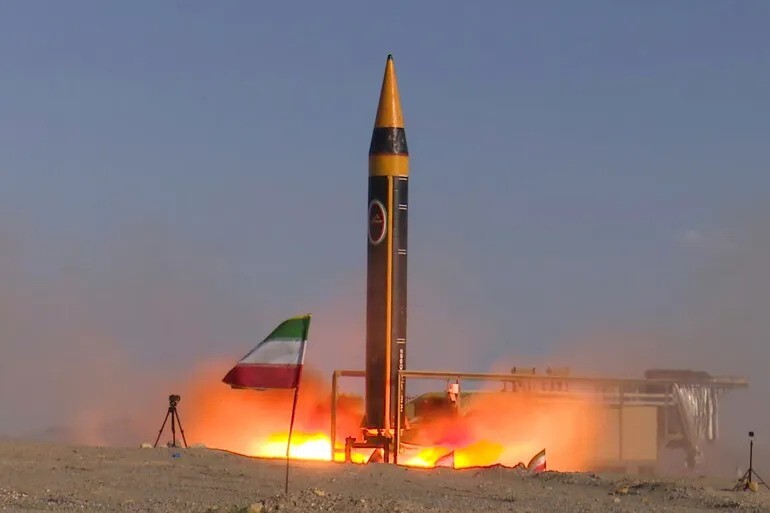
Iran’s Khoramshahr-4 ballistic missile launch amid nuclear talks
At the same time, it appears that in recent days, amid escalating regional tensions and increased US military threats against Iran, the unveiling of the “Kheibar Shekan” (Khoramshahr-4) missile has raised Iran’s deterrent and retaliatory readiness against any potential aggression to its highest level.
Following the release of a video showing the test of the new generation Khoramshahr-4 missile, which reaches speeds of Mach 16 outside the atmosphere and Mach 8 within it, France's LCI television highlighted Iran’s missile capabilities. The network stated that by possessing advanced missiles like the Khoramshahr 4, Tehran has demonstrated an unprecedented level of military power. According to the report, Iran has made clear through this capability that it possesses the capacity to respond and retaliate in the event of any attack.
The report also notes that Iran possesses missiles capable of targeting American bases in the Persian Gulf countries and even the Strait of Hormuz, an analysis frequently echoed in Western media regarding Iran’s defensive capabilities.
Simultaneously, CBS News reported, alongside the Oman negotiations, that the quality and deployment of Iran’s missile capabilities have significantly improved. Given the scale and dynamism of Iran’s missile program, the network suggested that the US was ultimately compelled to step back.
Khoramshahr-4 transforming Iran’s military doctrine
The latest test of Khoramshahr-4 came a day before Muscat talks, suggesting that Iran’s missile doctrine has shifted from defensive to offensive.
It should be taken into consideration that this ballistic missile was one of the missiles fired at Israeli regime in 12-day war Tel Aviv waged against Tehran in June 2025.
The weapon was first unveiled in 2023, though its earlier models were unveiled in 2017. This model is also known as Kheibar, not to be mistaken with Kheibar Shekan. Khoramshahr-4 has a range of 2,000 kilometers and can carry a payload of 1,800 kilogram.
Although this missile uses a liquid-fuel engine, its preparation time for launch is remarkably short, approximately 15 minutes. It is capable of striking targets with an accuracy of about 30 meters. The missile can maneuver and adjust its trajectory even before re-entering the atmosphere and can lock its guidance system immediately upon atmospheric re-entry to bypass air defense systems.
The missile can be armed with one or multiple independently targetable reentry vehicles (MIRVs). Its speed reaches up to Mach 16 outside the atmosphere and up to Mach 8 after re-entry. The missile sports advanced Arvand propulsion system, a powerful engine that operates on hypergolic fuel, which allows for faster operational preparation and eliminates the need for complex ignition procedures required by other propellants.
The most significant innovation of the Khoramshahr-4 lies in its integrated engine, which is housed within the fuel tank. This design simultaneously increases the structural stability of the missile and reduces its overall length, thereby improving its diameter-to-length ratio. Generally, these enhancements have contributed to an increased accuracy and probability of impact for the missile.