














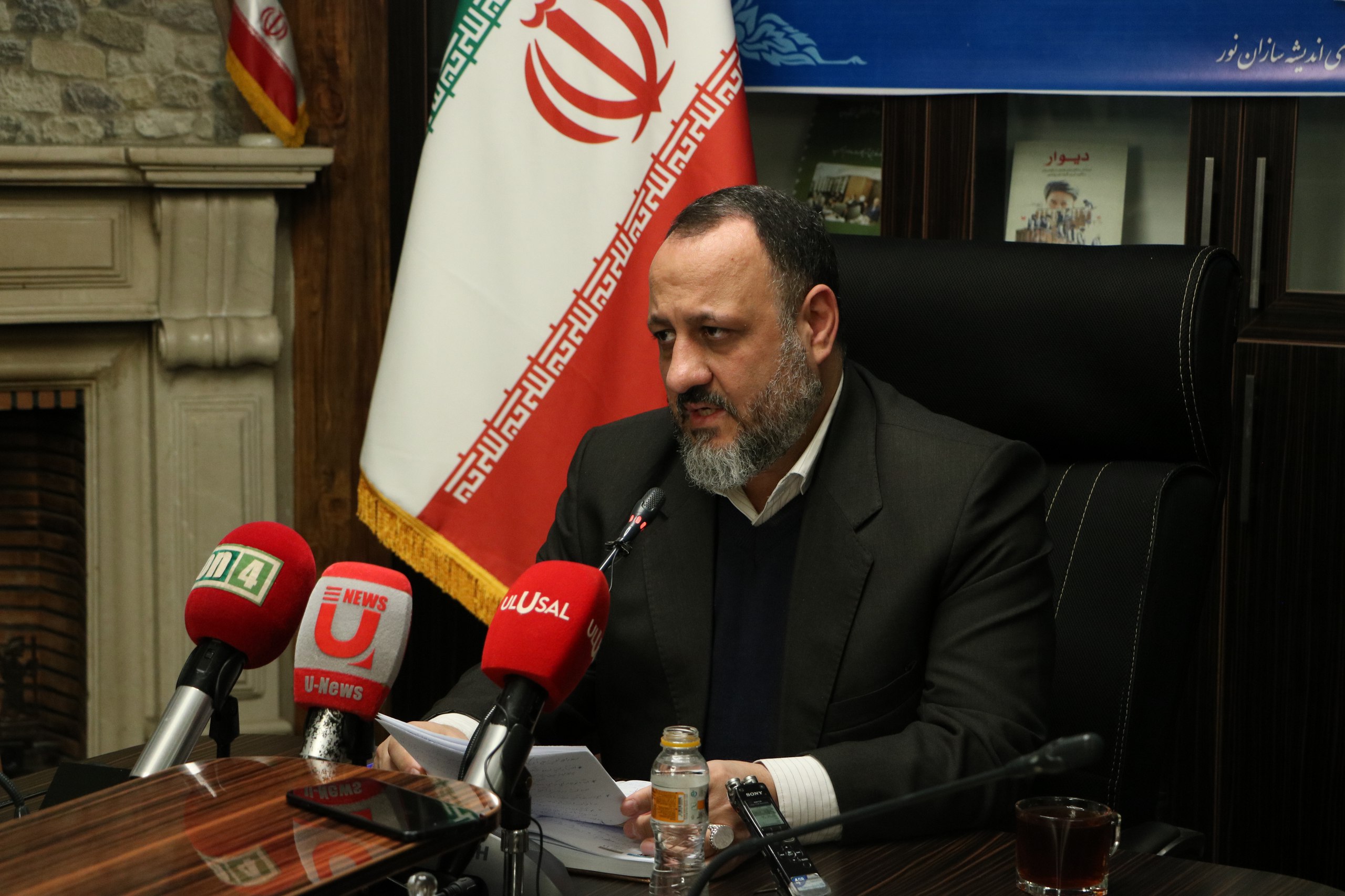


Alwaght- On Sunday, Andisheh Sazan-e-Nour Institute for Strategic Studies hosted a meeting shedding light on the newly published US national security document. In the meeting, the Tehran-based institute’s head Ahmad Zarean with the presence of journalists brought in a spotlight the document and its implications through a comprehensive analytical lens.
At the beginning, Mr Zarean outlined the document of the US national security, saying that it is significant though it may have some symbolic aspects.
This document does not necessarily reflect actual US policy, and it may instead outline the country’s stated strategic aims.
Mr Zarean pointed to the difference of the new document with its predecessor released in 2017, adding that the document of 2017 was largely authored by the traditional Republican mainstream, but the new document is written by the “MAGA” movement, a faction critical of US’s overarching trends and policies since the end of the Cold War, which has managed to create a significant political wave in the country with the slogan “Make America Great Again.” The ideology and thinking of this document also differ from the strategy of Trump’s first administration.
Zarean stated that “the document repeats Trump’s campaign positions and is a translation of talking points he has frequently reiterated in public diplomacy. In other words, it is the embodiment of US foreign policy over the past year.”
He went on: “This document has both a text and a subtext, and we must consider both dimensions. It portrays US’s past policies since World War I as a deviation, arguing that the country wrongly sought to shoulder the burden of global problems. This is framed as a profound error where Washington politicians made mistakes in pursuit of their own dreams.”
He added that the opening section of the document features an anti-elite statement. It criticizes past strategies, globalization, and free trade, and takes aim at the notion that the cost of defending allies has fallen on Washington’s shoulders. It further criticizes US foreign policy for being entangled in a network of international institutions that are either anti-American or seek to undermine the sovereignty of independent states.”
This international affairs expert added: “The document includes a section titled ‘What We Want,’ which reflects the Trump team’s perception of current challenges. It also raises the issue of survival, suggesting that Americans now face existential security concerns, something challenging for a country that sees itself as the world’s superpower.
Mr Zarean went on pointing to some other key issues, adding that the document contains stresses on migration and border control, national resilience for countering natural disasters, and that the US needs to have the strongest army to ensure its survival and security.
According to this political expert, the documents contains an emphasis on pragmatism and realism and the concept of power and goal-centered actions being among the main principles of the US foreign policy discourse.
The document emphasizes nuclear deterrence, stating that the US must achieve a capable missile defense shield. It also highlights the need to establish a balance of power in the economic, energy, technological, and soft power domains globally, identifying these as critical priority areas for the US.
A shift in perspective towards rivals such as Russia and China is also evident in the document. Geopolitically, the US strategy focuses on five specific regions: the Western Hemisphere, Europe, the Indo-Pacific, Asia, and Africa.
Regarding the Western Hemisphere, the document stresses a revival of the Monroe Doctrine, aiming to reassert American dominance in the continent. Threats in this region are concentrated around three main axes: combating drug trafficking, countering the intervention of rivals, and dealing with unaligned governments in the area.
The portrayal of Europe is notably bleak, with Americans likening the continent to a declining civilization. The document references Europe’s failure to meet its security financial commitments, a point Trump has repeatedly raised, questioning why the US should bear Europe’s security costs. According to the document, Europe’s future strategy should involve purchasing security as a strategic commodity from Washington.
The approach towards Africa is also critical, noting that previous U.S. policy documents were based on exporting liberal democracy ideology. It asserts that from now on, the focus should be on forming partnerships with African nations to gain control over the continent’s natural resources.
US’s fantasy about West Asia
Concerning West Asia, there is a approach highlighting solving problem, suggesting that the Americans apparently think that the problems and challenges in this region are settled to a large extent. The document says that West Asia has always been the e US priority as it is scene of competition of world powers over energy. But now things have changed and Washington has become the biggest exporter of energy.
The document further emphasizes that Trump’s policies have strengthened West Asian alliances in the Washington’s favor, which have focused on Iran as a destabilizing force that has been weakened following American and Israeli strikes. However, the image of West Asia portrayed in this US national security document does not reflect the region’s reality.
The US has outlined four primary objectives in the region: managing energy flows, ensuring the security of the Israeli regime, keeping sea lanes open, and countering terrorism. Despite Washington’s attempt to signal a reduced focus on West Asia, these very objectives confirm that the region remains a key geopolitical and geostrategic arena for the Americans.
The document dismisses nation-building projects in the region as futile and instead emphasizes expanding the “Abraham Accords” to include other regional countries and integrating the Israeli regime into regional economic projects. It attempts to present a narrative that while west Asia faced numerous crises in the past, many of these have been resolved during the Trump era.
Importance of subtext of the US strategic document
Mr Zarean in his comments shed light on the subtext of the US national security document, saying that the document contains an admission of the Americans about decline of the country as a global power and the fact that it lacks the power in once held to help manager the world challenges. The document’s blunt criticism of past strategies amounts to a clear admission of the failure of Washington’s previous playbook. It explicitly states that these strategies not only failed to improve US’s global standing but also created significant domestic challenges.
A key takeaway from the document is its acceptance of the international order’s transition from unipolarity to multipolarity. It implicitly acknowledges the status of Russia and China as major global powers, a paradigmatic shift signaling a new understanding of the limits of American power.
According to Mr Zarean, this document in a way a satisfaction of Trump’s psychological and spiritual needs and carries his name several times in the text while previous documents there were no mention of any president. Actually, the document tries to feign achievements for Trump and promote him ad the champion of peace in the world.
Iran case remains unsettled
The head of the institute further pointed out some contradictions within the US strategic document, stating: “Although the Americans consider the Iran issue resolved and aim to convince the world that recent attacks by the US and the Israeli regime on Iranian nuclear facilities have eliminated Tehran’s threats, the fact remains that key West Asian issues, sea lanes, terrorism, energy flow management, and the security of the Israeli regime, are intrinsically linked to Iran and the Axis of Resistance. Therefore, the interpretation drawn from this document is that Iran remains an unresolved challenge for Washington.”
According to Mr Zarean, the drafting of this document heavily reflects the personal views of Trump and the far-right movement. The far-right rejects the tenets of the liberal world order, including commitments to the rule of law and global trade. The document explicitly states that the internal affairs of other countries are not the US’s concern, while support for totalitarian regimes, such as the Persian Gulf Arab monarchies, is highlighted. This emphasis stems from economic interests, as these regimes can help address some of Washington’s problems through arms purchases and investments.
The criticism of international institutions in this strategic document comes despite these institutions having underpinned the bipolar and unipolar orders until now. However, there is profound distrust toward these bodies within the U.S. ruling establishment, which explains Washington’s withdrawal from and weakening of some of them.
The document emphasizes prioritizing American interests over those of any other actor. Given the realities of the international system and the structural realities within the US, it has relinquished its claim to global leadership.
The final assessment is that this document is a critique of past US foreign policies. It outlines Washington’s goals and ideals and declares the methods for achieving them. Overall, the impression is that the US is confronting new realities and has drafted this document under their influence.
Unreliable document
In one respect, this document is not inconsistent with the approach the US has taken over the past year. However, in the sections on West Asia, where it seeks to downplay the region’s importance and dismiss the Iran issue, it is unreliable. Given the conflict Israel has ignited in the region, we should not be optimistic about this document. Due to the management of energy flows and the commitment to the security of the Israeli regime, Washington’s stated desire to reduce its focus on West Asia should not be taken seriously. The opening of a American consulate in Iraq’s Kurdistan region, efforts to disarm Hezbollah, and attempts to dissolve the Popular Mobilization Forces (PMF) in Iraq all bear witness to the fact that the Americans have no intention of leaving the region and will continue their interventionist approach to achieve these objectives.”
Answering a question of Alwaght journalist about whether tensions with rivals like China and Russia in Latin America will inflame with the White House revival of the Monroe Doctrine, Mr Zarean held that for now the American, Chinese, and Russian approach is in favor of management of tensions and they want to settle cases without need for direct confrontation. Concerning Venezuela, it seems that the Americans are seeking their goal through psychological warfare and marine blockade in order to break Caracas resistance, and so the chance of military intervention to oust Venezuelan President Nicolas Maduro is slim.
The seizure of oil tankers and strikes against narcotics trafficking boats are part of an effort to bring down the Venezuelan government through economic pressure. Since a military intervention would require congressional approval. The Congress is against an escalation in the Caribbean.
Major powers are, therefore, avoiding direct confrontation with each other. The US, for its part, is seriously pursuing reviving the Monroe Doctrine, aiming to eliminate external influence in the Western Hemisphere, topple left‑wing governments in Latin America, and install puppet governments. Washington is employing a range of tools to achieve these ends.
He went on to answer a question about how Washington is likely to approach North Korea and the Taliban, given the lack of focus on East Asia in the US strategic document. He stressed: “The United States avoids engagement in arenas where it sees high costs and limited returns. North Korea is a clear example of a high-cost, low-benefit case, and Washington has come to terms with this reality, particularly since Pyongyang poses no direct threat to Americans. That said, the United States has made it clear that the cost of confronting North Korea would fall on South Korea and Japan, who would have to shoulder the burden themselves, with only limited backing from Washington.
Mr Zarean added that same logic applies to Afghanistan. Calls have been made to reclaim Bagram Air Base, but, much like Trump’s earlier ideas regarding Greenland or the Panama Canal, the Afghanistan issue is likely to follow the same path. In addition, China’s and Russia’s relationships with the Taliban government could prevent a renewed US footprint in Afghanistan, once again reflecting Washington’s cost-benefit calculus.”










