
















Alwaght- Having been isolated regionally and under pressure of its rivals for its crimes in Gaza and other parts of West Asia, the Israeli regime is seeking to bolster its relations with some of its transfer-regional partners to exit this political and security predicament.
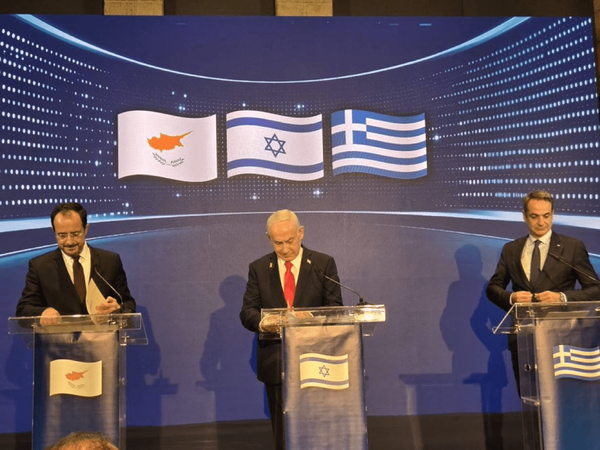
In this connection, Israeli Prime Minister Benjamin Netanyahu on Monday hosted Greece and Cyprus officials in Al-Quds (Jerusalem), discussing military cooperation with the Mediterranean countries.
According to the statement released by the PM office, Netanyahu and his Greek counterpart Kyriakos Mitsotakis first held a bilateral and then attended a broader tripartite meeting attended also by the foreign ministers of the three sides.
Netanyahu described the alliance between Israel, Greece, and Cyprus as a “cornerstone” for ensuring stability and shared interests in a challenging region, pledging sustained cooperation to enhance security and boost economic development.
Beyond these bilateral ties, however, lies a broader geopolitical contest. The trilateral partnership is directly entangled with Israel’s rivalry with Turkey in West Asia. Ankara’s vocal support for Palestine and its push to expand influence in Syria have placed it at odds with Israel, escalating tensions that now stretch well beyond the West Asia’s borders.
Countering Turkish energy policies in the Mediterranean
The expansion of the Israeli regime’s relations with Greece and Cyprus in the Eastern Mediterranean represents one of the most significant recent geopolitical developments in the region. This move aims to establish a power balance against Turkey and strengthen the Tel Aviv’s influence in the energy and security domains. Israel Hayom reported that, following tensions with Turkey, the regime is forming a new regional alliance, and Netanyahu met with the leaders of Greece and Cyprus in this context.
In related news, Yedioth Ahronoth reported that Tel Aviv’s political leaders have informed military commanders of their intent to explore the idea of establishing a “joint intervention force” with Greece and Cyprus. They have ordered preliminary planning to begin, though the implementation of any operational steps has been delayed due to “regional sensitivities.”
According to Walla news outlet, this plan aims to enhance existing military cooperation among Tel Aviv, Athens, and Nicosia, including joint air, land, and naval exercises. The primary reason for this cautious approach is the likely mission of such a tripartite military intervention force, which, if formed, would primarily address Turkey’s expansionist policies in the Eastern Mediterranean.
One of the main drivers behind the formation of such alliances by Tel Aviv is the exploitation of energy resources in the Eastern Mediterranean. Since Turkey competes with Cyprus and Greece over maritime boundaries and the exploration of oil and gas, this issue has led Tel Aviv to ally with Athens and Nicosia to protect its energy interests.
Eastern Mediterranean energy sources are vital to Tel Aviv since both meet its need and boost its influence in the region. Furthermore, partnership with Greece and Cyprus will allow Israel access to strategic European ports and enhance its role in the goods and energy provision chain, something that will bring about major revenues to Tel Aviv.
Given Turkey’s strategic position and its influence over major straits and transit routes, it is capable of putting the skids under energy projects unaligned to its interests. So, Tel Aviv and its partners work to construct sea pipelines and port infrastructure to ensure direct gas exports to Europe in order to minimize Turkey’s power of action.
Israeli media argue that the key goal of forming this trilateral alliance is to protect the economic interests and territorial waters of the parties involved in gas and oil extraction, and to counter Turkey’s claims in the Eastern Mediterranean. Through this move, Israel not only strengthens its own position in the regional energy market and security landscape but also enhances the weight of its allies against Ankara, thereby managing the geopolitical competition in its favor.
In line with this strategy, Israel recently signed a gas export agreement with Egypt, which, according to Israeli Energy Minister Eli Cohen, aims to economically bind neighboring countries over the next 15 years. Thus, Israel is seeking to dominate energy resources in the Mediterranean and limit the influence of rivals such as Turkey. This move enables Tel Aviv to control regional energy routes, and its cooperation with Cyprus and Greece further complements this strategy, allowing it to advance economic and energy competition with Turkey to its own advantage.
Military alliance against Ankara
Under an energy strategy, Tel Aviv has expanded its military and intelligence cooperation with Athens and Nicosia substantially, seeking to enhance its position as one of the key security actors in Eastern Mediterranean.
Strategically, Israeli regime is eyeing a balance of power against Turkey, a country that has key role in regional crises like Syria and Libya. So, this security alliance will allow the Israelis to establish a network of military and logistical bases in Eastern Mediterranean that enable rapid action at the time of crisis.
To counter Turkish moves, Israeli regime has already bolstered its security infrastructure in the Mediterranean. Two months ago, it deployed advanced air defenses to Cyprus. With an operational range of 400 kilometers, this system can engage drones, fighter aircraft, and cruise missiles and is mainly designed to provide a cover to the energy lines, transit routes, and Eastern Mediterranean skies.
Furthermore, in August, Tel Aviv, in association with Washington, Athens, and Nicosia, conducted joint sea patrols in Cyprus’s Exclusive Economic Zone.
On the other hand, joint military exercises between Israeli and Cypriot forces, including the “Onisilos-Gideon” exercise in 2019, which involved air operations, fighter jet sorties, and coordination between ground and air units; the “Agapinor-2023” exercise, focused on airborne training, urban warfare, and combined operations; and joint air drills with Greece in November 2025, stand as clear examples of the ongoing and deepening military cooperation among the three parties.
This level of military coordination shows that Tel Aviv views its cooperation with Cyprus and Greece as extending beyond temporary engagements. These actions can be seen as part of a broader framework, sometimes referred to as a “Mediterranean Security Alliance”, aimed at countering Turkey’s regional influence.
The Arab48 website reported in this regard: “Given that the Turkish military holds a quantitative and technological advantage over its Greek counterpart, particularly in land and naval forces, and that Ankara’s defense industry provides a clear edge in this arena, Israel is seeking to strengthen Athens against Ankara by expanding military cooperation.”
Thus, the deployment of missile defense systems, the conduct of joint exercises, and the sharing of security intelligence significantly enhance this alliance’s surveillance and response capabilities. This situation means Turkey’s military movements in the Eastern Mediterranean are under constant monitoring, and Ankara’s room for maneuver in the air and maritime domains is becoming increasingly constrained. For the Israeli regime, such an arrangement signifies the creation of indirect deterrence and the shifting of security pressure toward Turkey’s periphery.
Geopolitically, some observes believe that Tel Aviv, helped by Greece and Cyprus, is presenting itself as part of the European security equations and through this it wants to take the competition with Turkey to trans-regional levels. This Israeli interests overlap with Europe will challenge Turkish position in the Eastern Mediterranean and will open Israeli hand for swaying security and political decisions of the European Union.
Meanwhile, given Ankara’s sensitivity to the Israeli and allies’ moves in the Mediterranean, a Tel Aviv-Athens-Nicosia security alliance will not only fail to ease tensions in the mid and long-term, but also transform the strategic balance in Eastern Europe and push the energy and security equations to a stage of complexity.










