













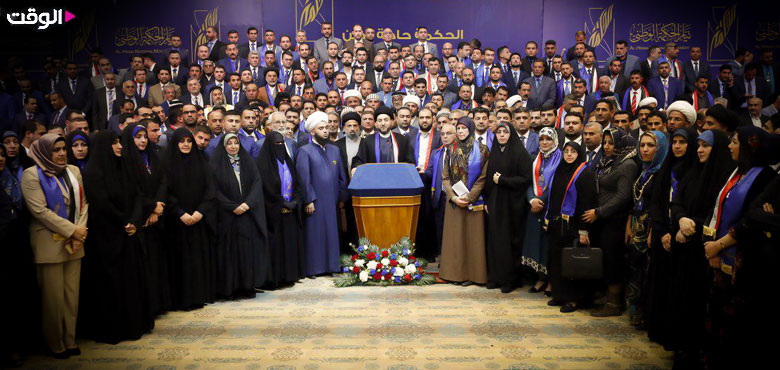


Alwaght- Iraqi National Wisdom Movement’s (MVM) announcement that it stepped out of the pro-government alliance and took the role of opposition on June 16 has drawn a spectrum of analyses and views among the supporters and opponents of the move inside the country. Some have taken the issue positively while others described it as a negative move by the movement.
First view: NWM seeks to establish good opposition role
With regard to the statement of the NWM in which there is a special emphasis on taking the role of opposition based on the constitution with a national and constructive approach, it seems that Sayyed Ammar al-Hakkim and his movement have decided to embark on a new path of constructive policy through which they take a mediatory role between the government and people to pass the critical voices to the politicians.
In this approach it is positive that the movement is highlighting reconstruction and development and even calls it setting up a new good-faith tradition in the country’s politics. This echoes the common process in the politics of democratic countries in which some parties by accepting the role of opposition take the task of supervising the government’s performance to help improve the living conditions. Now al-Hakim has taken a new role, has stepped out of the pro-government camp, and seeks to play as a positive-approached opposition leader.
Second view: NWM seeks to escape its responsibility
Another view is that the movement has shifted to opposition role to escape its share in contributing to solve the massive problems that the nation has been struggling with. As a proof to this view we can refer to the initial part of the MVM's statement which openly cites the country’s political conditions including the poor public services, the public concerns, and the government’s weak performance as the reason behind its decision to join the opposition.
According to this view, al-Hakim appears to have embarked on waves of anti-government criticism after Sayyed Muqtada al-Sadr, leader of Saerun Alliance, and Ayatollah Ali al-Sistani, the top Shiite cleric, criticized Prime Minister Adel Abdul Mahdi’s government. This effort appears to be aimed at, on the one hand, gaining popularity, and on the other hand, removing the responsibility of failures and weaknesses of government from the shoulder of the NWM. Regarding this, NWM’s measure not only is not positive but also can prospectively leave a negative influence on the government’s performance and lead to tensions on the political stage. The failure to pick the four remaining ministers of the cabinet will become even more complicated after NWM gets opposition role.
Third view: NWM mirage in the politics
Regardless of comments on NWM’s move, the third view can be based on the political realities of post-2003 Iraq. Two issues need to be taken into account.
First, the NWM, which was founded on July 24, 2017, following the breaking of al-Hakim with Islamic Supreme Council and won 19 seats in the new parliament, has never been as effective as other big political parties despite the deep roots of al-Hakim family in the Iraqi politics.
Second, the tradition of sharing the cabinet posts that followed 2003 has never been based on the Western democracies. Rather, it is based on the principle of agreement among the identity groups. In such a system a real opposition will never have room to emerge. That is because all of the Shiite, Sunni, Kurdish, and Turkmen groups find themselves part of the system and are responsible for the government’s decisions. In such a system, even if a group takes a critical approach towards the government, its voice will be stultified by the majority of the parliament.
The government of Abdul Mahdi still has the advocacy of Saerun Alliance, Fatah Coalition, Atta Movement, and Kurdish parties who all have nearly 200 out of 329 seats, something giving Abdul Mahdi majority support.
In such a situation, taking opposition role and allying with the relatively desolated opposition camp led by the previous PM Haider al-Abadi can never give al-Hakim weight in the country’s power structure. But it should not be ignored that one of the main goals of the movement is to gain posts in the future, and even current, government using the logic of futuristic behind-the-scenes game.










