









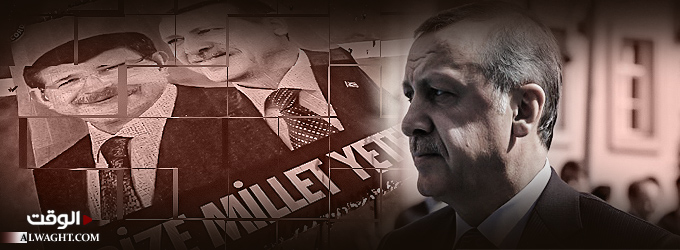


Alwaght - Turkey’s election results showed that the Islamist movement in Turkey is still the focal point of people's attention, and is the first option of Turkey’s Muslim population. Nevertheless, it also showed that the Islamist Justice and Development Party (AKP) is paying the cost of strategic mistakes of its leaders; i.e. the AKP is suffering a “crisis of leadership, rather than “falling short of votes”.
Taking the abovementioned issues into account, important notes can be made on the future of Turkey, some of which are as follows;
1. To AKP leaders, past elections must have paved the way for a shift from parliamentary to presidential system, in order for the country to be relieved of further domestic tensions. In which case, Turkey would have had stronger leadership authority to boost its regional domination by taking advantage of the region’s developments. In this regard, not only has Erdogan’s party failed, but it has also taken a big step backwards. Undoubtedly, Turkey was in a desperate need of a change to bring an end to its passive state, but for whatever reason, it did not happen.
2. On the other hand, under AKP’s wise leadership, Turkey could have played a more active role in solving the complex regional problems and seditions in Muslim world. However, Turkey’s elections couldn’t bring this about, and lack of wise leadership is seen as a major obstacle in this path.
3. Turkey’s election results and the relative growth in the participation of ethnic minorities show that Turkey has been implicitly influenced by major developments around the country. From this perspective, given the increase in turnout rates among ethnic groups, the electoral outcome signifies a “shift” towards a new political situation that can also improve the country’s security.
4. A glance at recent developments in Turkey will show that Erdogan has been engaged in struggle with religious spectrums rather than pursuing unity among Islamist movements. Although Erdogan followed the footsteps of Necmettin Erbakan--Turkey's Islamist Founding Father —but instead of making them involved and seeking their help, he sought to dispose of them. Accordingly, Erdogan’s attitude towards the Islamist Felicity Party (SP), led by Recai Kutan, reflects his efforts to lead the AKP based on Islamist views but at the same time contradicts wise decision making in politics. Erdogan could be the greatest role model for Islamist and justice-seeking segments of the society, but he went down the road of rejecting Islamic principles by regarding social movements as a tool to serve his interests.
5. The Justice and development Party adopted the so-called “zero problems with neighbors” strategy which marked a major turn in Turkey’s foreign policy, but this rational strategy didn’t last long and went through fundamental changes over the last 5 years. The first outcome of this change was Turkey’s further isolation in the region. Currently, Five years after the abandonment of its “zero problems” policy, Turkey does not have durable and friendly relationship with any of its neighbors. The shift in strategy was exemplified in Ankara’s current bilateral and multilateral relations with Iraq, Syria, Greece, Cyprus, Bulgaria, and Armenia, where the AKP’s strategists, Ahmad Dawoud Oglu in particular, displayed an upstart attitude that drew much criticism from Turkey’s elites.
Another example of a shift in AKP’s foreign policy is that except for the AKP, no group showed any support for interventionist policies in Syria, yet some of the leading figures of the very party such as Abdollah Gul were strongly opposed to this policy. This comes despite the fact that Turkey could have played a key role in bringing stability to Syria, which in turn would have led to enormous gains for Ankara.
The policy of creating antagonism toward neighbors, orchestrated by Dawoud Oglu, left a deep chasm in the Turkish society. Although, it abolished the dichotomy of “justice & discrimination” and “health & corruption” which was the root cause of people’s reluctance toward secular parties for 20 years, it brought along the dichotomy of “dictatorship and political reform”.
In the past 10 years, Erdogan and his party have turned Turkey into a scene of domestic disputes. Aside from the consequent deep split between the AKP and Islamist movements, Ankara’s relationship with Alevis and Kurds has also strained.
One of the strategic mistakes of Erdogan’s team, particularly Ahmad Dawoud Oglu, in recent years was that their policies and symbols (such as giving a name to the Istanbul Bridge or transferring the body of the Ottoman king into Turkey) revealed their “Ottomanist” tendencies. While, due to flagrant discriminations exercised by the Ottomans against Arabs, Ottomanism was never welcome in the region.
This issue has also been a major cause of division in Turkey itself. The best proof to this claim is that all other contending parties were against Ottomanism, and have secured many votes through anti-Ottomanist slogans. Ottomanist practices of Erdogan and Dawoud Oglu have, for certain, dealt major blows to the Justice and Development Party and have changed its face from a revolutionary to a reactionary party.