















Alwaght- The Israeli regime that under a far-right government and within framework of its territorial expansionism is seeking to change geopolitical equations in peripheral areas, after Gaza, West Bank, and Lebanon has now made Syria's south the new focus of its military occupation.
Actually, the Israeli army's strategy has shifted from destroying Syria's military capabilities on the border to consolidation of long-term stay in southern Syria, a policy pursued through destroying farming lands and pressing the Syrians to evacuate.
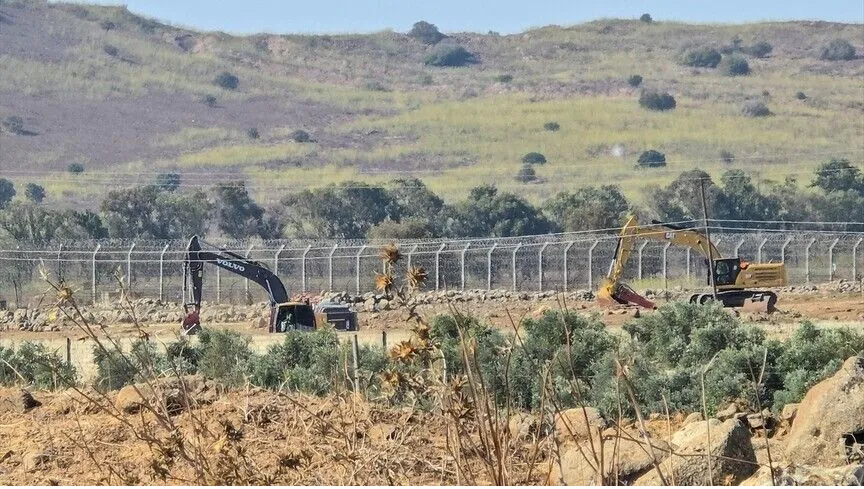
In this connection, in recent weeks, Israeli military forces have displaced Syrian farmers from their homes in Quneitra with raids on them. Reports talked about firing smoke grenades at the farms. In addition to destroying the military posts established by the previous government, the Israeli occupation troops have deliberately banned farmers from accessing their fields, filled the water wells, and demolished the farming lands with bulldozers
The Syrian Observatory for Human Rights, a London-based monitoring group, said that Israeli forces destroyed 1.3 hectares and cut 300 olive trees in Sayda village in Al-hanout district of Quneitra.
Al Jazeera reported September 17 that Israeli bulldozers have destroyed several farms in Yarmuk region of Daraa. North Press reported on August 14 that Israeli forces uprooted several olive trees near the village of Abdin in Quneitra and bulldozed part of the adjacent farmland.
The Israeli military has also built a narrow road across private farmland west of the Hannot farms, purportedly to reinforce military fortifications under a project dubbed "Sufa 53."
Media reports further indicate that in recent years Israel has conducted studies aimed at tapping groundwater resources in southern Syria and diverting them to the occupied Golan Heights. The Yarmouk Basin in Daraa province, home to 23 dams and boasting high catchment capacity, has been identified as a top priority for the scheme, a prospect that, if carried out, could lay bare a new dimension of the contest over strategic water resources and the consequences of occupation in southern Syria.
Such a plan could spell disaster for the environment and livelihoods of people in southern Syria: as groundwater is drained and diverted, the fertile lands that have sustained local communities and met their daily needs for thousands of years would gradually dry up and turn into unarable ground.
Silent displacement in Syria
What is unfolding today in southern Syria, particularly in the border areas of Quneitra, bears a striking resemblance to the pattern Israeli occupation has imposed on the West Bank over the past several years. There, settlers attack Palestinian villages, demolish homes and destroy farms and orchards, creating conditions that make life increasingly difficult, and ultimately impossible, for Palestinians. The end goal of this process is to ease the expansion of settlements and gradually alter the demographic and geographic fabric of these areas.
In southern Syria, too, the occupying army's repeated assaults on farmland, destruction of property and damage to farmers' livelihoods cannot be dismissed as isolated, episodic military actions. Sustained over time, such measures can generate a steady wave of displacement, ultimately forcing local residents off their land as their living environment becomes unsafe and their sources of income are wiped out.
This process must be viewed against the backdrop of the occupation of the Syrian Golan, which Israel seized in 1967 and has since sought to entrench through the expansion of settlements and the gradual transformation of the region's geographic and demographic makeup. The central worry now is that this same model of entrenching occupation, pressure on local residents, destruction of livelihood infrastructure and the creation of new facts on the ground, will be replicated in other parts of Syria, especially Quneitra.
The issue, then, is not merely the loss of a few hectares of land or the demolition of a handful of homes. It is the future of the indigenous population on its own soil, and the prospect of occupation being cemented step by step. If this process continues without an effective and deterrent response, Quneitra could well face consequences similar to those that have unfolded in the occupied Golan over the past decades, with native lands gradually turning into areas under Israel's lasting control and influence.
Inaction of al-Jolani's government
Despite continued occupation and aggression targeting Syrian territory, the government of Abu Mohammad al-Jolani, officially Ahmad al-Sharaa, has so far taken no action to counter the moves of the occupiers. Damascus reactions have been limited to weak statements in which the Israeli actions are described violation of Syrian territorial integrity and have not tangibly affected the Israeli behavior.
That same passivity, and the silence that speaks volumes, has given Israel's leaders the room to expand the occupation at will, with no interference whatsoever from the rulers in Damascus.
What is especially telling is that al-Jolani, rather than sending troops to confront the occupiers and stop the seizure of more Syrian territory, is preparing to dispatch thousands of his fighters to help Saudi Arabia fight Yemen's Ansarullah, an anti-Israeli resistance movement. The forces that should be defending Syrian soil and confronting an invading enemy are instead being sent in a wholly different direction, to fight Yemeni Muslims.