












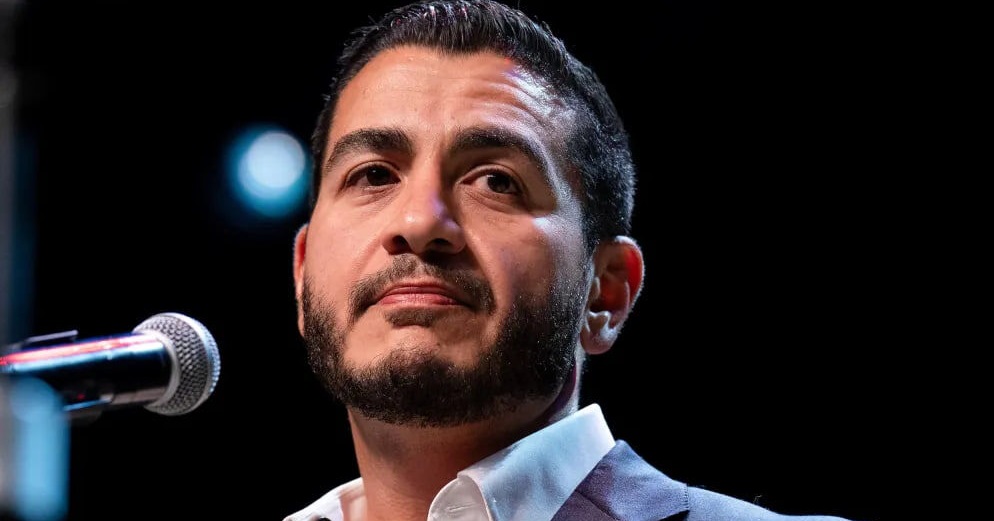


Alwaght- Abdul El-Sayed's victory in the US Senate race in Michigan is more than just an election result; it signals a gradual shift in the country's political balance, one in which Muslim voters and supporters of Palestinian rights are playing a larger role in determining electoral outcomes.
El-Sayed, by defeating Republican candidate Mike Rogers, became the first Muslim elected to the US Senate, a historic moment that could reshape Washington's political calculus as well.
This report examines the significance of El-Sayed's victory in Senate race.
Who is Abdul El-Sayed?
Abdulrahman Mohamed Abdul El-Sayed is a 42-year-old American politician and the son of Egyptian immigrants, born in Rochester Hills, Michigan. Raised in a Muslim family, he began his university studies at the University of Michigan, earning a bachelor's degree in biology and political science in 2007. He then attended Oxford University as a prestigious Rhodes Scholar, completing his doctorate in public health in 2011. In 2014, he earned his medical degree from Columbia University in New York.
From public health management to politics
Unlike many American politicians, El-Sayed launched his professional career in public health. After completing his studies, he worked as a university professor and public health researcher, and in 2015 was appointed director of the Detroit Department of Health, a post he held until 2017. His first serious foray into electoral politics came in 2018, when he ran for governor of Michigan but lost the Democratic primary to Gretchen Whitmer. He later served as director of the Wayne County Health Department, a position he held until 2025.
Why did he run for Senate?
In 2026, after Democratic Michigan Senator Gary Peters announced he would not seek reelection, El-Sayed saw an opening to reenter the political arena. He campaigned on promises to lower the cost of living, curb corporate influence in politics, enact universal health care, and cut off U.S. military aid to Israel. His victory in the Democratic primary against Haley Stevens, followed by his defeat of Republican Mike Rogers in the general election, paved his path to the Senate. Opposition to the war in Gaza and criticism of Washington's military support for Tel Aviv became hallmarks of his campaign.
What was El-Sayed's campaign message?
El-Sayed's campaign positions on the Gaza war and American military support for Israeli occupation drew widespread attention during the congressional race, and he went on to defeat his Republican rival to become the first Muslim elected to the Senate. He is an outspoken critic of Tel Aviv's policies and has opposed continued US military assistance to Tel Aviv. He has also described Israel's actions in Gaza as genocide and called for a serious reconsideration of American financial and military support for the country. He has even said explicitly that Israel cannot be considered a true US ally.
These positions came amid intense political and propaganda pressure on El-Sayed. According to the Associated Press, the American Israel Public Affairs Committee (AIPAC), spent nearly $30 million in the Democratic primary to defeat him. Nevertheless, he cleared the primary and won the general election. The result shows that support for Tel Aviv is no longer an unbreakable electoral red line across all corners of American politics.
Muslims and Pro-Palestinians gain political weight in the US
His victory should be seen as a sign of the growing political power of Muslims and pro-Palestinian supporters in the US. The result also points to a loosening of the traditional monopoly and influence of pro-Israel currents in electoral politics.
This shift, indeed, shows that the American Muslim community is no longer merely a social group or religious minority relegated to the margins of political life; it is gradually becoming a force to be reckoned with in electoral calculations. Growing Muslim political participation, especially in decisive states like Michigan, home to a substantial Muslim population, could reshape the competitive dynamics between Democrats and Republicans. Candidates, in turn, are being forced to incorporate this community's demands into their platforms more than ever before.
At the same time, the Gaza war has become a turning point in shifting how part of the American public views Israeli regime. Campus protests, street demonstrations and widespread criticism of US weapons shipments to Israel have shown that unconditional support for Tel Aviv no longer enjoys the political and social consensus it once did. Especially among young people and Democratic voters, opposition to the ongoing war and demands to halt military aid to Israel have become serious issues in political rivalries.
Against this backdrop, the victory of a politician who openly opposed continued military aid to Tel Aviv sends a clear message to the US political establishment, telling them that demands of millions of Muslim and pro-Palestinian voters cannot be ignored, and traditional support for Tel Aviv can no longer be expected to come without an electoral price.