














Alwaght- The fast advances of the Yemeni Ansarullah forces in western coast regions has not stopped seizing the strategic city of Mokha, and continued with the retreat of the Saudi-backed mercenaries from Perim island and Bab-el-Mandeb region, marking one of the fastest collapses of the defense lines of the militias backed by Riyadh. New Arab reports that this loss derives not only from fire and strength upper hand of Ansarullah resistance movement but also from a combination of structural weaknesses, absence of a unified command, and fragility of the morale of the Saudi-aligned forces.
Various Arab sources have drawn the way the Saudi proxies collapsed and investigated why they lost this decisive conflict.
Course of collapse: From Hais to Perim
The starting point of the collapse of Saudi-backed forces in Yemen can be traced to the Hais and al-Wazi'iyah fronts in the south and southeast of Mokha last Wednesday and Thursday. Saudi-aligned proxies first pulled back from these areas, and with those lines broken, direct pressure on positions around Mokha intensified.
The next phase came Friday with the fall of the defense lines surrounding al-Mokha. Ansarallah applied simultaneous ground pressure and deployed missiles and drones against Saudi-backed forces and their allies. Ultimately, an order to withdraw from the city itself was issued, and the so-called "Joint Forces" backed by Saudi Arabia retreated without mounting a prolonged defense of the city.
This phase carried enormous significance, because Mokha served as the command center for the anti-Ansarallah militias on western coast. Its fall was not merely the loss of a city; it eliminated the military center of gravity for the entire front opposing Ansarallah in this stretch of the coastline.
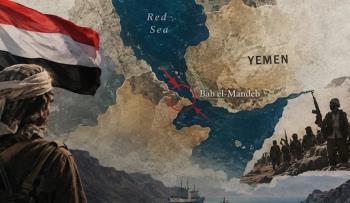
But the collapse did not stop there. On Friday, the retreat extended to Perim island, a strategic outpost at the mouth of the Bab-el-Mandeb strait. The withdrawal route of Saudi-backed forces thus stretched from Hais and al-Wazi'iyah to the outskirts of Mokha, then the city itself, and finally to Perim and Bab-el-Mandeb, erasing, in a matter of days, the Saudi-aligned presence along the southern Red Sea coast.
Actually, Saudi-backed forces withdrew from Perim island just one day after Mokha fell, even though before the operation began, reports had circulated of these same forces advancing on several fronts. New Arab reported that the defensive lines of Saudi-backed forces crumbled in an extraordinarily short span, raising serious questions about the true capability of the Saudi-supported military coalition. Official sources told New Arab that an order to exit Mokha was issued Wednesday evening, initially described to the troops as a "repositioning."
30 brigades without unified command
The defeat of Saudi-backed forces at the hands of Ansarallah unfolded even though these forces rank among the most important military formations in Yemen's anti-resistance front.
They encompass roughly 30 military brigades and were reorganized in early 2026 into five divisions and a core command structure, forces under direct Saudi supervision, including the National Resistance Forces, the Tihama Brigades, the Zaranik, al-Amalika, a naval unit, and specialized security forces.
Yet Yasmin al-Aryani, executive director of knowledge production at the Sana'a Center for Strategic Studies, argues that the recent battle showed these forces have still failed to forge a unified military command. Confronting a battle-hardened force like Ansarallah, she says, demands unified command, a flexible military strategy, and a disciplined defense doctrine, elements entirely absent during the recent fighting. She also stressed that any operation against Ansarallah requires the simultaneous, coordinated mobilization of forces across multiple fronts, but no such coordinated mobilization materialized in the recent battle.
Lightening assault on Mokha
In the days leading to fall of Mokha, Ansarullah put strains on the city. According to New Arab, the city came under dozens of missile and drone attacks and at the same time thousands of Ansarullah forces were deployed to western Taiz fronts.
Mokha sits in the southwest of Taiz province, roughly 60 to 70 kilometers from Bab-el-Mandeb. The city's importance is doubled by the fact that it housed the headquarters of the Saudi-backed Joint Forces.
With Saudi-aligned forces also withdrawing from Perim, Ansarallah's position at Bab-el-Mandeb has strengthened further. New Arab reported that an Ansarallah official declared the movement has completed its control of Perim and, by extension, the Bab-el-Mandeb area.
Bab-el-Mandeb is one of the world's most critical maritime chokepoints, linking the Red Sea to the Gulf of Aden and the Indian Ocean. Military developments there therefore bear directly on shipping security and energy transit along the Red Sea corridor.
Fragmentation and infighting inside anti-Sana'a front
On the opposite side, various groups exist, including Tareq Saleh forces, and National Resistance to Al-Amalika Brigades, Tihama, and Taiz Axis forces. These militant groups follow various political and regional agenda and have records of clashes. The structure that looks unified and disciplined on the paper is not necessarily so on the ground.
A major portion of anti-Ansarullah forces in Yemen have belonged to conflict-ridden Saudi and Emirati militia networks. So, the issue is not just dispute among Yemeni commanders. Actually, the two foreign backers of these militias do not necessarily follow a unified agenda for Yemen future, something making it hard to form a chain of joint command. Recent reports have talked about weakening of the Saudi coalition as gaps emerge inside it.
Dispersal of forces on several fronts
In the course of its advance, Ansarallah sought to sever the lines of communication linking the western coast, Mokha, and the Taiz front. Al Jazeera reported that the operation's objective was to seize the commanding high ground, cut supply routes between Mokha and Taiz, and prevent Saudi-backed forces on the western coast from linking up with the Taiz military axis.
As a result, anti-Ansarallah forces found themselves grappling with the classic problem of fighting on multiple fronts without operational focus: some units were stationed in Taiz, others along the coast, and still others in the southern areas, while Ansarallah concentrated its pressure squarely on the junctions connecting them.
A defeat beyond battleground
What has happened in Yemen, therefore, is not just defeat of a number of military units. The forces that were organized with Saudi backing and with a structure comprised of tens of brigades to fight Ansarullah is a short time lost a major part of their defense lines.
Fall of Mokha and Perim, beside Bab-el-Mandeb developments, shows that Ansarullah has managed to seize the initiative in one of the country's most critical regions, while the opposite camp is grappling with the fundamental problem of lack of unified command and political-military coordination.