














Alwaght | News & Analysis Website

Editor's Choice

News

Most Viewed

Day Week Month

In Focus

Ansarullah

Ansarullah

A Zaidi Shiite movement operating in Yemen. It seeks to establish a democratic government in Yemen.
Shiite

Shiite

represents the second largest denomination of Islam. Shiites believe Ali (peace be upon him) to be prophet"s successor in the Caliphate.
Resistance

Resistance

Axis of Resistances refers to countries and movements with common political goal, i.e., resisting against Zionist regime, America and other western powers. Iran, Syria, Hezbollah in Lebanon, and Hamas in Palestine are considered as the Axis of Resistance.
Persian Gulf Cooperation Council

Persian Gulf Cooperation Council

A regional political u n i o n consisting of Arab states of the Persian Gulf, except for Iraq.
Taliban

Taliban

Taliban is a Sunni fundamentalist movement in Afghanistan. It was founded by Mohammed Omar in 1994.
  Wahhabism & Extremism

Wahhabism & Extremism

Wahhabism is an extremist pseudo-Sunni movement, which labels non-Wahhabi Muslims as apostates thus paving the way for their bloodshed.
Kurds

Kurds

Kurds are an ethnic group in the Middle East, mostly inhabiting a region, which spans adjacent parts of Iran, Iraq, Syria, and Turkey. They are an Iranian people and speak the Kurdish languages, which form a subgroup of the Northwestern Iranian branch of Iranian languages.
NATO

NATO

The North Atlantic Treaty Organization is an intergovernmental military alliance based on the North Atlantic Treaty which was signed on 4 April 1949.
Islamic Awakening

Islamic Awakening

Refers to a revival of the Islam throughout the world, that began in 1979 by Iranian Revolution that established an Islamic republic.
Al-Qaeda

Al-Qaeda

A militant Sunni organization founded by Osama bin Laden at some point between 1988 and 1989
New node

New node

Map of  Latest Battlefield Developments in Syria and Iraq on
alwaght.net
News

Oil, Trade, and Tariffs: The Middle East at the Center of Geoeconomic Tensions

Tuesday 24 February 2026
Oil, Trade, and Tariffs: The Middle East at the Center of Geoeconomic Tensions

ALWAGHT- According to The Global Risks Report 2026, geo-economic confrontation now tops global threats, with US–China trade frictions and oil volatility transforming the Middle East’s strategic landscape.

Geo-economic confrontation has emerged as the most severe global risk over the next two years, according to the World Economic Forum’s Global Risks Report 2026. Economic tools such as sanctions, tariffs, and investment controls are increasingly replacing military force, signaling a shift toward economy-driven power struggles. The EU’s sanctions on Russia illustrate both the reach and limits of this approach, offering lessons for regions heavily dependent on trade and energy.

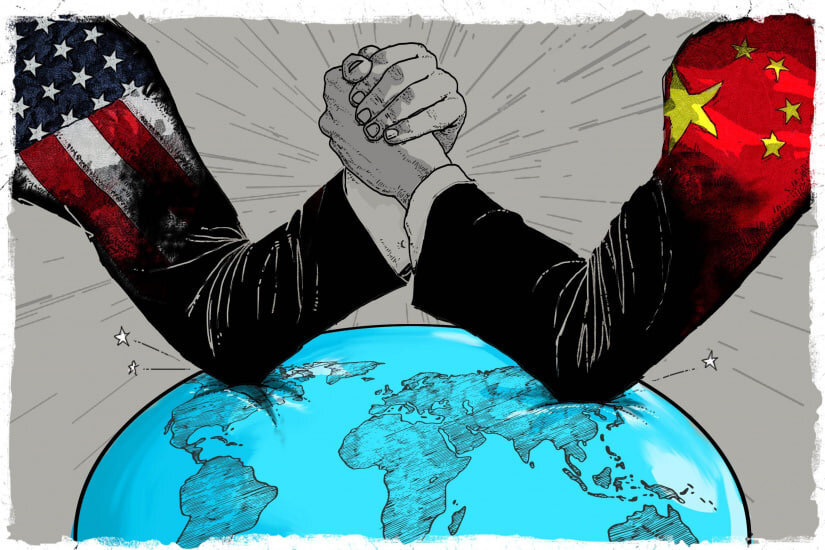
The rivalry between the United States and China is the central fault line of this new geoeconomic era, with major spillover effects for the Middle East. China has become the region’s largest trading partner and a dominant buyer of Middle Eastern oil, deepening regional exposure to US–China trade tensions. As tariffs and sanctions escalate, oil demand, investment flows, and access to technology across MENA are increasingly affected.

These tensions have fueled oil price volatility, directly impacting Persian Gulf economies that rely on energy exports. Sharp drops in Brent crude prices in 2025—linked to tariff threats and trade retaliation—cut into state revenues and strained national budgets, particularly in Saudi Arabia, the UAE, and Kuwait. Sanctions on Iranian oil further reshaped regional crude flows, reinforcing Persian Gulf producers’ role in Asian markets while amplifying price uncertainty.

In response, Middle Eastern states—especially in the Persian Gulf—have pursued a strategy of balance rather than alignment. They have expanded energy and trade ties with China while simultaneously deepening investment, technology, and security partnerships with the United States. In an increasingly multipolar world, the region’s ability to manage geo-economic confrontation through diversified partnerships will be crucial to preserving economic stability, strategic autonomy, and long-term growth.


Tags :

United States China Middle East Persian Gulf Oil Trade Tariffs The Global Risks Report 2026

Comments
Name :
Email :
* Text :
Send

Gallery

Photo

Film

Commemorating the 36th anniversary of the passing of Imam Khomeini (RA), the founder of the Islamic Republic of Iran.

Commemorating the 36th anniversary of the passing of Imam Khomeini (RA), the founder of the Islamic Republic of Iran.








