










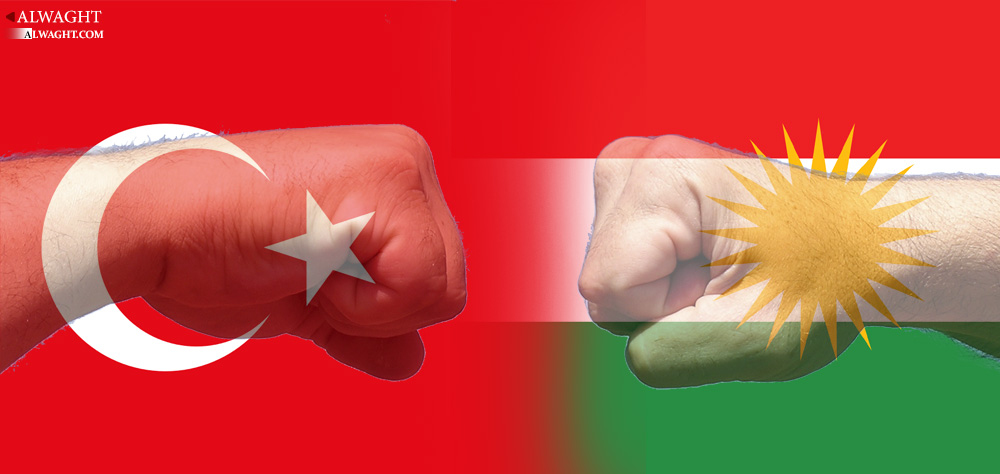


Alwaght- Making an understanding of the ethnic issues in the world for politicians and governments that seek a sustainable security and development is something necessary and indispensable. In today’s world, the developing countries, due to inflexible political structures and a strong adherence to the classical sense and function of the nation-state which somehow ignores the political and cultural rights of the ethnical groups, are grappling with ethnicity-related problems and challenges. Turkey, as a developing nation for instance, is no exception. Because of confrontations with the Kurdish ethnical minority, Turkey, in past four decades, has borne burden of heavy costs.
For Turkey, the Kurdish cause or the “Kurdish reality”, as the Turks call it, is the most painful and most challenging issue the Turkish leaders since establishment of the Republic of Turkey as a modern state have been dealing with. The modern Turkey in no way accepted the concept of the Kurdish minority beside rights of other ethnic groups in the country. This issue, combined with the troubles and insecurity caused by the anti-Ankara Kurdistan Workers' Party (PKK) moves, generated a series of security threats for Turkey. The clashes between the Turkish security forces and the PKK militants have so far claimed lives of many people, not to mention the big number of people became displaced because of the deadly encounters.
In very recent developments, Selahattin Demirtas and Yüksekdağ, two top leaders of People’s Democratic Party of Turkey which strongly supports the rights of the Kurds inside Turkey, were given very long jail terms by the Turkish prosecutors. On Tuesday, January 17, the Diyarbakir court demanded 142 years in jail for Demirtas and 83 years for Yüksekdağ on charges of having links and coordination with the PKK.
Demirtas, Yüksekdağ, and ten other Kurdish members of Turkey’s parliament were detained in November last year on suspicion of collaboration with “the terrorists.” Since that time one of the detainees, among the ten, was released while another one was given long-time jail sentence. The Turkish parliament on May 20, 2016, voted to lift immunity of the pro-Kurdish MPs. The motion was put forward by the Justice and Development Party (AKP), the country’s ruling party. At that time, the People’s Democratic Party of Turkey argued that the goal behind stripping the immunity was to support an effort by Ankara to remove the pro-Kurdish law makers from the parliament to pave the way for their prosecution. A short time later, it became clear that the Turkish government intended to push the Kurdish law makers out of the parliament and isolate them in the political scene on the strength of the legal action.
At the current time, it appears that while the outlook of peace in the country is surrounded by questions and ambiguity, the government and the Kurdish opposition will face bigger problems in the short run.
What is clear is that the Kurdish issue will not be settled using repression and military violence because the Kurds account for a significant part of Turkey’s population, and the government by no means can disregard them in the country’s future, especially that they have roots also out of the Turkish borders. At the same time, they have diplomatic representations both across the region and in the European countries, and can influence the Turkish government in the long run.
So in the long run Ankara cannot find a solution for the Kurdish challenge by use of military operations. In fact, a continuation of such conditions will result in deterioration of the Turkish economic conditions and rise of other security problems. Additionally, the Turkish military operations against the Kurds have drawn criticism both in regional and in international levels.