










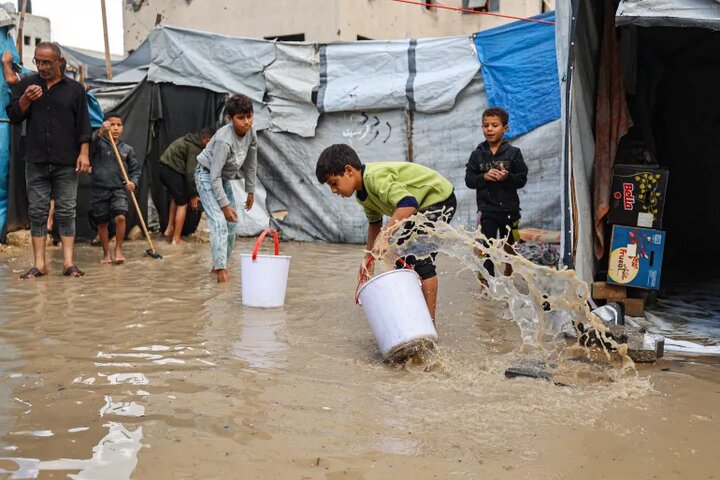


Alwaght- Heavy rains and floods in the Gaza Strip have left thousands of Palestinian families, who are still living in threadbare tents and displacement camps after more than three years of war, into a fresh crisis. The first winter storm to hit Gaza has submerged tens of thousands of tents, destroyed essential belongings, and left hundreds of thousands exposed to cold, disease and renewed homelessness.
At least 70,000 tents sheltering displaced Palestinians have flooded amid the heavy downpours. Gaza government's press office said the rains inflicted widespread damage on displacement sites in just 12 hours. Gaza's civil defense forces, meanwhile, fielded roughly 1,500 emergency calls in 10 hours from families trapped in the floodwaters. In some camps, water has risen to 30 to 40 centimeters.
An Al Jazeera report from the al-Mina camp in northern Gaza found that about 1,700 Palestinian families live there, with the recent rains turning large swaths of the site into muddy pools. In other camps, strong winds have torn down and uprooted tents.
Many families, their mattresses, blankets, clothing and food soaked through, have effectively lost the ability to keep living in their tents. In one Al Jazeera field account, Rana Hamida, a 29-year-old Palestinian woman, said the rain drenched all of her family's belongings and left her children shivering from the cold. Cradling a two-month-old infant, she said she spent the night unsure whether to fight the water flooding into the tent or keep her children warm.
950,000 Gazans affected by floods
The dimensions of crisis go beyond the damaged tents. According to assements by the UN Office for Coordination of Humanitarian Affairs, around 950,000 displaced Palestinians are living in areas exposed to flooding. Over 400,000 of them are living in areas with high risk of being hit by flooding.
Al Jazeera, citing US assessments, reports that some 294,250 Palestinian families need shelter and housing assistance ahead of winter, yet available supplies cover only 18 percent of those needs. More than 1.5 million displaced Palestinians, meanwhile, are bracing for another winter in worn-out tents.
According to the UNOCHR, Gaza needs roughly 121,000 tents and 561,000 tarpaulins to meet displaced people's basic needs, a far cry from what is currently in stock.
The International Organization for Migration has also said about 1.8 million people in Gaza require shelter assistance. More than half of the existing tents are dilapidated and cannot protect families from winter rain and cold.
24,000 Palestinians living in damaged
The risk of flood is not threatening just Palestinians living in tents; rather, thousands of families are living in buildings that have been damaged in Israeli airstrikes and now are under the danger of collapse.
According to Al Jazeera, citing the UNOCHR, some 44,000 Palestinians are living in buildings that are structurally unsafe. More than 4,000 buildings across Gaza also require full or partial demolition because of damage from Israeli airstrikes.
Al Jazeera reports that more than 2,000 buildings in Gaza City alone are at risk of collapse. The volume of rubble left behind in the city has topped 25 million tons.
Destruction of infrastructure: Capacity to handle flooding is only 20 percent
One of the main factors intensifying the crisis in Gaza is the vast destruction of urban infrastructure by the Israeli occupation's strikes.
According to the Gaza municipality, cited by Al Jazeera, about 15 kilometers of the surface water transfer channels and 212 kilometers of the sewage network has been damaged. Eight pumping stations and three main stormwater collection basins have also been knocked out of service.
Hosni Muhanna, a spokesman for the Gaza municipality, said the network's remaining capacity to handle rainwater, even under the best of conditions, does not exceed 20 percent of what is needed. The municipality has tried to ease the flooding by clearing drainage channels, opening sewage routes and activating the pumps still in service, but shortages of fuel, equipment and spare parts have blocked efforts to restore the network's capacity.
Israel denying entry to aid equipment and tents
Meanwhile, Palestinian officials say that Israeli occupation forces block entry of pre-fab homes and construction materials to the enclave.
Al Jazeera reported that according to the terms of the ceasefire deal, entry of 60 mobile housing units and 200,000 tents to Gaza was predicted, but they are yet to get the Israeli permission. So far, only 20,000 tents were allowed in, and mobile housing units remain behind borders in Egypt.
Rami Abdo, head of the Euro-Mediterranean Human Rights Monitor, told Al Jazeera that large shipments of tents, residential caravans, prefabricated homes and shelter equipment are stalled at Gaza's borders. He stressed that even families living in houses and apartments lack safe conditions against winter rain and cold, given that roughly 85 percent of Gaza's homes have been destroyed or damaged.
According to the rights activist, Israel continues to block the entry of certain timber shipments and emergency equipment needed to repair buildings, restrictions that have limited the rebuilding of damaged homes and the rehousing of families.
UN estimates put Gaza's need at 121,000 tents and 561,000 tarpaulins, even as available stock falls far short of that figure and hundreds of thousands of families remain without adequate shelter.
New Gaza administration, an actionless organization
The National Committee for the Administration of Gaza, formed under the Sharm el-Sheikh agreement to manage civilian affairs, restore public services and lay the groundwork for reconstruction, has so far failed to meet the expectations it raised. Despite its promises to govern Gaza and improve living conditions, the body is still struggling seriously to establish itself and carry out its responsibilities, and it has been unable to play an effective role in providing shelter, restoring infrastructure or addressing displaced people's urgent needs. Israel's prevention of the committee's work inside Gaza is one of the main obstacles, but the absence of effective action and of positions commensurate with the scale of the crisis has also cast doubt on the structure's effectiveness.
The Board of Peace, formed around Donald Trump to oversee the ceasefire, consolidate security conditions and steer Gaza's reconstruction, has likewise produced no tangible results matching its promises. Continued attacks and ceasefire violations, restrictions on the entry of humanitarian aid and shelter equipment, and the lack of visible progress in reconstruction show that this body, too, has failed to fulfill its responsibilities. Gazans, in effect, remain trapped between the devastation of war, the blockade and the dysfunction of political and international mechanisms, paying the price of these institutions' delay and inaction with their lives.
Board of Peace: Israeli regime responsible for critical humanitarian conditions in Gaza ahead of winter
Facing criticism over its inaction, the Board of Peace late Monday blamed Israel for the worsening humanitarian crisis in the Gaza Strip at the onset of winter, citing its delays in allowing humanitarian aid to enter and its failure to honor its commitments under the Sharm el-Sheikh agreement, and called for immediate action to facilitate the entry of winter supplies and equipment.
In a statement released by its communications office, the board voiced "deep concern" over the deteriorating humanitarian conditions, noting that severe flooding over the past two days has swept across parts of the Gaza Strip, destroying or inundating tens of thousands of tents and temporary shelters for Palestinians displaced by Israel's war.
It stressed that the floods have damaged property and basic supplies and left families already living in extremely difficult conditions more exposed than ever to the cold and the dangers of severe weather.
The board added that Gaza conditions are now an immediate humanitarian emergency, not just a potential threat and the Israeli occupation should, without delay, allow in aid and equipment crucial for countering the winter cold wave and fallout of floods.