







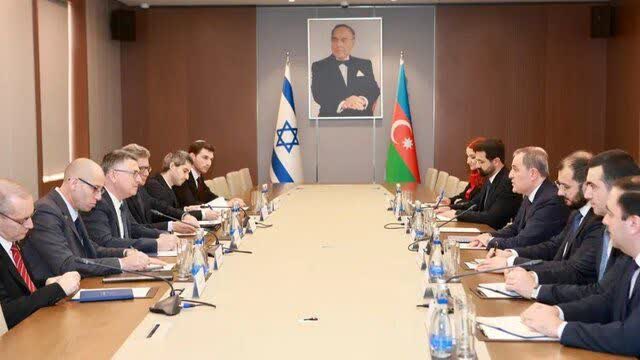


Alwaght- Amid rising tensions in West Asia, an Israeli delegation has visited Azerbaijan and Kazakhstan. According to the reports, Foreign Minister Gideon Sa'ar is heading the delegation and the visit is meant to "boost bilateral political and economic ties."
Azerbaijan 24 website reported that "during the visit, a number of official events as well as contacts with the state officials and communal members, including the Jewish society, are expected."
However, given the growing tensions in the region, the Israeli delegation's visit to Baku and Astana is considerable economically and politically.
The push for trade and economic normalization
Sa'ar is visiting Kazakhstan as the country joined the normalization agreements with Israel, officially called Abraham Accords. The Israelis are pushing hard to expand their influence in Central Asia and now it seems that they are working towards this end through trade and economic channels.
The composition of the Israeli delegation's visits to Azerbaijan and Kazakhstan further reveals Tel Aviv's push for economic influence in Central Asia. Reports indicate that Sa'ar is accompanied by a business and economic delegation comprising over 40 Israeli entrepreneurs and representatives from various organizations.
The delegation is said to represent sectors including water and agricultural technology, cybersecurity, engineering, finance, healthcare, and others.
In effect, the Israeli regime is seeking to expand its regional footprint and weight, leveraging its economic and technological capabilities as "soft power" tools to forge ties with secular, majority-Muslim, non-Arab nations in the region. For instance, in agriculture and medicine, projects are being pursued by Mashav, Israel's Agency for International Development Cooperation under the foreign ministry, in a bid to carve out a role for itself in Central Asia’s power dynamics.
It should also be noted that despite the toll of the two-year war in Gaza, the Israeli regime remains a leading hub for advanced technology, particularly in IT. According to DW, Tel Aviv has the highest per capita concentration of startups in the region, with high-tech products accounting for over 10 percent of its GDP.
For years, the Israelis have worked to position themselves as a regional technology and IT center. With Central Asia’s sizable IT market, they see ample opportunity to achieve their desired outcomes in the region.
Security agenda
The Israeli FM also met with the Azerbaijani and Kazakh presidents.
Over the past decade, one of the policies of the Israeli regime has been presence in Iran's peripheral environment, especially Iraq's Kurdistan region, the UAE, and Azerbaijan to impose a new equation against Tehran. Its present moves serve the sane agenda.
It also shuoud be taken into account that Central Asian states have substantial regional and international positions as they are, along with West Asian countries, are members of the Organization of Islamic Cooperation (OIC). Tel Aviv, driven by its disputes with Arab countries and Iran, has felt a need for improving relations with countries having non-Arab Muslim populations. So, part of its push for getting a foothold in Central Asia falls under this aim.
Currently, Kazakhstan and Uzbekistan are the only Central Asian nations maintaining embassies in the Israeli regime. In practice, Astana and Tashkent are more concerned about the rising influence of Islamic parties within their own societies than with the Palestinian issue. From this perspective, they are pursuing closer ties with Tel Aviv as a means to counter the activities of Islamic groups.
Azerbaijan, a country in the Caucasus region, has also significantly expanded its relations with Tel Aviv in recent years. Despite the fact that all these nations have secular political structures, with no formal role for Islam in their governance, Israel classifies them as part of the "moderate Islamic axis" and has actively deepened its diplomatic and strategic relations with them accordingly.
Also, it should be taken into consideration that for Tel Aviv, moving closer to the Central Asian states is not only a means of anti-Iranian pressure through presence in Tehran's peripheral environment, but also means adding to pro-Israeli votes in the UN. In his visit to Astana two years ago, the Israeli Prime Minister Benjamin Netanyahu called for Kazakhstan's support for Israel’s bid for temporary seat at the UN Security Council. This, observers suggest, indicates an Israeli approach to draw diplomatic support and votes of the Central Asian countries. This will be very likely on the agenda of the Israeli FM during his current visit to the two countries.