







Alwaght- The peace process between the Turkish government and the Kurdistan Workers Party (PKK) that after years of a stalemate showed signs of revival is now again running into deep questions and challenges. The announcement of the PKK dissolution by its imprisoned leader Abdullah Ocalan and then accepting suspension of armed struggle all promised a new chapter in the complex relations of Ankara and this terrorist group. But it seems that the heavy shadow of the past and the flawed logic of confrontation disallow smooth advance to peace.
In the latest and perhaps the most serious warning, senior PKK commanders in unprecedented resolution have tied any interaction for negotiations to two essential conditions: Unconditional freedom of Ocalan and recognition of the identity and political rights of the Kurds in the Turkish constitution.
In a trench in the Qandil mountains of northern Iraq, a commander who identifies himself as “Malazgirt” told AFP on Saturday that his group has completed all steps outlined by the imprisoned PKK leader, Abdullah Ocalan, and that no further action will be taken from their side.
“The measures set by Leader Apo [Ocalan] have all been fulfilled,” he said. “It is now Turkey’s turn to act.”
The commander laid out two core demands for advancing the peace process: The unconditional release of Ocalan, and the constitutional recognition of the Kurdish people’s rights in Turkey.
Another senior commander, Serdar Mazlum Gbar, reinforced this position, stating that “as long as our leader is in prison, the Kurdish people cannot be free, and we as guerrillas will not feel free. Our path to freedom passes through our leader’s freedom.”
These statements amount to more than mere bargaining, they form an ultimatum that threatens to derail the fragile peace process, potentially halting it entirely or even reigniting a cycle of violence.
Peace process negotiations on the brink of collapse
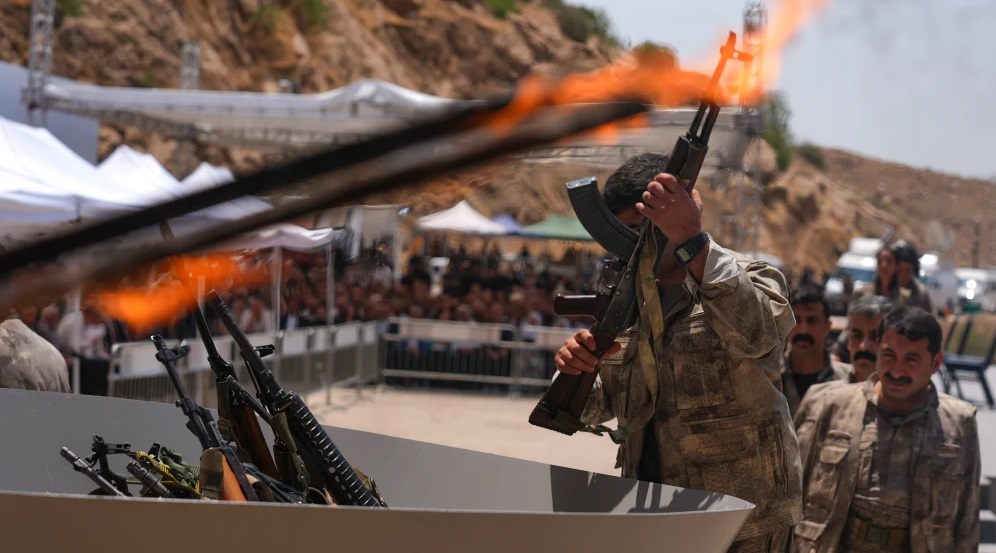
Ankara commenced indirect talks with the PKK later last year. Then Ocalan in February in a statement called on the militants to put down their arms and embark on democratic processes to advance the aspirations of the Kurds. Responding to the 76-year-old leader, the group in May officially announced it's armed struggle against Turkey and then gradually removed forces from Turkish soil to northern Iraq. In a symbolic ceremony, 30 of the PKK fighters in northern Iraq set fire to their arms in indication of their commitment to the peace process.
This rapid progress came to an abrupt halt in recent weeks, jolting Turkish officials into action to salvage the agreement, given the bitter experience of failed peace efforts with the PKK, most recently the violent collapse of the 2015 ceasefire.
In response, earlier this week, members of a special Turkish parliamentary committee tasked with overseeing the peace process visited Ocalan in his island prison on Imrali, near Istanbul. The cross-party commission was established to lay the groundwork for peace and draft a legal framework for the political integration of the PKK and its fighters.
A statement released on Monday said the five-hour meeting had concluded with “positive outcomes regarding enhancing social cohesion, brotherhood, and advancing the peace process from a regional perspective.” It noted that the delegation received “detailed statements” from Ocalan during the talks.
Though President Recep Tayyip Erdogan of Turkey hopes that the fresh peace path remains open with Ocalan’s new stances and his political advices to the Kurdish militias and the rest of this path will have less challenges until the end of the PKK’s armed insurgency, the reality is that the demands of the Kurdish leaders is not just freedom of Ocalan and they talk about reviving the Kurdish rights in Turkey, something they think requires reforms to the constitution and fundamental political changes.
Indeed, at the heart of the peace process lies an intractable knot, where identity, cultural rights, and minority demands (such as language) are inextricably intertwined with national security concerns (like combating terrorism). The fundamental and unresolved challenge remains finding a balance between the Kurds’ demands for greater rights and Turkey’s insistence on territorial sovereignty.
The conflict with the PKK is rooted in deep-seated historical tensions between the Turkish state and its Kurdish minority, a dynamic stretching back centuries to the status of Kurds under both the Ottoman Empire and the modern Republic of Turkey.
Hopes for Kurdish autonomy flared briefly after World War I with the Ottoman defeat and the Treaty of Sèvres (1920). Brokered by the Allied powers, the treaty promised an independent Kurdish state encompassing parts of southeastern Turkey, Syria, Iraq, and Iran. However, this promise was never realized. The nationalist forces of Mustafa Kemal Atatürk successfully repelled foreign influence in the Turkish War of Independence, and their ultimate victory was sealed by the Treaty of Lausanne in July 1923. This treaty not only solidified Turkey’s territorial sovereignty but also extinguished the dream of an independent Kurdish state.
Atatürk’s leadership in securing Turkey’s independence gave him the authority to pursue policies of “Turkification,” aimed at culturally assimilating ethnic minorities, including the Kurds. Under these policies, Turkish was established as the sole official language in education, public life, and state institutions, while the use of the Kurdish language was heavily restricted. These constraints on cultural expression fueled deep Kurdish resentment and anger, leading to repeated uprisings against the central government.
These systematic policies ultimately contributed to the emergence of various resistance movements. Following the 1971 military coup, the groundwork was laid for the establishment of the Kurdistan Workers’ Party (PKK) as a radical force. Abdullah Ocalan, a student activist, formally founded the PKK in 1978, grounding its ideology in Marxism-Leninism and framing its struggle as an anti-colonial fight against what it termed “Turkish state oppression.” The PKK rapidly expanded its influence, mobilizing significant support by highlighting perceived injustices. Over time, the group increasingly turned to violent and terrorist tactics to advance its goals, posing a serious threat to Turkey’s national security. Its activities intensified after 1984, encompassing armed attacks, bombings, and involvement in drug trafficking to finance its operations.
During this time, bloody clashes between the Turkish army and the PKK militias took place. One of the largest military operations of Turkey against the PKK, dubbed Operation Hammer, was carried out in 1997. I this operation, Turkey deployed tens of thousand of troops to northern Iraq, leading to arrest of over 3,000 militants and killing of around 4,000. Another turning point was arrest of Ocalan in 1999 in Kenya by the Turkish Special Forces. Though his arrest led to a truce, the PKK’s armed struggle did not stop.
Failure of Erdogan’s peace initiative
History is replete with broken promises, failed negotiations, and cycles of violence, which have eroded trust between the two sides to a minimum.
In the early 21st century, despite intermittent ceasefires, conflict persisted. The rise of the Justice and Development Party (AKP) led by Erdogan to power in Turkey initially heralded a new approach to the Kurdish issue. His government embarked on reforms easing some restrictions on Kurdish culture and language and pursued a fresh peace process between 2012 and 2015.
The pinnacle of these efforts came in 2013. After six months of secret negotiations, Erdogan personally met with Ocalan in prison. This led to the publication of a historic statement by the imprisoned PKK leader, calling for a ceasefire and withdrawal. In April 2013, the PKK began pulling its fighters out of Turkish territory into northern Iraq.
However, this peace initiative also proved unsustainable. By 2015, armed conflict had resumed with greater intensity. Between August 2015 and March 2016, a massive Turkish military operation claimed the lives of at least 4,000 PKK militants. The conflict took on a cross-border dimension, spilling into Iraq and Syria and becoming intertwined with Turkey’s broader regional objectives in those countries, a factor that continues to complicate the path to peace negotiations in the present day.
Complex and cross-border dimensions of conflict
The key point about the current challenges to the peace process is the cross-border aspects of it. PKK is no longer a domestic actor and so its bonds with other Kurdish groups in Iraq and Syria ties any progress in the peace process to the political and security dynamics in these countries, which not only does not help push the peace ahead, but also adds to its complexities.
Turkey funds the Syrian branch of the PKK, People’s Protection Units (YPG) that make the backbone of the Syrian Democratic Forces (SDF) as the continuation of the PKK ideology. After Ocalan in May called fir disarming, Turkish officials claimed this extends to include the SDF. But SDF’s commander Mazloum Abdi rejected this demand, asserting that “this deal does not concern us in Syria.”
During this period, Turkey hoped that the regime change in Syria and the rise of Ankara-backed armed groups like Hayat Tahrir al-Sham (led by Abu Mohammad al-Jolani) in Damascus would pressure Syrian Kurds to dissolve their military formations and integrate into the new Syrian army. The aim was to neutralize the threat from Syrian Kurds, even if they remained indifferent to the peace process between the PKK and Ankara. Erdogan’s supporters seem to harbor a dual aspiration: to secure Kurdish support for his long-term presidency and to achieve the disarmament and dissolution of Kurdish autonomous structures (both in Turkey and Syria), compelling them to adhere to the unitary, non-federal nature of both states. However, even the agreement brokered by the US between Mazloum Abdi and Syrian interim President Abu Mohammad al-Jolani, officially Ahmad al-Sharaa, earlier this year failed to fully ease Turkey’s deep-seated security concerns.
Now, several months after the March 10 agreement was signed between the Syrian government and SDF to resolve conflicts in northern Syria, its implementation has largely stalled. Just three days after the signing, Kurdish officials in the Autonomous Administration of North and East Syria (AANES, or Rojava) outright rejected the provisional constitution draft presented by the Syrian government. They denounced it as a reproduction of Ba’athist mentality, contrary to the Syrian revolution and neglectful of Syria’s democratic ideals and societal diversity. This sharp rebuff shattered the initial hopes of Ankara and its allies.
In response, referring to the killings of the Druze minority in Syria at the hand of the al-Jolani’s loyalists, Turkish Foreign Minister Fidan warned that the Kurds should not see their security guaranteed. However this warning backfired and the Kurds of Syria showed a stronger will to maintain their defenses when they saw the fate of the Druze minority.
In this climate, whether the PKK’s core demands, autonomy, linguistic and cultural rights, and a broader, non-ethnic redefinition of national identity in Turkey and Syria, will actually make it onto the agenda remains a major subject of speculation in Turkey and across international media. That speculation itself highlights the enduring complexity and persistent obstacles to reaching a comprehensive and lasting resolution to this long-running conflict.