




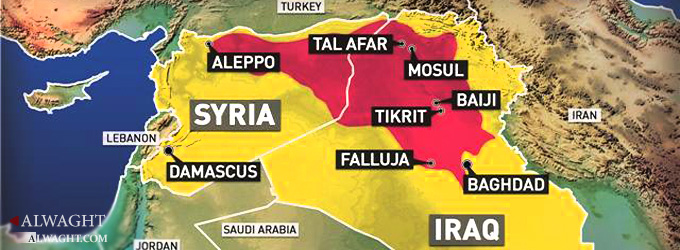


Alwaght- Having multiple political, intellectual, ideological, social, strategic and security dimensions, ISIS terrorist group is one of the most complicated phenomena growing in Iran’s surroundings in the recent years. Presently, the group is active in Iraq and Syria as its major areas of influence and control, as Libya is the third most significant place where ISIS holds sway. ISIS considers the territories held by it in Iraq and Syria as the unanimous realm under the rule of the so-called Islamic State. However, there are some similarities and differences in the forms of ISIS in both Iraq and Syria which are specially worth considering.
A couple of elements could be pointed to as indicating ISIS’ similarity and commonalty of performance in Syria and Iraq, the most significant of them include:
- Considering the ISIS-held areas in Syria and Iraq as a unanimous sovereignty under the title of Islamic State.
- Calling the entire Muslims to move to all of areas under its control as center of caliphate in order to fight against the enemies.
- Adopting such common scenarios and strategies as suicidal attacks in both Syria and Iraq.
- Using a mix of native and foreign forces to carry out its military operations.
- Building a united military and political administration both in Iraq and Syria.
- Presenting a common concept of enemy and maximizing the spectrum of its adversaries in both countries to include the countries’ national governments, the rival military groups and the foreign players.
- Introducing and adopting similar religious rules in both Syria and Iraq.
Regarding the differences of ISIS in Iraq and Syria, a couple of elements could be referred to, which compared to similarities, they are less in number.
- Considering Iraq as the land of birth of ISIS group and taking Syria as the place where the group strengthened its power.
- ISIS’ countering of government and international forces covers a wide range in Iraq while in Syria the terror group is facing a wider spectrum which includes the government and other armed groups.
- The ISIS’ stronghold (or capital as they call it) has been located in Syria which means freer performance and movement for the group in comparison to Iraq.
- ISIS takes advantage of a cohesive range of forces including the former Iraqi Baathists, Sunnis and a portion of foreign forces in Iraq while the group relies in Syria on a more diversified spectrum of fighters.
Generally, it must be noted that despite differences and similitudes of ISIS’ role both in Syria and Iraq, the terror group emerged and grew strong in the two countries due to existence of common grounds. The group has ahead of it in Syria and Iraq a favorable political and social milieu backing its presence. Also, it acts under the shadow of week national governments which are under strategic offensives by the regional and global powers, as it exploits adequately the disaccords and the rivalry between the regional and international players in the two countries. Additionally, Iraq and Syria as, according to its fans, ISIS’ stronghold and the center of the so-called Islamic State are working as magnets attracting foreign fighters.
Thereby, due to the multiple aspects and wide-ranging intricacies the future of ISIS in Syria and Iraq remains complicated and to a large extent ambiguous, as it is subject to impacts of different variables, all of which should be taken into account by the experts and the decision-makers.