














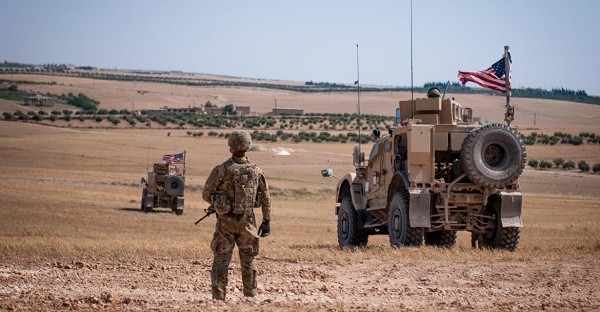


Alwaght- Two months after the debate inside the US between the supporters and opponents of Trump plan to withdraw the American forces from Syria, yesterday, the Reuters news agency cited a senior American official as saying that Washington intends to keep 400 troops in two Syrian regions, one in the north and the other in Al-Tanf town west of the country. Earlier, the White House had announced that the exit plan will go ahead but 200 “peacekeeping” troops will remain stationed in the war-ravaged country.
Although Trump has said that the White House agreement to keep partial forces does not mean a reversal of the December 2018 announcement about the Syria pullout, a set of reasons have pragmatically driven the president to move back from his plan. What are they? Here are some of them.
Israeli fear of new Syrian conditions
For a long time, one of the key determining factors shaping the US policy in the West Asia region has been the consideration of the Israeli interests and security as a strategic ally to Washington. Some analysts read the Trump move a new approach adopted by the White House towards Syria. They suggested that by this decision Trump sought to scale down the tensions in the Israeli security environment by seeking to crack the expanding relations between Moscow and Tehran, both allies of the Syrian government. Even if we accept this theory, the Sochi peace initiative and the increasing scale of the Russia-Iran cooperation in various regional and interactions cases indicate a full defeat of this White House plan.
At the present time, Tel Aviv finds itself the losing side of the new regional situation, mainly because Damascus remained part of the Iran-led Axis of Resistance and Iraq and Lebanon weathered the terrorism dangers and saw the rise of pro-Iranian parties to power. This is what makes the Israeli blood run cold. The Israeli leaders are deeply concerned that the US exit from Syria will destroy the last chance of damaging the Tehran-Baghdad-Damascus security axis, and corridor. Now Washington wants to keep an eye on the axis’s activities and contacts by keeping some 200 troops in Al-Tanf military base near the Iraqi border and perhaps by getting help from the Washington-led coalition troops already serving in the area.
Syrian Kurds’ threat to make a strategic shift
When Trump sent a signal of imminent, and then reviewed it to gradual, exit from Syria to the Turkish President Recept Tayyip Erdogan, the Syrian Kurds, acting as key US allies on the ground and even dubbed the “US infantry” in the crisis, for the fear of further Turkish military action in their areas considered a shift to Russia and the Syrian government to pressure the White House. Continuing their pressures, they allowed in later December the Syrian Arab Army into Manbij, a key city under their control, for the first time since 2011. On February 14, they released a statement declaring their readiness to talk to the central government and Turkey on a proposed safe zone in the north under the UN supervision. The US, responding to their openness to dialogue with Damascus and Ankara, threatened to cut all of the military aids to the People’s Protection Units (YPG).
Washington is apparently the losing party in the Syrian equations in the face of Moscow-Tehran-Damascus alliance, but it needs the northern regions as bargaining chips in the future. Last week, the Russian Foreign Minister Sergei Lavrov said the US still seeks to form a “puppet quasi-state” in Syria’s north behind a safe zone. But with the Turkish threats of the anti-Kurdish campaign and the conflict of the Washington-Ankara mindsets on Syria, such a plan is hardly implementable. So, the program to keep 400 troops and invite the European allies to send forces to the north is a corollary of the clash of the views of the US-Turkey leaders on a buffer zone. As the Turkish Defense Minister General Hulusi Akar is in Washington to discuss the Syrian case with the Americans, President Erdogan, commenting on the status of the proposed zone, reiterated yesterday that the safe zone “must be controlled by Turkey.”
Alternative plans fail
From another aspect, the failure of the plans that were scheduled to replace the military presence in Syria can be another drive for Washington to reverse the exit program. Shortly after his controversial Syria statement, Trump in a surprise visit met with his troops stationed in Ain Al-Assad military based in Iraq and said part of the troops removed from Syria will be deployed to Iraq. The remarks drew strong reactions from Iraq’s military and political leaders, something made the plan almost dead. Then Ahmed Jarba, the former head of the Syrian opposition, during a trip to Iraq proposed dispatching Arab and Kurdish forces, excluding the YPG, to the Kurdish-controlled northern regions. The suggestion had the backing of Washington, said the media. But it fell flat with Turkey’s objection.
Anti-Russian circles’ pressure
And finally, the special counsel of investigation of the alleged Trump’s links to Russia Robert Mueller, who is the face of the hysteric reactions of Trump opponents in the case of the allegations about the president’s closeness to his Russian counterpart Vladimir Putin, has done efforts against Trump that should not be disregarded in this shift. After Trump revealed his new Syria policy, not only the critics but also some of his friends and advocates of his rightist policies, such as Senator Lindsey Graham of South Carolina, deemed the pullout decision playing into the hands of Russia and will allow Moscow and Tehran, both staunch backers of the Syrian President Bashar al-Assad, to even further entrench in Syria and turn the tide in favor of the Syrian leader. In such a situation Trump needs to take steps meant to eliminate the grounds of suspicion of him being a Russian interests materializer.










