









Alwaght- On August 20, Syrian Foreign Minister Assad al-Shaibani visited Pakistan, the first of a senior Syrian diplomat in 19 years.
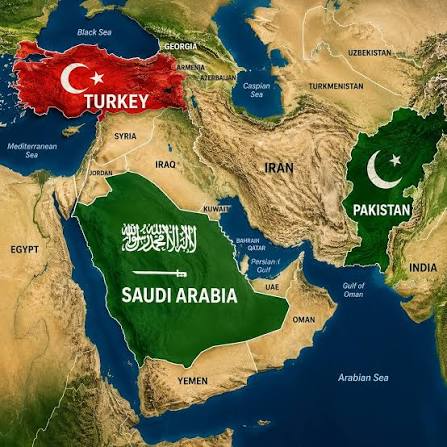
During his stay in Islamabad, he met with top Pakistani officials, including Prime Minister Shahbaz Sharif, with the two sides agreeing on boosting diplomatic, trade, and security ties. However, perhaps the key point of this visit was al-Shaibani's remarks regarding mulling Damascus’s joining the defense pact, officially known Mecca Pact and signed between Pakistan, Saudi Arabia, and Turkey on August 7, though he added a final decision is yet to be made.
Mecca Pact is a joint defense agreement whose some of articles bear resemblance to NATO's, like Article 5 which says attack on one member is an attack on others. For many, the agreement bore the fact that the US influence in the region is eroding and the regional states are rushing to establish a newer and more independent security order.
It is noteworthy that the Mecca Pact should first and foremost be seen as an effort to forge a security and defense framework among its member states, an agreement that, in the event of armed aggression against any member, invokes the principle of mutual support, with the aim of boosting deterrence, military coordination, and reducing members' security dependence on powers outside the region. Turkey, Saudi Arabia, and Pakistan form the core of this mechanism, and its significance lies in the fact that, unlike traditional regional alliances, it is taking shape outside the direct framework of American leadership. That said, this pact should not be equated with a Middle Eastern NATO. Because scope and form of members' response to an attack on any one of them remain unclear, and its defense commitment does not necessarily mean automatic entry by all members into war.
Within such a framework, examining the possibility of Syria's accession takes on added significance. The prospect of Syria joining the Mecca agreement raises questions about the implications of its potential membership. Joining this emerging security pact could bring strategic benefits both to Damascus and to its current members, while also introducing political and security complexities that could put the agreement's credibility to the test.
For Saudi Arabia, it could prioritize its regional leadership. The signing of the agreement in the holy city of Mecca underscores Riyadh's central role in the pact from the outset. Its expansion could therefore further entrench Riyadh's position as the political and strategic hub of the alliance. For Turkey, Damascus's most important military partner, such membership would mean strengthening its own front against the challenges posed to Ankara by the Israeli regime in Syria. Under its 2025 defense agreement, Turkey provides military training, technical assistance, and weapons to Syria. And for Pakistan, Syria's accession could bolster its strategic presence and growing influence in West Asia.
In general, Syrian accession could grant a key strategic privilege to the current members, which is geography. Actually, Syria can link this pact to the Israeli borders and the heart of Levant equations.
In return, the Mecca Pact could offer Damascus a regional bulwark during its reconstruction era. Saudi Arabia brings its geopolitical weight and capital to the agreement, Turkey contributes its advanced military capabilities, and Pakistan lends its formidable military and nuclear power.
Yet, if Damascus joins this pact, the arrangement shifts from a defense cooperation among three states into a mechanism with a member sitting directly in one of the region's principal conflict zones.
Syria, unlike Saudi Arabia and Pakistan, lies in the immediate vicinity of the usurping Zionist regime, and it weighs this option while simultaneously confronting attacks by the occupying regime, rebuilding its military and security structures, and managing Turkey's expanding presence on its soil.
Should Syria join the agreement, the Israeli regime would pose the foremost challenge. Recent strikes on Abu al-Duhur airbase are the latest sign of Tel Aviv's willingness to use military force to push Syria back from security cooperation measures Damascus deems in its own interest. Beyond Israel's overt concerns over Turkey's actions in Syria, the Israelis have voiced anxiety about Pakistan's growing regional influence and the Mecca Pact itself.
Therefore, Syria's motivation for such a move, should be sought above all in its quest for deterrence. After years of war and political upheaval, the Syrian army is still in no position to single-handedly create an effective balance against the Israeli occupation force. Membership in the Mecca Pact could partially offset this weakness by establishing defense, intelligence, training, and logistical ties with more powerful members. Among them, Turkey, given its proximity to Syria and its extensive role in the country's developments, would be Damascus's most important partner.
This is where the tension between Turkey and the Zionist regime comes into play. Their dispute is no longer confined to the Palestinian question; Syria has become one of the primary arenas of their competing interests. Israel is sensitive to the deployment and expansion of Turkish military power in Syria, while Ankara views Zionist attacks on Syrian territory and Tel Aviv's efforts to impose security constraints there as a threat to its own interests.
In such conditions, Syrian accession to the pact can elevate the competition between Turkey and Israeli regime from a bilateral dispute to a multiparty security equation.
Additionally, for Ankara, Damascus entry to the agreement will mean that Syria's southern depth will be covered by a broader defense mechanism. For Syria, it will mean enjoying a support between the extent offered by bilateral ties with Ankara. Saudi Arabia and Pakistan in this equation do not necessarily enter war with the Israeli regime, but they can back Syria through military, political, intelligence, and economic cooperation. Also a network of support can complicate the Israeli calculations about the costs of intensifying pressure on Damascus.
It must also be remembered that Syria's membership carries a significant risk. If Tel Aviv reads the Mecca Pact as a vehicle for entrenching Turkish influence in Syria, it may grow more sensitive to any strengthening of Damascus's military capabilities. In that case, Syria, rather than simply using the pact to bolster its own security, could become the site of a more direct collision between Turkish interests and those of the Israeli regime. The same agreement that serves as a deterrent for Damascus could, if the resulting security pressure is mishandled, intensify the strain on the country.
It is also noteworthy to suggest that the Syria question will also be a serious test for the Mecca Pact itself. As long as its members have not faced a direct threat to their own territory, the true extent of their defense commitment remains untested in practice. But if Syria joins and is then targeted in a large-scale attack, how Turkey, Saudi Arabia, and Pakistan respond will determine just how much the Mecca Pact is an operational alliance and how much it is a political framework for security coordination.
Damascus, meanwhile, must strike a balance between two divergent paths. On one hand, drawing closer to the Mecca Pact can sharpen Syria's deterrence and its bargaining power; on the other, Damascus is still pursuing de-escalation and security arrangements with Israeli regime. A hasty leap into a defense pact could therefore narrow its room for negotiations with Tel Aviv. A more possible strategy for Syria may be to keep the membership option alive and wield it as political leverage, without necessarily placing itself in the position of an active member of a military front against Tel Aviv.
For this reason, the prospect of Syria's accession must be understood as part of a larger contest over the future of the region's security order. If Damascus can balance among Turkey, the Arab states, Pakistan, and the US, the Mecca Pact could become a tool for advancing Syria's strategic independence. But if it becomes one of the front lines in the rivalry between Turkey and the Israeli regime, that same pact could drag the country into a new phase of regional security competition.
All in all, the Syrian possible membership of the Mecca Pact has both opportunities and risks. For Damascus and the current members of this pact the question is not whether joining this agreement yields strategic benefit, it is whether these benefits outweigh the subsequent security and potential complications.