





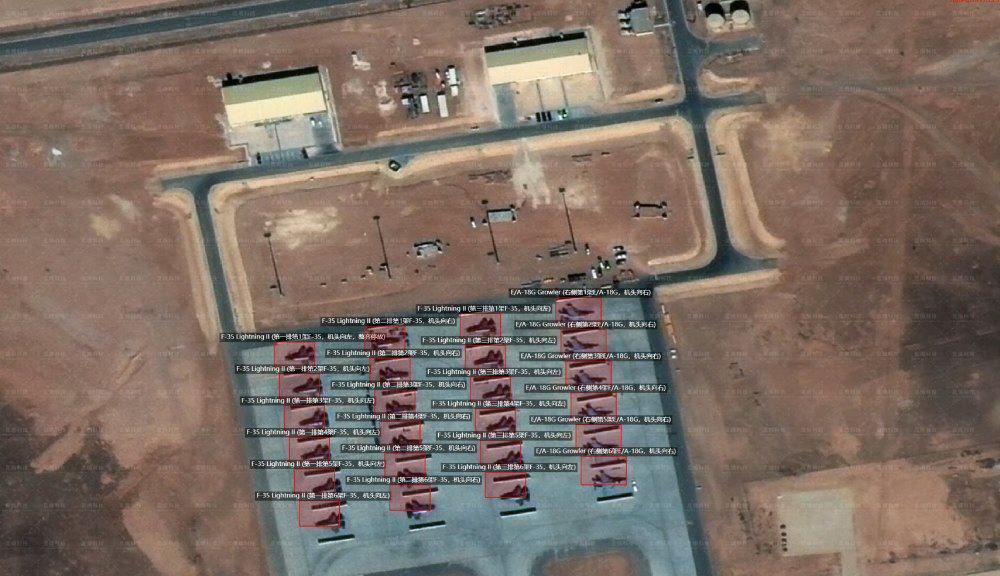


Alwaght- In recent days, reports suggested a change in the formation of the American forces at their key West Asia military bases.
Relocation of the forces from key bases
As the clock ticks down on Trump’s 48-hour deadline for talks, the movement of American forces across the region has come under the microscope of political and military analysts, who are parsing every deployment for clues about what happens next. Amid the scrutiny, a flood of conflicting reports is circulating.
Earlier this week, The New York Times sparked the narrative, citing Pentagon officials in a claim that hundreds of US troops had been relocated from Al Udeid Air Base in Qatar in recent days. The base is one of the core American assets in the region. Iran struck the base in response to American bombing of its nuclear sites in June.
According to the report, similar efforts were underway to shift personnel at other American installations, including a base in Bahrain that hosts the US Naval Forces Central Command (NAVCENT) and the Fifth Fleet. The assessment suggested that no American troops remain stationed in Iraq, Syria, Kuwait, Saudi Arabia, Jordan, or the UAE.
However, shortly after the Times report was published, Fox News pushed back, quoting an unnamed but reliable US official who flatly dismissed the claims as inaccurate.
US military equipment amassment
Amid the floods of contradictory reports, open source data and satellite imagery suggest massive and multilayer strengthening of the operational equipment and infrastructure in the region.
According to intelligence reports watching the flights, over the past week, over 100 military transport planes belonging to the US flew into its bases in Europe and West Asia.
The Military Aviation Watch, a collective of around 30 open-source analysts, has reported tracking over 85 tanker aircraft and more than 170 cargo planes heading toward the region since mid-February.
In a separate development, speculation from Forces News suggests that at least 200 heavy transport aircraft, including C-17s and C-5 Galaxy planes typically used for rapid deployment of troops, defense systems, precision-guided munitions, and heavy equipment, have arrived in the region.
Satellite imagery from Planet Labs PBC, analyzed by the AP, reveals more than 50 aircraft stationed at Jordan's Muwaffaq Salti Air Base. This aerial buildup positions Jordan as a critical hub supporting air operations in the eastern Mediterranean and Iraq.
850 miles southeast of this base, there is the Prince Sultan Airbase in Saudi Arabia that has witnessed tangible movement of the American military assets. High-defenition images of China's MizarVision report deployment of heavy aircraft, including 13 KC-Stratotanker 135 tankers, one early earning aircraft E-3G Sentry, and five C-130 Hercules transport aircraft that are deployed for supporting regional operations.
A new CNN report sheds further light on the build-up at the base, with images revealing the deployment of at least four additional E-3 Sentry aircraft. These surveillance planes play a critical role in providing early warning against missile and drone threats, as well as coordinating complex air operations. In addition, four E-11 communication aircraft, often described as "battlefield airborne communications nodes", have also been spotted in the area. The convergence of AWACS, refueling tankers, and communication aircraft points to the establishment of an integrated command-and-control umbrella, likely designed to manage large-scale operations.
This posture transforms Prince Sultan Air Base into both a key logistics hub and a critical node in any direct confrontation scenario, a facility capable of supporting defensive missions like air defense and early warning, as well as long-range offensive operations.
However, Defence Security Asia website warns that the aging E-3 fleet is grappling with operational readiness challenges and delays in replacement programs. If maintenance constraints or parts shortages reduce the availability of these platforms, sustained coordination of air sorties and radar coverage could be disrupted, an issue that, in a high-intensity conflict scenario, could become a significant operational risk.
A similar buildup is unfolding at Al Udeid. Satellite imagery from early February shows the number of KC-135 tankers jumped from five to 14 between mid and late January. That surge points to a bolstered aerial refueling capacity, enabling sustained, long-duration sorties across the region, a critical capability for striking distant targets or countering successive waves of missile and drone attacks.
US naval equipment
In the naval area, the military force boosting is ongoing. USS Abraham Lincoln aircraft carrier since early February entered the Arabian Sea after shifting route from Southern China Sea. It carries around 60 F-35 and F/A-18 jets. It is accompanied by three guided missile destroyers.
This task force, bolstered by the arrival of approximately 5,700 military personnel, has reinforced the existing presence of five Arleigh Burke-class destroyers in the Persian Gulf, the northern Red Sea, and the eastern Mediterranean. The result is a networked grid of naval missile defense systems and ballistic missile tracking capabilities encircling the region.
Two weeks later, on a direct order from Trump, USS Gerald R. Ford aircraft carrier, the world’s biggest one, was deployed to West Asia along with three other destroyers with over 5,000 personnel on board.
Collectively, 16 naval ships have been deployed to the region.
From closing Strait of Hormuz to attacking American bases: Assessment of a merciless Iranian response
As the US bolsters its military footprint in the region to an unprecedented level, the key question now is how Tehran might respond if an attack were to occur, and how far that retaliation could reach.
In recent days, Iranian officials have issued stark warnings against American miscalculation. Foreign Minister Abbas Araghchi told MSNBC that Iran is prepared for both war and peace. Earlier, on Thursday, Amir Saeid Iravani, Iran’s ambassador to the United Nations, sent a letter to the UN Security Council stating: "Under such circumstances, all bases, facilities, and assets of the hostile force in the region are considered legitimate targets within the framework of Iran's defensive response."
Western analysts acknowledge both Iran's stated resolve and its military capabilities to strike back. Michael O’Hanlon, a defense and foreign policy expert at the Brookings Institution, noted: "In response to nearly anything we might do, Iran could continue firing drones and cruise missiles at Israeli and American bases."
Ali Vaez, an Iran specialist at the International Crisis Group, suggested Tehran’s response might not be as restrained as in the past. He pointed to a previous incident in which Iran allegedly warned ahead of a retaliatory strike on Al Udeid Air Base in Qatar, allowing US and Qatari air defenses to prepare and thereby minimize damage.
"It is unlikely Iran will limit its response as it did after the US attack on its nuclear facility in June," Vaez said.
According to a Congressional Research Service report, Iran possesses some of the most powerful short- and medium-range ballistic missiles in the region. A March 2025 report from the US Defense Intelligence Agency added that Iran maintains the largest stockpile of missiles and drone systems in the region. The same report warns that Tehran also operates long-range offensive systems, including cruise missiles and anti-ship missiles, capable of threatening US assets and maritime transport.
The Strait of Hormuz, through which approximately 20 percent of world oil shipments flow, is a pressure point and any tensions in it can immediately bring consequences to the world economy and impact the oil-reliant economies.
Additionally, Tehran will see any permit to the US by other countries to use their soil and military bases as a complicity giving it the legitimacy to strike the sources of attacks and threat.