














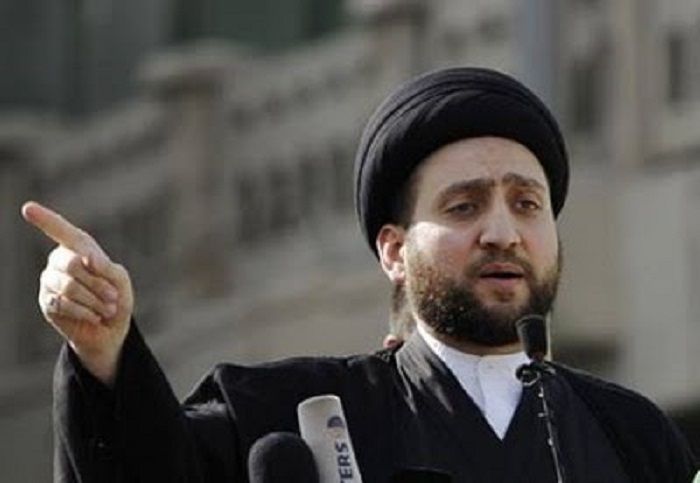


Alwaght- Sayyed Ammar al-Hakim, one of the leaders of the Shiite National Iraqi Alliance, believes that the best way for settlement of Iraq's problems is to move to formation of a coalition that would cover all of the ethnic and sectarian groups in the country.
In addition to al-Hakim, Nouri al-Maliki, another leader of the Shiite coalition and chief of State of Law Coalition, has proposed a similar idea and is striving after founding a new alliance that would not include only Shiite political forces, rather, it includes other parts of Iraqi political body. Mohammed al-Sayhoud, a member of parliament from State of Law Coalition and a close figure to al-Maliki has said that the recent al-Maliki's visit to Sulaymaniyah in Kurdistan region aimed at building a new alliance. He added that the alliance would be unveiled in the future.
The former prime minister of Iraq is seeking establishment of a majority alliance to go beyond sectarianism. The features of the aimed alliances are expected to be as follows:
- Commitment to national-level political activity
- Insisting on justice and citizens’ rights
- Protecting the country against foreign interventions
Current status of Shiite coalition and Iraq's political conditions
The Shiite National Iraqi Alliance accounts for the majority in the present Iraqi parliament. It managed to hold for itself the post of the prime minister. It includes some main and minor Shiite movements of Iraq. It is still active and the meetings of leaders of its coalitions are regularly held. However, the alliance to a large degree has become divided, not holding unanimous and coordinated views in the country's political scene. Furthermore, it is not reacting to the country's political developments and publicizing no ideas on them.
This comes while inside the parliament the efforts are going on to reshuffle the government. Some other efforts are also focusing on changing the prime minister, the president, and the parliament speakers. At the same time, reforming the constitution is also on the agenda. The parliament has made a committee responsible for following the case. It is believed that as the committee continues working, serious conflict begin appearing between different ethnic, sectarian, and political groups, and so there is a very narrow chance of reaching an agreement on implementing any constitutional reforms.
Currently, all of sides of Iraqi political scene are raising slogans of fighting corruption and making reforms. However, they aren't ready to cooperate to achieve their objectives. Everybody who takes a post is immediately accused of corruption and so is demanded to leave office.
The Kurdish and Sunni sides are seeking realization of their extralegal goals, and are eyeing impairing the central government to achieve religious independence or federalism, or at least regional and provincial federalism. The conditions are so critical and the threats are so big that grand Ayatollah Sayyed Mohammed Taqi al-Modarresi, a Karbala-based Shiite cleric, has cautioned against possible "explosion of the conditions" as the country remains locked in accumulated economic problems and a political stalemate. He called on the political sides to learn lessons from the recent Turkish coup. The Shiite cleric also called for essential political reforms across the government institutions, as well as in the educational and disciplinal systems.
Nouri al-Maliki has said that the failure of political forces to show commitment to rules of political activity and political law has been the major factor behind the current security and public service crisis. He continued that no solutions are found unless there is alteration of views. According to him, putting an end to the present-time security crisis and starting moving towards a boom are not possible only by force, rather they need founding a coherent and pro-constitution political team.
In general, it must be noted that divisive forces in Iraq are strong and diversified. Many of analysts suggest that the general picture of the Iraqi conditions indicates that the country is moving towards partition, and thus further weakness. They argue that the Iraqis are not serious in keeping Kurdistan, the Sunnis are looking forward to form an autonomous region, and are at crossroads between choosing to side with ISIS terrorist group or a Shiite-led government, and the Kurdish region would not unite with Baghdad once again.
The fact is that, despite existence of a slew of problems, the uniting forces that inject fresh energy and union to Iraq are larger and stronger. Inside Iraq, the motive to protect sovereignty and provide security in the country is strong among people. The popular forces have augmented the hopes, and with frequent wins over ISIS strengthened morale of the security forces. The international support for unity, stability, and security of Iraq is also considerable.
On Shiite coalition, it must be said that in any elections, the makeup and structure of the political movements have undergone some changes, and the upcoming elections would also see rise of fresh alliances.










