



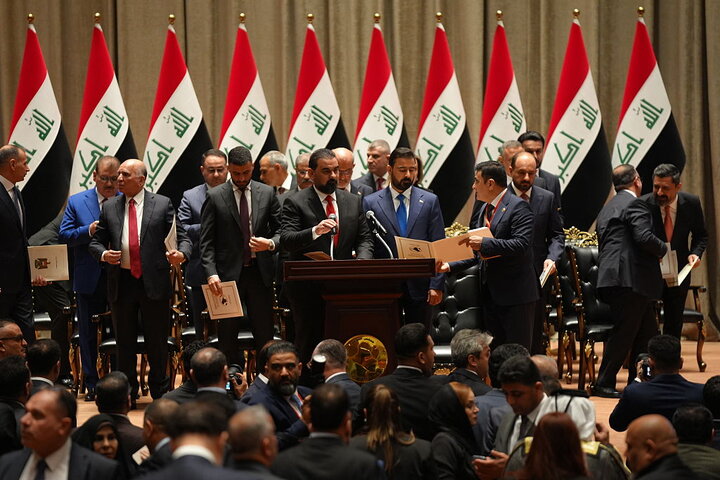


Alwaght- After nearly five months of debate among political parties, the Iraqi parliament finally approved remnants of the ministers of the government of Ali al-Zaidi on Thursday. The lawmakers granted confidence to 11 new ministers and created a number of new posts, as well as three deputy PMs.
The parliament had voted yes to 14 out of 23 cabinet ministers in May, but the differences among political factions have left the rest of the cabinet in uncertainty. Finally, parliamentarians paved the way for completion of the government by settling their differences.
Distribution of posts among political factions
According to the vote, Yasser al-Maliki, of State of Law coalition, was approved interior minister. Nayef al-Shamari, of National Coalition, was elected defense minister. Qatibeh Ghazi Majid, of Azm Coalition, was elected Minister of Planning, and Haydar Bahaa al-Husseini, of State of Law was approved as minister of Higher Education and Scientific Research.
Yasin Muhammad al-Aithawi, of the Azm Coalition, was tapped as culture minister, while Mohammad Raad al-Mousawi, of the Sadiqoun bloc, took the helm at the Ministry of Labor and Social Affairs. The Ministry of Youth and Sports went to Safaa Mahdi Salih al-Kanani, of the National Wisdom Movement.
In other posts, Ribaz Hamlan from the Kurdistan Democratic Party was named minister of construction, housing and municipalities. Mohammad Sahib al-Darraji, of the Services Coalition, was put in charge of the newly established Ministry of Digital Economy, Governance, Science and Technology. The Ministry of Tourism and Antiquities was handed to Ali al-Dakhili of the Muntasiroun bloc, and Mohammad Sam'an Kan'an Youssef, of the Turkmen Front, was appointed as a minister of state.
Political disputes over the candidates' names and how ministries were divvied up among the parties and factions taking part in Iraq's political process had been a key driver of the delay in completing the cabinet. With the latest vote and the naming of the remaining ministers, PM al-Zaidi's cabinet is now complete, and his government can get on with running the country and pursuing its agenda with a fuller lineup.
Dispute among political factions
Even with the cabinet complete, disagreements persisted among some political blocs over several key posts at the voting session itself.
Among Shia forces, competition between ex-PM Nouri al-Maliki's State of Law Coalition and the Sadiqoun bloc over the interior ministry and the deputy premiership complicated the path to agreement. State of Law had backed Qasim al-Atta, but after objections from some factions, Yasser al-Maliki was ultimately put forward as the final nominee.
Disputes over the nominees for the defense and planning ministries also played out among Sunni parties, though backroom bargaining eventually produced agreements on the candidates.
One of the most visible points of contention in the confidence vote was the opposition of a number of lawmakers to the creation of new deputy premierships and new ministries. Opponents argued the posts were doled out on the basis of party quotas and could not be justified at a time when cutting public spending is a priority, but with most lawmakers on board, parliament ultimately approved the new positions.
The vote on the construction , housing and migration ministries, however, stalled over differences between the Kurdistan Democratic Party and Christian lawmakers. As a result, al-Zaidi's government is still waiting on a political agreement over the two ministries in the coming days.
Significance of fate of key ministries
The importance of these competitions lies in the broad powers of the key ministries. Defense ministry is one of them, with key position in determining the management of the armed forces and the security policies of the country, especially at a time the government of al-Zaidi is stressing on restriction of arms to the official security institutions. Carrying out this policy looms as a major challenge for the government, given the presence of armed groups that wield political and parliamentary influence. The defense ministry, then, is not tasked with military cases alone, but it also plays a decisive role in the domestic balance of power, in entrenching the state's authority and in shaping Iraq's security relationship with Washington.
The interior ministry is likewise one of the most important centers of executive power in the state, an institution that, through command of the police, the provision of internal security and oversight of provincial law-enforcement structures, helps carry out government policy and manage developments on the ground. The ministry's weight grows heavier on the eve of elections, since how security is managed and how law-enforcement forces deal with political competition can shape the electoral process and the space in which parties operate. That is why naming an interior minister has always been part of the high-stakes bargaining among Iraq's political forces.
The economy ministry, for its part, plays a decisive role in the state's direction, setting development programs, ranking construction projects by priority and drawing in investment. Decisions on allocating resources and on how to advance economic plans bear directly on the government's ability to answer public demands. Alongside those duties, the creation of a Ministry of Digital Economy, Governance, Science and Technology can be read as a sign of al-Zaidi's push to modernize the administrative system, expand digital services and put technology to work in running the country, a goal whose realization depends on institutional coordination and the practical implementation of reforms.
Top position of resistance in the cabinet
Completion of the cabinet of al-Zaidi shows that a major part of the new ministries are held by figures close to the resistance groups and aligned forces. As the composition of the cabinet shows, the Reconstruction and Development Coalition with three ministries is on the top. Progress Party, State of Law Coalition, Azm Coalition, Badr Organization, National Wisdom Movement, and Kurdistan Democratic Party each hold two ministries.
Services Coalition, Sadiqoun bloc, National Coalition, Patriot Union of Kurdistan, New Generation Movement, National Accord Party, Justice and Unity Party, Sovereignty Coalition, Montaseroun Coalition, and Turkmen Front each hold a ministry.
Message of al-Khazali's brother beconing deputy PM
The elevation of Laith al-Khazali, brother of Qais al-Khazali as leader of the Asa'ib Ahl al-Haq movement, to the post of Iraqi deputy PM ranks among the most consequential political outcomes of the cabinet's completion, given that al-Khazali appears on US sanctions lists and his appointment drew sharp criticism from a US congressman.
From the viewpoint of factions close to the resistance, al-Khazali's appointment as deputy premier can be read as a sign that these groups' political influence within the state's executive structure endures, and that domestic institutions can hold their ground against outside pressure. The significance of the appointment goes beyond the mere presence of a figure close to resistance groups in a top government post: it shows that Washington's opposition, at least in this case, could not block a decision by Iraq's parliament. Before the vote, sources close to the Sadiqoun Coalition said al-Zaidi had sought to soften American objections to al-Khazali's nomination.
The appointment could also strengthen the hand of the Sadiqoun bloc and its allies in government decision-making and shape how the government handles the armed-groups case. Al-Khazali's presence could, on the one hand, open the way for greater dialogue and participation by resistance factions in the official state structure, while at the same time the shift could help narrow disputes over how armed groups should be organized and how their relations with official state institutions should be arranged.