


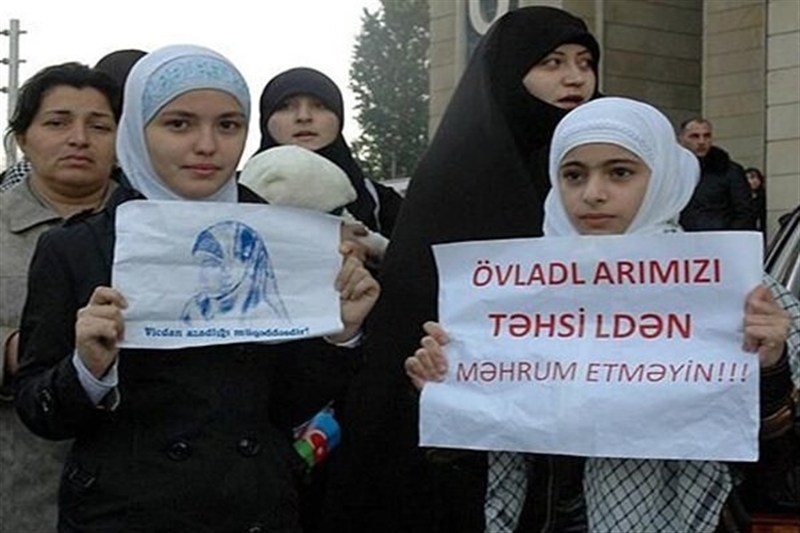


Alwaght- Students in Azerbaijan headed to their classrooms last week to shocking news. The government announced a ban on girls entering schools wearing the Islamic headscarf.
Images of schoolgirls left stranded behind closed doors, along with protests from their families, reverberated not only across social media and domestic outlets but internationally as well, because this ban was unfolding not in a Western, non-Muslim country, but in a nation with an overwhelmingly Muslim majority.
It began last month when the government approved rules barring school students from wearing clothing that differs from the official school uniform or is incompatible with the secular nature of public education.
Although the regulations made no explicit mention of the headscarf, their anti-religious thrust was laid bare this week after reports emerged that some hijab-wearing students and teachers had been barred from entering schools, sparking protests among students, their parents, and religious segments of society.
This controversy has thrown into sharp relief a glaring contradiction and it is that Azerbaijan is a majority-Muslim country with a largely Shiite population, yet its authoritarian government keeps a tight grip on Islamic life and aggressively promotes secularism.
The country has repeatedly seen clashes over the hijab in public schools, especially since uniform-related restrictions around 2010 triggered demonstrations.
This time, too, the government has sought to calm public opinion by denying the anti-religious character of its policies. Zahid Oruj, head of the Azerbaijani parliament's human rights committee, said the measure is not an attack on religious freedom or freedom of expression.
"There is no ban on wearing a headscarf outside school, and the main goal is to maintain uniform rules in the educational environment," he told Al Jazeera.
But for many devout Muslims, hijab restrictions violate their fundamental religious freedoms. For Muslim women, the headscarf is not merely a cultural tradition. Under prevailing Islamic jurisprudence, covering the hair is a religious obligation for Muslim women who have reached puberty. It signifies obedience to God, modesty, dignity, and religious identity. Authorities, meanwhile, justify the new regulations under the principle of secular education and school uniform rules, not their anti-religious nature.
The latest controversy over the hijab in Azerbaijani schools thus once again exposes the deep rift between the country's Muslim identity and its secular political system, a rift fueled both by the legacy of communist rule and by the Western-leaning authoritarian regime's drive to fully Westernize society and to find pretexts for suppressing its largely Islamist domestic opposition.
The collapse of the Soviet Union in 1991 brought fresh opportunities for religious expression. Mosques reopened, Islamic education was revived, and Azerbaijanis began rediscovering religious traditions that had been suppressed for decades.
Religious influences flowed in from Iran, Turkey, and other Muslim countries, while some young Azerbaijanis traveled abroad to study religious sciences.
Yet, the country's new rulers were determined to preserve the secular political system inherited from the Soviet era. Under Heydar Aliyev, who became president in 1993, and his son Ilham Aliyev, who succeeded him in 2003, the state consolidated its sweeping control over religious institutions.
Azerbaijan's constitution formally guarantees freedom of religion. In practice, however, the faithful face stringent requirements in observing their Islamic rites and beliefs, and Islamic parties and activists in particular encounter severe restrictions on political and social activity.
Under current laws, all religious organizations must register with the state to operate legally. Registration requirements include detailed information on members, activities, funding sources, and more. Proselytizing is banned, and the publication of religious texts is subject to state approval. Groups deemed "non-traditional" by the government, especially Islamic movements and Shiites, face harassment, fines, and obstacles to legal registration.
One contentious episode came in 2015, when police carried out a violent operation against members of the Shiite Muslim Unity Movement in Nardaran, leaving several killed and wounded and many arrested.
The government frames its repressive policies as a fight against extremism, a guard against foreign interference, and a defense of national security. But critics argue that secularism has become a pretext for suppressing independent religious activity and political dissent in society. Even local human rights groups and detainees say the government has used drug charges as a pretext to arrest and imprison religious activists, particularly Shiites.
Anti-religous secularism gaining traction with geopolitical developments
The authoritarianism of Azerbaijan's political system dates back to the country's earliest years of independence, when presidential term limits were abolished and each term extended from five to seven years, and international observers have consistently questioned the freedom of elections there. But the government's repressive policies against Islamic movements, particularly Shiite ones, have intensified in recent years, with experts pointing to the role of geopolitical shifts and Baku's approach to regional alliances.
Polls show that religiosity is growing in Azerbaijani society despite state policies. In one of the few surveys conducted under government restrictions, the nonprofit Caucasus Research Resource Center reported in 2013 that its estimates showed a steady rise in the number of people in Azerbaijan who consider religion a very important part of daily life, from 28 percent in 2001 to 33 percent in 2012. Another 44 percent said they now regarded religion as a "fairly important" part of their daily lives.
Given that more than 70 percent of Azerbaijani society is Twelver Shiite, the enemies of the Axis of Resistance are surely deeply worried by the growth of religious sentiment in Azerbaijani society, which could bring it closer to the Islamic Republic. And so, in parallel with this shift in society, evidence points to escalating repression against religious institutions, especially Shiite ones. The Union of Nongovernmental Organizations for the Freedom of Political Prisoners in Azerbaijan reported that by the end of 2025, 183 people had been imprisoned for performing religious rites or for religious opposition to the government, compared with 22 at the end of 2022.
Alongside the West, the Zionist regime has in recent years been one of the most important actors laying grand plans to expand its presence and influence in Azerbaijan across economic, energy, intelligence, military, and cultural spheres. The peak of this cooperation came at two junctures: the 2020 war between Baku and Yerevan, and Baku's oil exports to Tel Aviv during the 2023–2026 Gaza war. Still, many of the tensions Baku has been embroiled in over these years appear to stem from Israeli interventions. Among the most important consequences of Israeli infiltration in Azerbaijan is the promotion of Western culture and of anti-Islamic and secular thinking, because the more society moves toward religiosity, the more public opinion criticizes and opposes the government's policies of closeness to the child-killing regime.
In general, the rise in religious sentiment shows that restrictive policies do not necessarily weaken religious belief. The key question now is how far Baku can push manifest expressions of faith out of the public sphere in the name of secularism without deepening the rift between state and society, a rift that this time has burst open from behind the closed doors of schools.