














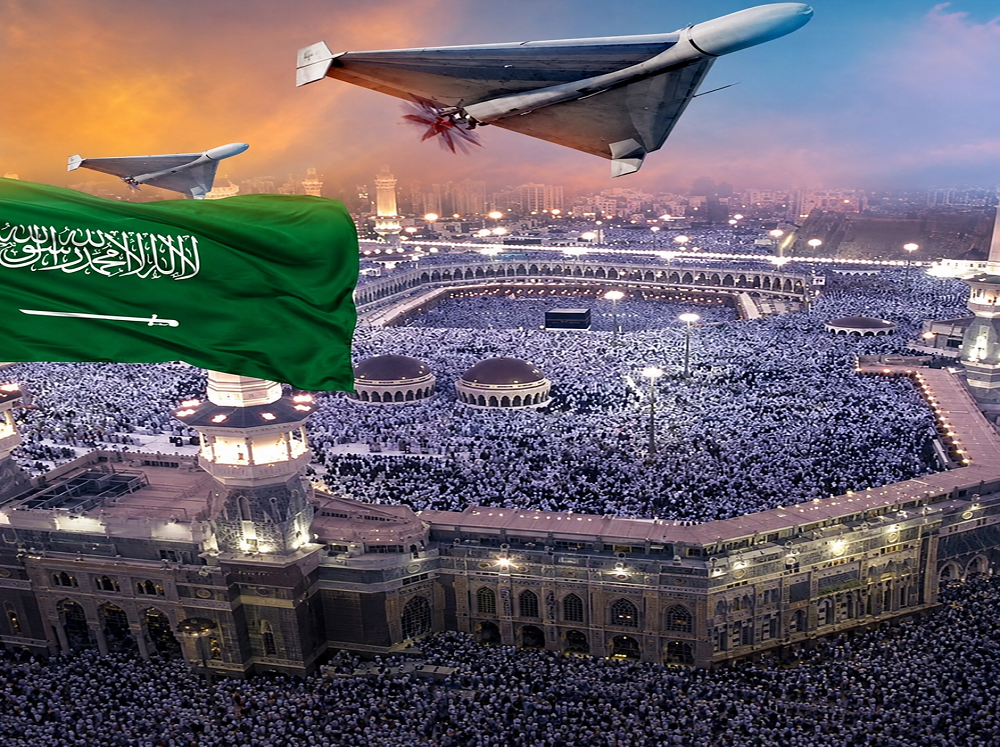


Alwaght- Recent drone incident in south of the holy city of Mecca soon spiralled into a political and trans-regional case from a security issue regardless of the origin of the attack, its target, and the precise nature of the flight. Saudi Arabia rushed to claim the country's air defense downed a Yemeni drone before it could penetrate the Mecca airspace. Yemen's Ansarullah movement strongly rejected the Saudi allegation of its link to the drone.
Ansarullah's Political Office member Hizam al-Assad said that "the claims about attacking Mecca is a repeated lie already made and nobody will be deceived anymore."
Meanwhile, the religious importance of Mecca triggered fast circulation of the incident, drawing attention to it beyond a usual military attack.
The false-flag operations that have been ordinary in Ukraine and West Asia conflicts have become a tactic to advance political and propaganda agenda of various sides in recent years.
Here is where the main issue forms: If we place this incident within the broader arc of the war and the region's political shifts, who stands to gain from turning it into a wider sectarian and media firestorm? Answering that question does not necessarily mean identifying who carried out the attack; it means examining the conditions under which it unfolded.
War in a point where the balance is shifting
The first background is the field course of Yemen war. In recent weeks, Ansarullah has made major gains in the western coastal regions of Yemen, gaining control of the strategic city of Mokha, Bab-el-Mandeb, and some significant islands. The importance of these developments is not limited to the Yemeni internal geography and have to do directly with one of the world's most important waterways. Reuters, too, has described the Ansarullah's advances on Red Sea coast and liberation of Mokha the key developments of the new phase of war.
Under such conditions, the war's equation is no longer defined solely by front lines on the ground. Bab-el-Mandeb, the Red Sea ports, and Saudi Arabia's energy export routes have become part of the pressure campaign. This matters all the more now that disruption in the Strait of Hormuz has squeezed Saudi oil exports as well, leaving Riyadh more dependent than ever on Red Sea routes to keep its exports flowing.
International media have likewise spotlighted the link between Ansarullah's advance along Yemen's western coast and the threat to Saudi oil and shipping lanes at the port of Yanbu.
But these advances have not been confined to strategic areas. In recent days, Ansarullah have laid siege to al-Jawf province on the Saudi border, leaving Riyadh far more anxious about further Houthi gains and a possible penetration into its own frontier.
Saudi airstrikes, meanwhile, have failed to turn the tide, and the kingdom's absolute air superiority is fading in the face of new capabilities Sana'a has put on display. On Wednesday, Ansarullah said to have shot down a Saudi F-15 fighter jet over Marib province.
Yemen's Al-Masirah network aired night-vision video showing a missile striking a fighter jet. Another image showed the wreckage of a downed Saudi aircraft, with the Saudi flag painted on its charred tail.
Ansarullah had already downed several drones and even an advanced US F/A-18 fighter jet during clashes with American forces in 2025.
Viewed through that lens, the key question is whether targeting Mecca could have delivered gains commensurate with the political and religious costs it would impose on Ansarullah. Plainly, no. On the battlefield, the Houthis have a range of tools at their disposal to pressure Saudi Arabia and reshape the military and economic equation, and in recent weeks they have stepped up attacks on Saudi infrastructure and ratcheted up pressure on energy export routes. To attribute a deliberate strategic target to the Mecca incident, then, is at odds with the military and strategic logic of the war.
Turning the incident into something bigger than the Yemen war, by contrast, could hand Riyadh a political opening, reframing the issue from a conflict with Ansarullah into a question of "the security of Islam's holiest sites." The spokesman for the Saudi-led coalition has seized on precisely that framing, calling the security of Mecca and its pilgrims a "red line."
Battle for the Muslim world's public opinion
The second axis is public opinion across the Muslim world. Mecca is not merely a city in Saudi geography; it is a shared religious symbol for millions of Muslims worldwide. Any security incident around it can therefore quickly transcend a political dispute and become an emotional and religious cause.
Here, too, there is a critical distinction between what actually happened and the narrative constructed around it. Saudi Arabia has sought to anchor its narrative on the claim that an attack by Ansarullah targeted Islam's holiest city. Ansarullah's leaders, for their part, have dismissed the accusation as propaganda lies, insisting that targeting Mecca was never on their agenda. Even Iran, while condemning any assault on holy sites, has stressed that merely claiming to have intercepted a drone headed toward Mecca is not enough to pin responsibility on a particular party.
This clash of narratives shows that a major part of the battle is now being fought in the realm of perception and legitimacy.
In recent years, Ansarullah has sought to cast itself as a defender of Palestine and an opponent of the war on Gaza — a stance that has resonated with broad swaths of Arab and Muslim public opinion, and even with non-Muslim audiences elsewhere. Saudi Arabia, by contrast, has drawn criticism over its security cooperation with the US and Israel against Palestinian interests, above all, Riyadh's and its Arab League allies' failure to act to stop Israel's atrocities against the people of Gaza.
The Saudis, then, have plainly lost the war of narratives on the soft-power front to Yemen, and in that sense the Mecca incident is a golden opportunity to recoup that loss and damage Ansarullah's image.
In its foreign ministry statement, Saudi Arabia even spoke of "repeated patterns of targeting holy sites and inflaming the feelings of Muslims everywhere."
In the statement, the kingdom calls on the international community to take a firm stance against Sanaa's attacks on holy sites, civilian and economic targets, and threats to freedom of navigation, tying the war to the defense of the security of the Two Holy Mosques and Hajj pilgrims.
This scenario matters in particular for shaping and laying groundwork within segments of Muslim public opinion, namely Pakistan and Egypt.
Pakistan and Egypt are the two military powers of the Muslim world with close military and security ties to Saudi Arabia, and public opinion in both countries is easily inflamed by events such as attacks on holy sites, given the strong influence of religious currents and the presence of major Sunni religious institutions like Al-Azhar and religious schools. Yet what is striking is that public opinion in both countries has never backed Saudi Arabia's warmongering in Yemen, the seven-year war, and their governments, despite a token presence in the 2015 coalition against Yemen, refrained from meaningful participation.
Now the Pakistani reaction to the Mecca incident is exactly what Riyadh wants. Pakistani Prime Minister Shehbaz Sharif, in a post on X, condemned what he called the cowardly attack, expressing his condemnation in the strongest possible terms of the criminal and heinous drone attack on the Masjid al-Haram in Mecca. Muhammad Taher Mahmood Ashrafi, head of the Pakistan Ulema Council, also said the security and stability of the Saudi kingdom is "our red line," stressing that we will not allow it to be crossed.
The sanctification of the incident thus has the potential to shift the debate from the military and political conduct of the parties to the defense of the sacred, a shift that could sway the positions of governments and public opinion in Islamic countries.
Mecca and regional coalition-making
The third axis has to do with the coalitions equation. In recent years, Saudi Arabia has sought to build a network of regional and extra-regional support, leaning on its ties with the US, its claim to leadership of the (Persian) Gulf Cooperation Council and the Arab League, and new Arab cooperation and security arrangements with countries such as Pakistan and Turkey.
Yet for all the regional and extra-regional pacts Riyadh belongs to, it has in practice scored no success in building an effective coalition capable of defending it and joining the fight against the Yemenis. Meanwhile, the regional coalition of the Axis of Resistance has managed to align the equations of the Strait of Hormuz and Bab-el-Mandeb and synchronize its forces from Lebanon to Iraq and from the Persian Gulf to the Red Sea coast, advancing the battle against the United States and Israeli regime effectively on both the military-security and economic warfare fronts.
Under such conditions, an attack on Mecca, Islam's holiest city, ought to serve the party that has failed at coalition-building. That is, the sacred status of Mecca should compensate for Riyadh's inability to build coalitions around geopolitics and help bring such a coalition into being.
Main question: who does hold the narrative?
The Yemen war has reached a stage where public opinion, political legitimacy, energy routes, and regional coalitions have all become arenas of competition alongside the geography of the battlefield itself. In such a war, Mecca can transform from a geographic location into a political symbol, one whose value to the parties lies not in direct military power, but in its capacity to reshape how Muslims perceive the conflict and to shape political coalitions.
Understanding the Mecca incident is therefore impossible without seeing this broader context. And the ultimate question is not simply "where did the drone come from?" but whose political and military equation the narrative of that drone will ultimately be built and cemented to serve. In a war whose battlefield balance is shifting rapidly, controlling the narrative can matter as much as controlling a port or a strategic island.










