














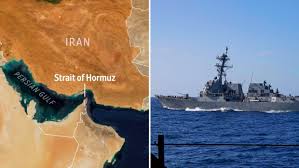


ALWAGHT- Following the failure of US military efforts to reopen the Strait of Hormuz, a naval blockade was imposed as a fresh pressure tactic against the Islamic Republic of Iran. Yet, even before the blockade took effect, the forty-day closure of the strait had already unleashed a wave of economic instability and rising costs across the globe—trends that are now expected to worsen under the new conditions.
The ongoing confrontation in the Persian Gulf between Iran and the United States has evolved into a multilayered conflict extending beyond the military sphere into economic and maritime domains. After failing to reopen the Strait of Hormuz through military means, Washington turned to a commercial blockade against vessels linked to Iran—a move that has now entered a stage described as a "game of unpredictable consequences."
The roughly forty-day closure of the Strait of Hormuz demonstrated how heavily the global economy depends on this vital passage. Even before the naval blockade could significantly impact Iran's economy, disruptions rapidly appeared in global energy, fertilizer, metal, transportation, and insurance markets. Rising oil prices, increasing logistical costs, and supply chain uncertainty emerged within weeks, revealing that the global economic impact of a strait disruption occurs far faster and more broadly than the impact of sanctions on Iran.
Unlike the global economy, Iran has developed pathways to bypass restrictions and diversify its trade routes through land and maritime borders in the north, east, and west. While these routes cannot fully replace southern routes, they can reduce shock intensity in the short term. This creates a significant asymmetry: a blockade's effect on Iran requires time, whereas disruption of the Strait of Hormuz produces almost immediate and wide-ranging global consequences.
According to TankerTrackers data, Iran's oil storage includes not only well-known terminals like Kharg Island but also concrete tanks for gas condensates and approximately 120 million barrels stored on Very Large Crude Carriers (VLCCs). However, before a naval blockade could decisively affect Iran's oil production, the consequences of closing the Strait of Hormuz would pressure major economies, directing political costs toward the United States and its allies.
This situation places Washington in a paradoxical position: sustaining a naval blockade requires time to be effective, yet that same passage of time intensifies pressure on the global economy and increases international costs for the US Unlike classical sanctions where the target economy suffers first, here the global economy shows crisis signs before Iran does. Thus, while designed to weaken Iran, the blockade may instead intensify America's strategic challenges in managing a global crisis—one whose containment could prove far more difficult than its initiation.










