

















Alwaght- While the US President Donald Trump has repeatedly claimed that Iranian military capabilities have been decimated, not only Iran's armed forces every day launch tens of missiles and drones at the Israeli regime and American military bases in the region, but also Tehran's air defenses have made major gains in countering this joint aggression, demonstrating that just contrary to the bluffs of the enemies, Iran's airspace is unsafe to the fighter jets.
Over the past two weeks, the Iranian air defense network has been increasingly successful in hunting enemy drones and fighter jets in the Iranian skies as armed forces have implemented new tactics in downing the intruding aircraft. Actually, after a month and the struggle to totally destroy Iranian air defense as the core aim of the military operations, the country's airspace is scarier to the pilots of the aggressors.
Detecting and striking F-15, F-16, F/A-18 jets and even the stealth F-35 jet in the Iranian skies by the Iranian forces bears witness to the Iranian armed forces' capabilities to deal heavy blows to the US and Israeli regime at all levels.
By engaging an F‑35, something unprecedented in the history of modern warfare, Iran has now placed its name among the first countries to score a hit on the aircraft, while also casting doubt on the reputation of the weapons manufacturers behind it. Following the drop in the stock value of American defense companies, some analysts say countries considering purchasing this fighter jet may rethink their plans. As the US and Israel continue their military operations, their cutting‑edge weapons are increasingly being challenged by Iran’s air‑defense systems and missiles.
From AWACS aircraft to air tankers within Iran's air defense fire range
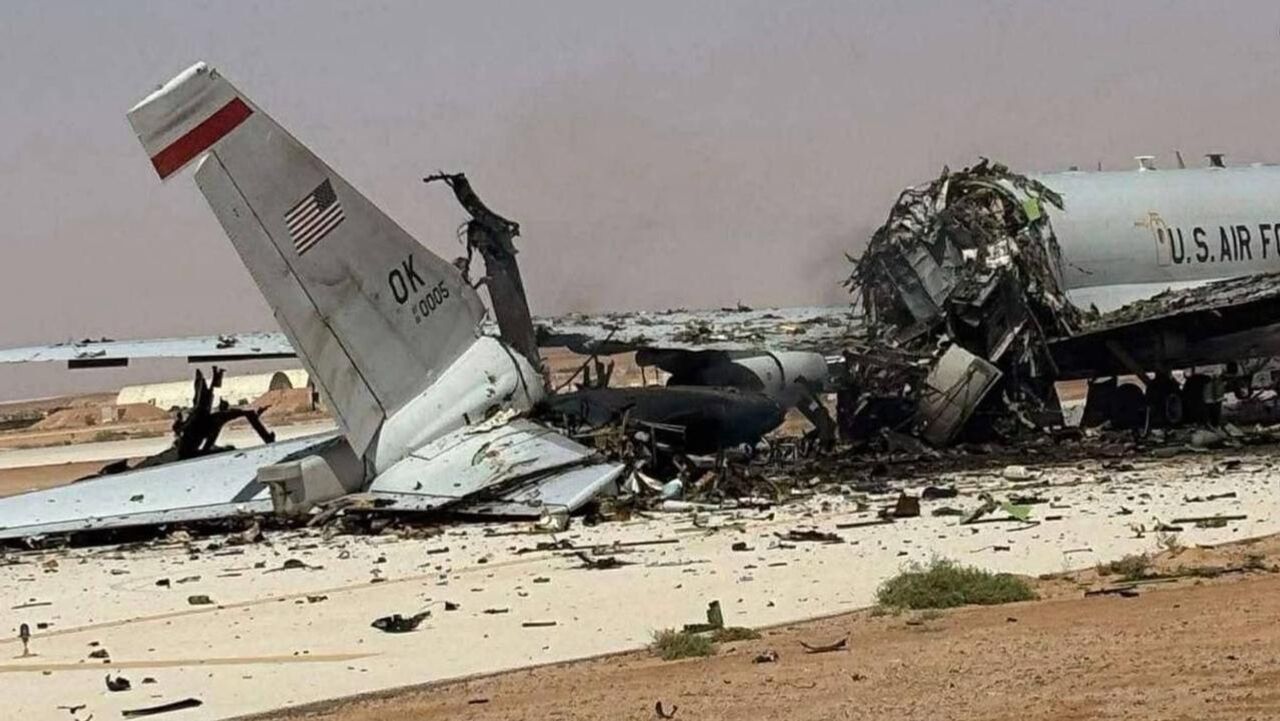
One of the advanced US weapons systems recently struck by Iranian missiles was the E‑3 AWACS, a $700 million aircraft known E-3, that sought to flee to safety from the Iranian drones. But it was hit by a$20,000 drone, Shahed-136, that not only destroyed this this huge aircraft but also damaged other aircraft. This gain was so important that some Western media stressed that this painful blow exposed a gap in the Pentagon’s assessments of Iran's battle capabilities.
This advanced aircraft had played a key role in previous US wars around the world, providing critical, sensitive intelligence. With US AWACS and other hundreds‑of‑millions‑dollar fighter jets now vulnerable to relatively inexpensive Iranian drones and missiles, the cost imbalance has become stark.
Military analysts say the hit goes beyond a tactical success, delivering a direct blow to the US airborne command‑and‑control network and affecting its operational readiness at multiple levels, a clear sign, they argue, of shifting power dynamics in modern warfare.
The Israeli news outlet Natziv highlighted the significance of the AWACS aircraft being targeted, reporting: “The operational fleet of US AWACS aircraft has decreased from 16 to 15, creating ‘operational blindness’ for America. Losing this aircraft disrupts the ability to detect and intercept missile and drone threats from a distance, limiting US situational awareness in the Persian Gulf.”
Also, Yedioth Ahronoth described destroying the AWACS in the Saudi Air base as “a blow to America’s eyes in the Persian Gulf,” explaining: “This aircraft provided commanders with a real-time picture of the battlefield, allowing them to direct assets to intercept threats. Therefore, targeting this plane is a very significant issue, jeopardizing the American ability to control events in the Persian Gulf and maintain situational awareness.”
Furthermore, destroying several US refueling aircraft in recent weeks marks another achievement for the Islamic Republic against its adversaries, making it more difficult for enemy fighter jets to maintain continuous presence in Iranian airspace.
Air tankers are essential for long-range strikes by fighter jets, and damage to them degrades the enemy's operational capacity. The ongoing attacks on Iran by the US and the Israeli regime with a smaller number of fighter jets are attributed to a shortage of refueling tankers. It is even said that some fighter jets are carrying fewer missiles and two fuel tanks when entering Iran to compensate for the lack of tankers.
Iran, the killing field of adversary drones
Over the past 34 days ago, Iran has shown a distinctive strong spot in downing Israeli and American drones that, beside the fighter jets, have been lunching attacks on some parts of Iran. They, however, have been shot down easily by Iranian air defense systems.
According to official reports, Iran has so far downed over 140 drones of all kind, from Hermes 900 and Hermes 450 to MQ-9 and Orbier, all expensive drones whose price tags sometimes go beyond those of the fighter jets. Analysts suggest that by downing these UAVs, Iran has actually dealt working blows to adversaries.
There are numerous reasons why American and Israeli drones, some of which are stealthy, are insecure in Iranian skies.
Drones, due to their lower speed, are compelled to fly longer routes, thus granting adversaries greater opportunity to counter them. Iran’s air defense systems are deployed in many cities and immediately open fire upon spotting drones, with widespread missile barrages neutralizing the drones’ operational capabilities. Unlike fighter jets, drones lack the maneuverability to evade interceptor missiles. If detected by radar, they are easily destroyed. Iranian armed forces have demonstrated significant capabilities in this regard.
Typically, drones are employed for espionage, gathering intelligence on air defense system activities, missile launch site locations, and ground force movements, transmitting this data to command centers for precise targeting. Iran has proven effective in neutralizing these enemy “eyes.” Enemy fighter jets lack accurate intelligence on the locations of hidden missile launchers and air defenses precisely because reconnaissance drones are intercepted by air defenses before they can acquire the necessary information, thus failing to gain the intelligence.
The drones being unmanned is among the reasons countries use them in operations. Actually, once they are hit, they have no human casualties or pilot captures. Pilot capturing is a trump card for the warring sides, used to wrest concessions from the opposite side.
Furthermore, fighter jets, due to their immense cost and stealth capabilities, could inflict a significant reputational blow on their manufacturer if intercepted by adversaries. This was evident after American F-35 fighter jets were intercepted over Iran, leading analysts to question Pentagon officials’ claims of the jet’s global superiority. Online, some users ridiculed the fact that American fighters were targeted by less expensive Iranian weaponry.
Drones produced in various countries in recent years are often of the kamikaze variety. Their lower cost allows them to inflict greater damage on an enemy, effectively substituting for fighter jets with fewer capabilities. Russia and Iran are leading in this domain, having successfully delivered severe blows to adversaries using drones.
Overall, the course of developments on the ground indicates that the US and the Israeli regime have lost the initiative against Iran’s air defense systems. Should this self-inflicted crisis continue, they are poised to lose more advanced drones and fighter jets.
Iran's missile and air defense capacities have gone beyond expectations of the enemies. Senior Washington officials have repeatedly admitted that the Iranian military strength has been underestimated by the US. So, the claims by the American and Israeli officials that they hold under their control the Iranian airspace is as hallow as the claim of reopening the Strait of Hormuz, which has been closed since the early days of war.










