














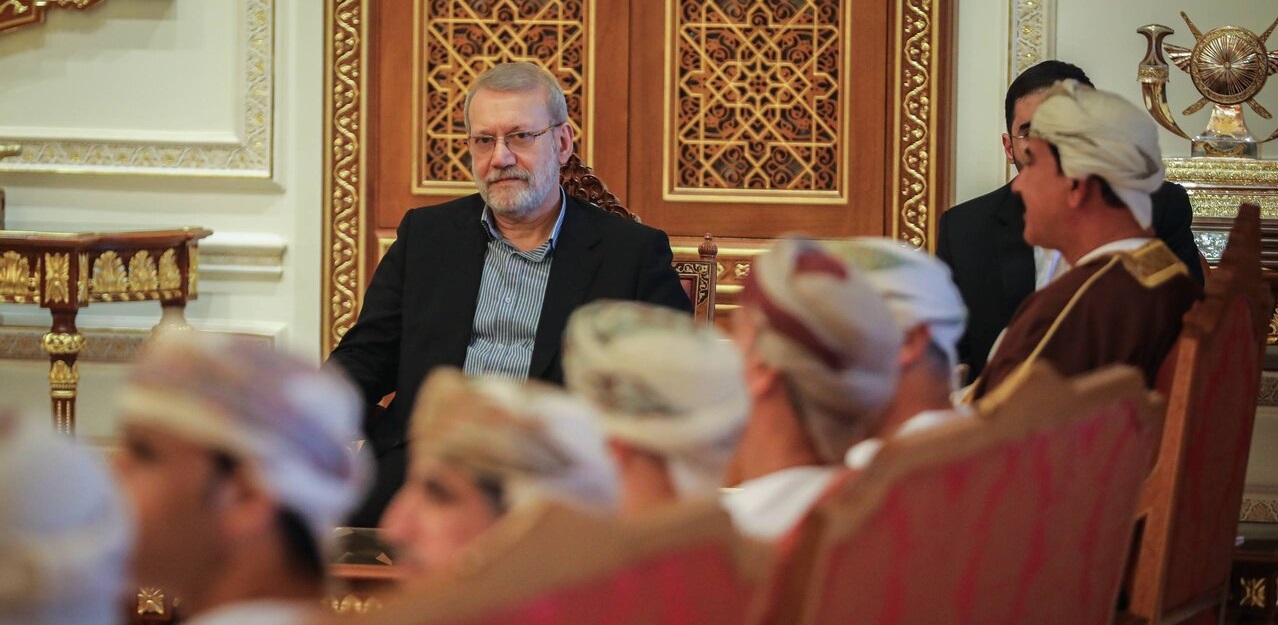


Alwaght- As tensions between Tehran and Washington escalate, Iranian Supreme National Security Council’s head Ali Larijani has visited Oman. The visit comes a few days after Tehran and Washington held their first round of nuclear talks in Muscat, with the main aim appears to be following up on the outcomes of the talks and advancing the coordination with the Omani mediator to continue the negotiations.
Larijani arrived in the Persian Gulf Arab state on Tuesday and was received at the airport by the Oman minister of royal court. Larijani then met Sultan of Oman Haitham bin Tariq.
Meanwhile Iran’s Foreign Ministry announced that the senior official’s trip to Muscat is part of his diplomatic efforts to strengthen relations with neighboring countries. Following his meetings, he will visit Qatar.
Upgrading level of negotiations
The AP reported that Larijani’s visits are meant to respond to the US regarding the talks, but this time the response is delivered by a more senior official. Recently, the US Vice President JD Vance called for higher level talks between Tehran and Washington.
The direct entry of Larijani into the negotiations has already signaled a potential upgrade in the talks. This is partly because, within Tehran’s political hierarchy, the Secretary of the Supreme National Security Council holds a more decisive authority than the foreign minister.
Furthermore, Larijani brings to the table a long-standing political history with the nuclear case, having previously spearheaded high-level nuclear negotiations for Iran.
No meeting with Americans in Oman
The Independent has reported that Larijani’s trip to Oman is likely nuclear-related, with the high-ranking diplomat carrying Tehran’s official message for this phase of the negotiations. According to the report, the visit aims to deliver Iran’s response to the first round of indirect talks held last week in Muscat between Iranian and American representatives, talks intended to manage tensions and prevent potential US military action.
However, it is certain that no meeting will take place between Iranian and American officials during this trip. Iran’s Foreign Ministry spokesperson has explicitly stated that Larijani has no plans to meet with US officials in Oman. Therefore, while no direct US-Iranian meeting is expected, it appears Iran’s response to Washington will be relayed through Omani mediation.
Oman, the ever mediator
Larijani is visiting Oman and Qatar, two nations that have consistently played the role of mediator in indirect talks between Tehran and Washington for years. Iran has always drawn a distinction between mediators who facilitate dialogue and understanding, and those who create new pressure levers or align with hostile agendas. Over time, Oman has firmly established itself in the former category.
Unlike traditional or emerging regional powers that often seek to convert mediation into political influence or regional standing, Muscat has generally limited its role to facilitating communication, relaying messages, and helping parties formulate constructive initiatives and explore options, without imposing its own agenda.
Oman’s historical style of mediation has allowed Tehran to quietly test options while retaining room for diplomatic maneuver should talks stall or fail. Continuity and stability also play a central role in Iran’s preference for Oman. Over the years, through various phases of tension and détente, and despite leadership changes in both Tehran and Washington, Muscat has remained consistently engaged and active.
For Iran, this continuity helps reduce uncertainty. A mediator who disappears when negotiations become politically difficult or who abruptly shifts position in response to external pressure creates additional risks, something Oman has not done. Thus, part of Oman’s value lies in the expectation, reinforced by experience, that its communication channel will remain open even amid setbacks, crises, and interruptions.
In fact, Oman has played the role of a secure and neutral channel in the US-Iran relations. From the secret talks preceding the 2015 nuclear talks to trading messages between Washington and Tehran during high-tension periods, Muscat has always provided a secure space for messaging. Now that talks are resumed after months of a hiatus and as military tensions in the region are at their height, this visit can bear a significant sign of a true progress.










