















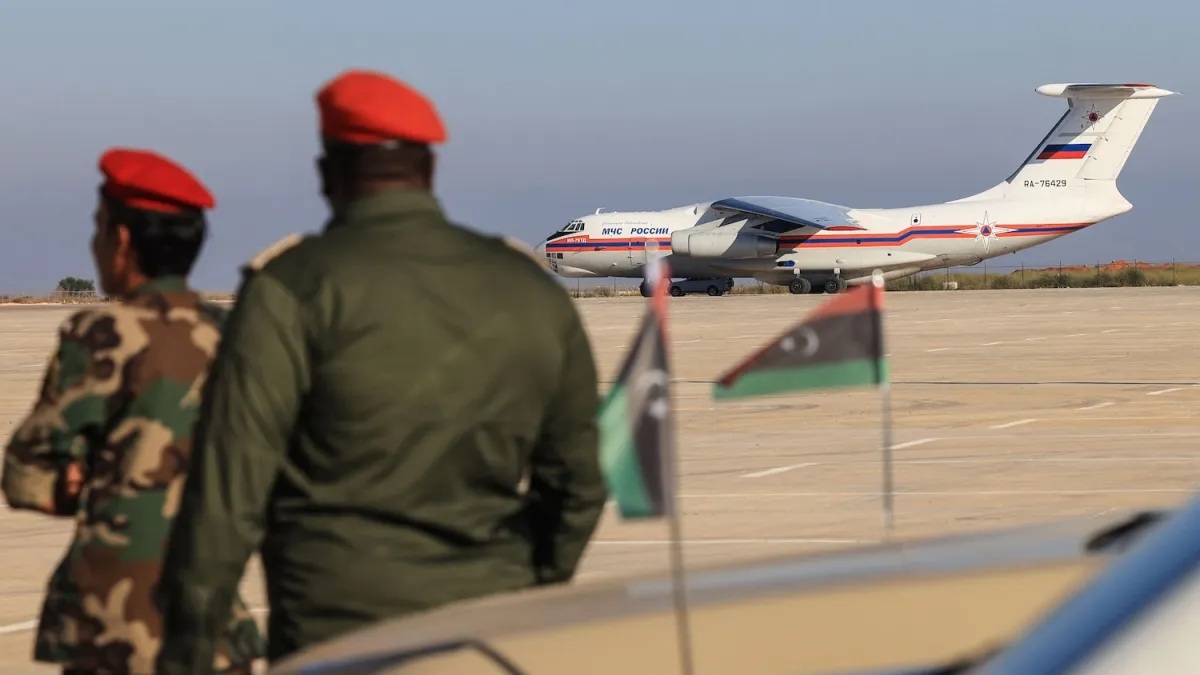


Alwaght- The geopolitical developments of West Asia and North Africa in recent years and especially after fall of Bashar al-Assad of Syria later in 2024 have once again brought to focus on the Russian strategic realignment in these regions. While many Western analysts have expected Moscow to embark on a strategic retreat after losing its key military bases in Russia, field evidence and security reports suggest that Russia, along with minimally reestablishing itself in Syria, is working in a targeted way to build an alternative strategic and supplementary platform in southern Libya.
Concerns about Syria future and activating Libya option
Security think tanks and specialized defense media reports emphasize that in the final months of 2024, uncertainty over the future of Russia's military presence in Syria compelled Moscow to seek backup options in the region. During this same period, reports emerged of repeated flights from Syria to eastern and southern Libya, along with the movement of military equipment and the transfer of personnel linked to Russian structures. From the perspective of Western observers, Libya, with its governance vacuum, fragmented power centers, and presence of rival actors, provided a suitable environment for Russia's geopolitical maneuvering.
Conversely, Russian sources close to military and security circles describe these movements not as a "replacement for Syria," but as part of a strategy of "diversifying operational depth." This strategy aims to reduce dependence on any single geography and increase flexibility in the face of Western pressure.
One year after al-Assad's fall, Russia's position in Syria appears stronger than many predicted in the initial days following the militants' rise to power. Russia has managed to maintain a smaller yet persistent presence in Syria. High-level meetings between Russian President Vladimir Putin and Syria's interim president, Abu Mohammad al-Jolani, reaffirmed Moscow's role in the country, with al-Jolani publicly committing to uphold previous military agreements. The result is a diminished footprint, but not one that can be characterized as a strategic defeat.
Impasse on the coast and shift to territorial depth
One of the key points in the analysis of the reason of the Russian focus on southern Libya is Moscow's failure to secure a port for its military forces on the Mediterranean coast.
Moscow has been cozying up to General Khalifa Haftar, the commander of Libyan National Army (LNA), for access to the eastern Libya and its military infrastructure to transform Libya into a logistical hub for projecting and expanding its military power deep in Africa.
But just contrary to the initial speculation about possible establishment of a Russian marine military base in eastern Libya, western diplomatic sources and even some Russian analysts have admitted that eastern Libya authority are uninterested to handover a key sea facilities to Moscow. Providing infrastructure to Russia could damage their improving relations with the US, Turkey, and European countries.
So, Russia have taken a different way: Expanding influence in Libya's depth. Here is where southern Libya with its remote geography, limited international watch, and natural bonds with Sahel Region turns into an ideal choice.
Airbases, the backbone of the new strategy
Both English and Russian sources jointly emphasize the pivotal role of airbases in southern and central Libya. The Maaten al-Sarra base, near the borders with Chad and Sudan, is recognized as one of Russia's most crucial logistical hubs. While active even before the Syrian developments, this base has seen a significant influx of Russian equipment, military personnel, and even armed Syrian elements linked to the former Damascus structure since late 2024.
In addition, airbases at Al-Khadim in eastern Libya, Al-Jufra in the center of the country, Brak al-Shati near Sabha, and Al-Qardabiyah south of Sirte form a dispersed yet interconnected network. This network enables Russia to establish a resilient logistical corridor connecting the eastern Mediterranean, Libya, and the Sahel region, a corridor that offers flexibility against diplomatic pressure and carries lower political costs for local actors.
By serving as transit centers, the Libyan airbases provide Russia with the potential for access deep into the African continent
Libya's alignment with Moscow Africa strategy
In the eyes of Russian sources, significance of southern Libya goes beyond the domestic equations of this country. Libya, especially the south, has become a gate for the Russian influence in Africa. Deployment of arms, logistical support, and establishing African Army forces, which are described by the Western sources as the Wagner private security company replacement, are conducted using this network.
While the Russian narrative frames this presence as "legitimate security cooperation" with local governments and actors to combat terrorism and extremism, Western powers see it as part of Russia's effort to exert controlled destabilization in the Sahel Region and weaken Western influence in countries like Mali, Niger, and the Central African Republic. In response, Western actors have ramped up their own activities to confront Moscow's expanding influence in Libya.
Washington and its key international partners have sought to contain Russian activities and influence. A central pillar of this effort has been a strategy to accelerate military integration between eastern and western Libya, paired with promises of security cooperation and military training. Libyan National Army deputy commander Saddam Haftar has been the focal point of these attempts to reduce the LNA's dependency on Russia.
In February 2024, the US flew two B-52H Stratofortress bombers into Libyan airspace for a joint exercise with LNA tactical air controllers. In April, the US Navy made its first port calls in Libya in over fifty years, docking at Tripoli and Benghazi. That same month, Ankara hosted Saddam Haftar, and in August, the Turkish Navy also docked at both Tripoli and Benghazi.
Overall, southern Libya has become the new Russia strategic platform because it simultaneously provides Moscow with multiple key benefits: Its distance from center of global attention, access to African transit sources, and lower political costs compared to the Mediterranean coasts and offering the possibility of linking Syria front to depth of Africa.
Either from the viewpoint of the West that sees this Russian strategy as a threat to the regional stability or the Russians that describe this as a part of the defense and development strategy of Moscow, one point is clear: Libya's south has now become one of the crucial nodes in the Russian geopolitical plan in Africa and West Asia.










