









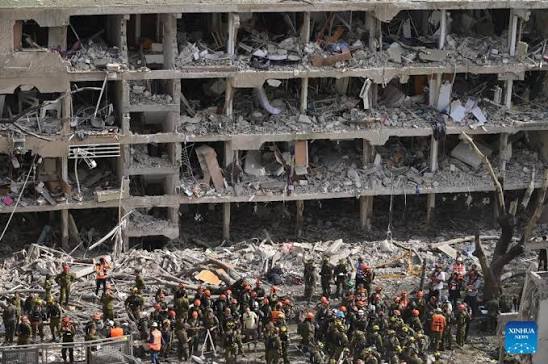


Alwaght- Five months after hard Iranian missile response to the Israeli aggression, still many Israeli buildings and areas damaged in the Iranian attacks are not reconstructed, with some buildings left to their own in some neighborhoods. Israeli media have published reports of discontentment of a large number of people whose homes are damaged by the Iranian missile strikes, with many saying that the local authorities in Tel Aviv are indifferent to the devastation and the rebuilding of these areas in the capital.
Yedioth Ahronoth in a report pointed to halt of the reconstruction process of thousands of houses in Israel destructed by the Iranian missiles, adding that the marks of these attacks are visible after five months and thousands of families are awaiting the government to rebuild their homes. The reports further adds that due to the procrastination of the tax authority and the shortage of labor force, many of the contractors have had to leave the repair projects due to the working pressure.
Israeli human shield disclosed
Now that the Israelis claim that many of the residential areas after the Iranian missile strikes have not been rebuilt yet, something revealing a fact: Israel had deployed its military systems and air defenses in the residential areas. Earlier, Grey Zone website in a research unveiled existence of a military shelter beneath a residential tower in Tel Aviv. The shelter is believed to be one of the targets of Iranian strikes in a June 13 operation.
According to the investigation, Grey Zone identified the location of a military installation known as “Site 81”, a joint US-Israel intelligence command and control center. It is built beneath the “Da Vinci” residential complex in a densely populated central Tel Aviv neighborhood.
Leaked documents, emails, and Israeli reports show the facility is electromagnetically shielded, under heavy security, and was constructed with US backing as part of a development project covering approximately 6,000 square meters. Grey Zone added that Israeli authorities immediately imposed a security cordon after the Iranian strikes, blocking journalists from accessing or documenting damage in the area, especially near the defense ministry headquarters and the nearby Azrieli complex.
The website also stated that Site 81 is likely directly linked to an older command center called “The Pit,” which was later expanded into another underground facility known as “Zion’s Fortress.”
These disclosures come amid repeated accusations that the Israeli regime locates military facilities inside civilian zones, while itself accusing others of using “human shields”, a violation of international humanitarian law.
Other available reports further indicate that many of the locations portrayed as residential areas struck by Iranian missiles were in fact housing compounds for Israeli military personnel, including air force officers.
How much damage did Tel Aviv sustain?
Initial reports suggest that in Tel Aviv, 480 buildings in five points sustained damage. In Ramat Gan in eastern Tel Aviv, 237 buildings were destroyed, with 10 taking extreme damage. In Bat Yam south of Tel Aviv, 78 buildings were damaged by IRGC missiles.
Haaretz reports has reported that the Israeli tax administration has received applications for funding to reconstruct around 33,000 damaged buildings. Furthermore, 4,450 cases were opened to compensate for the damage inflicted on the household appliances and devices and 4,119 cases were opened for damage claim for cars.
The citing local authorities the Times of Israel reported that over 11,000 people during the war with Iran evacuated their homes due to direct and indirect damages of the Iranian missile attacks and currently over 7,000 are still not capable of returning to their homes.
Israelis disillusioned with improvement of situation leave homes
The failure to address the grievances of those whose homes have been damaged in the war has driven fury among the Israelis. A resident of Haifa whose home was struck by an Iranian missile told Calcalist, an economic news website, that the reconstruction has made no progress so far and “plundering continues.” “The damages of the Iranian missile attacks on Tel Aviv continue to unfold.”
A Middle East Eye report reveals that approximately 50,000 damage claims have been filed with Israel’s property tax authority, with 39,000 related to residential property damage.
Estimates circulated in Israeli media indicate that Iran’s missile strikes inflicted total losses of around 5 billion shekels (approximately $1.53 billion) on the Israeli regime.
The harsh conditions in the occupied territories and the slow pace of reconstruction in war-damaged areas are fueling an emigration wave from Israel. In the past year alone, nearly 900 doctors, over 19,000 individuals with academic degrees, and more than 3,000 engineers have left the occupied territories. According to the report, 75 percent of all emigrants were under 40 years old. The report warns that if the current difficult conditions in Israel persist, the regime could face “severe macroeconomic consequences due to the loss of essential human capital.”
A separate report about Israel’s high-tech sector reports a major wave of migration of human resources from the occupied territories. Reports suggest that only in last year, over 8,000 technology sector employees have left Israel. Ala Aqbariyeh, an Arab researcher and analyst told Al Jazeera that the wave of reverse migration stems from unprecedented trust crisis between the citizens and government in Israel that covers almost all of the social classes. He added that this phenomenon has caused a political shock in Israel and disclosed the fragility of the home security and stability and that its impacts will show themselves on the Israeli regime in the long run.