














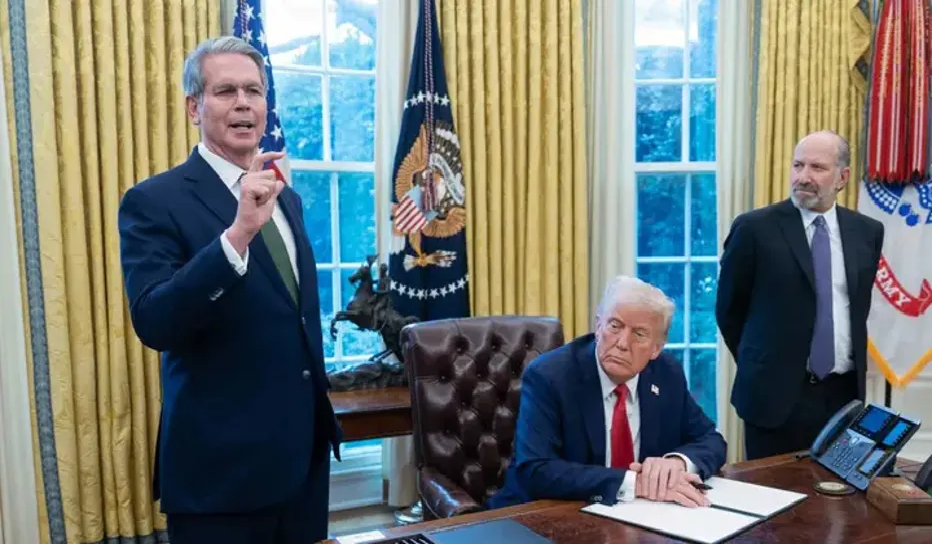


Alwaght- The Department of Treasury on Monday rolled out under what it called "D-Day sanctions" a new round of sanctions under a new economic campaign against Iran.
Treasury Secretary Scott Bessent said the goal of the new measures is to cut off every source of revenue for Iran and seal the routes that allow Tehran to sell oil, move its money around, and bring its earnings back home.
He also called on countries and companies doing business with Iran to sever their ties, warning that they would otherwise face secondary sanctions.
The latest salvo in the economic war campaign, which Iranian officials decry as “economic terrorism” against their citizens, has raised a pressing question: Can the Treasury Department’s new actions block the ventilation shafts of Iran’s resilience, an economy that has kept chugging even under naval blockade?
Since the return of the “maximum pressure” campaign and the subsequent naval cordon, Iran’s economic survival has hinged on five key areas. And global experts argue that the Treasury secretary’s economic warfare trumpet cannot squeeze those lifelines much tighter than they already are.
Iran's economy domestic-driven and adapted to sanctions
The first hurdle is Iran’s economic structure itself, which has gradually adapted to external constraints over decades of sanctions. Iran’s economy is not fully tethered to the Western financial system, you cannot simply pull the plug by cutting access to American or European banks. Over the years, a significant share of Iran’s trade has shifted to intermediary companies, informal networks, regional markets, and non-Western partners.
Reuters, questioning Washington’s sanctions strategy, noted that Iran has repeatedly skirted penalties over the decades by setting up shell companies, creating new entities, and re-registering vessels.
Trita Parsi, executive vice president of the Quincy Institute, said that these measures can put considerable pressure on Iranians. But the pattern so far shows that inflicting pain is one thing and translating that pain into a policy shift is something else entirely. The US has almost never succeeded in doing that. As a result, rather than bringing the conflict to an end, sanctions are more likely to provoke Iranian retaliation and escalation, ultimately feeding yet another round of this long-running cycle of escalation.
Washington’s push comes as a vast swath of Iran’s business community has already been living under sanctions, banking restrictions, and limited access to dollars for years. So, Washington is not dealing with an economy that is new to sanctions, but it is dealing with a country that has spent years learning how to adapt. From that vantage point, new sanctions mostly raise the cost of doing business rather than necessarily sealing off all of Iran’s economic pathways.
Susan Maloney, a senior fellow at the Brookings Institution, dismissed the effectiveness of the sanctions, saying: “As was entirely predictable, Scott Bessent’s so-called ‘economic D-Day’ spectacle was all sizzle and no steak. The emperor has no clothes, and the Trump administration has no operational plan to repair the immense damage that its catastrophic Iran war policy has inflicted on America’s national security interests and on the interests of our Persian Gulf partners.”
Robert Malley, who served as the lead US negotiator under President Barack Obama, called the plan muddled and stressed: “The administration will likely roll out statistics in the coming months showing economic contraction and a plummeting rial. But that does not add up to strategic success.”
Analysts at ING, the Dutch bank, weighed in on market reaction, noting: “The market was barely rattled by Washington’s move. Traders viewed the US effort to push away Iran’s trading partners as more of a sideshow than a game-changer for oil markets. That matters economically, if global oil markets had really expected new sanctions to dramatically slash Iranian exports, we would have seen a significant spike in prices. Instead, oil prices actually dipped in the initial response.”
Peter Schiff, the American investor, said: “Because Trump couldn’t achieve his goal in Iran through military force, he’s now turning to economic sanctions. But this ‘economic exclusion operation’ will not only fail, but it may end up tightening a noose around our own neck, and that noose is the one that’s actually getting drawn tighter.”
Complex network of trade based on national currencies and barter
The second factor is the sprawling network of exchange houses, financial intermediaries, shell companies, and indirect money transfer channels. This network has in fact become a primary target of the new US sanctions. Bessent explicitly called out exchanges, free-trade zones, maritime shipments, and overland routes as conduits that allow Iran to move oil and money. But that very focus by Washington underscores a stubborn reality: these channels still exist, and they are not easily erased.
In Iran’s trade, the dollar is hardly the only medium of exchange. National currencies, barter arrangements, indirect payments, and settlements outside the US financial system have all become part of the toolkit developed over years of sanctions.
The most striking example is oil trade with China. According to estimates from the US-China Economic and Security Review Commission, Beijing purchased roughly 1.4 million barrels of Iranian crude per day in 2025, and a significant share of those transactions was settled in Chinese yuan through mid-tier Chinese banks rather than in dollars.
That mechanism matters enormously. In this model, Iran does not necessarily need to receive its oil revenue as direct dollar transfers into domestic bank accounts. Part of the value of its exports can flow back into the Iranian economy through goods, services, equipment, and infrastructure projects.
Khaled Azim, an expert at the Atlantic Council, said: “Iran has found many ways to keep trading over decades of sanctions. Its commercial and financial networks operate like a cat-and-mouse game, when the US closes one channel, traders and intermediaries look for another. Sanctions can raise the cost of doing business for Iran, but there is a gap between that and shutting down Iran’s economy altogether.”
Nate Swanson, another Atlantic Council expert, took a longer historical view: “The United States has imposed every conceivable type of sanction on Iran for nearly half a century. It has severely weakened Iran’s economy, but it has not eliminated the Islamic Republic or lastingly altered Tehran’s strategic behavior. Sanctions can impose costs, but economic pain does not automatically translate into political surrender. That may be the single most important gap between the economic aim and the political aim of Washington’s new policy.”
The Washington Post wrote that over decades of sanctions, Iran has built up intricate networks and methods to evade financial and trade restrictions. That is why executing a ‘zero-leak’ policy, as Scott Bessent has promised, will be exceedingly difficult.”
More critically, secondary sanctions work best when the other side depends on the U.S. financial system for its trade. But the larger the share of transactions conducted outside the dollar and outside US banks, the less leverage Washington has to directly control them.
In this relation, a Russian official, without mentioning Iran, recently said that Russia may turn to cryptocurrencies for cooperation with “friendly countries” that are under Western sanctions.
The US is trying to close even that loophole. The new sanctions package now sweeps in digital assets, gold, technology, aviation, and shipping under its secondary-sanctions umbrella. But expanding the sanctions list does not necessarily eliminate all alternative routes — in many cases, it merely raises the cost and complexity of doing business.
Crypto-currencies, a market outside control of states
The third factor is the growing use of digital assets and cryptocurrencies — an area that Washington explicitly targeted in its latest sanctions package, a clear sign that the U.S. views this market as a potential conduit for Iranian funds.
Reuters reported that in the wake of the US action, roughly tens of billions of dollars in cryptocurrency assets linked to Iran have been frozen under the sanctions framework.
Yet cryptocurrencies, unlike traditional bank transfers, do not rely on a central bank or a single payment network. Their decentralized nature puts them largely outside direct government control. The US cannot simply identify, freeze, or police all of Iran's crypto transactions and holdings. Crypto transactions are recorded on decentralized ledgers, and moving assets between two wallets does not, in principle, require clearing through an American bank or intermediary.
Sanctioning one exchange, then, cannot bring down the entire crypto financial network. The US can force centralized exchanges to block Iran-linked accounts or assets, but it cannot outright sanction or shut down the underlying networks themselves, like Bitcoin.
To be sure, cryptocurrencies cannot fully replace oil, banking, or foreign trade at scale. Converting very large volumes of crypto into goods and hard currency still requires real-world economic networks. But for moving money, making cross-border payments, and creating complementary financial channels, they can absorb at least some of the sanctions pressure. That is precisely why the new US policy is not just about banking and oil; it is trying to go after Iran's entire informal financial system. And Washington's success on this front will largely depend on the cooperation of exchanges, tech companies, and intermediary countries.
China and Russia not cooperating with the US against Iran
The fourth, and perhaps most important, obstacle to Washington’s strategy is the lack of full cooperation from China and Russia. China has long been Iran’s largest oil buyer, with a significant share of Iran’s crude exports going to the Chinese market.
Reuters reported that, even in its latest sanctions package, the US government refrained from targeting major Chinese banks involved in transferring the proceeds of Iran’s oil trade. The reason, according to the report, was Washington’s concern about Beijing’s reaction and the potential damage to bilateral economic ties. US Treasury Secretary also explained why Washington had not immediately gone after China’s major banks, saying that he did not want to “blow up the global financial system.”
China’s Foreign Ministry said on Tuesday: “Pressure and sanctions are not the solution to problems. We are closely monitoring the threats and will take whatever necessary measures to safeguard our rights and interests.” The statement highlights a major challenge for Washington: fully enforcing an economic blockade against Iran would require it to confront not only Tehran but also China, the world’s second-largest economy.
China and Russia have never fully aligned themselves with Washington’s sanctions regime against Iran. Despite US pressure and threats, both countries have continued their economic relations and trade with Tehran through various channels—and they are unlikely to abandon that approach this time either.
Daniel Fried, a former US State Department official, argues that the initial measures do not amount to a “game changer.” To inflict a truly decisive blow, he says, Washington would have to target major Chinese banks and companies. The fact that it has yet to do so underscores the gap between the Trump administration’s political rhetoric and its actual capacity to exert economic pressure.
Reuters columnist Clyde Russell made a similar point: “China remains Iran’s most important oil customer, and if Washington genuinely wants to drive Iran’s oil revenues close to zero, it will have to target Chinese banks, refineries and companies. But doing so could push US-China relations into crisis. The real problem, therefore, is not that the United States lacks the tools to impose sanctions; it is that fully deploying those tools could impose costs on Washington itself that it may be unwilling to bear.”
The Washington Post likewise wrote that Washington needs China’s cooperation to close Iran’s export channels. If Xi Jinping leaves Washington after his visit next month without making a serious commitment to reduce purchases of Iranian oil, the paper warned, Washington’s threats could lose their credibility.
Al Jazeera also reported that maximum pressure on Iran could come at a cost to US-China relations, with some analysts questioning whether the Trump administration would be willing to put its relationship with Beijing at such risk simply to sever Iran’s economic ties with the outside world.
Washington therefore faces a difficult dilemma. Targeting major Chinese banks and the key networks facilitating trade with Iran could significantly increase pressure on Tehran. But it would also raise the risk of a direct economic confrontation with Beijing, and potentially disrupt the global financial and trading system.
Regional trade
The fifth factor is Iran's geography and its long land borders with a diverse set of neighbors. From the north, east, and west, Iran shares frontiers with countries that maintain varying degrees of economic ties to Tehran. That geographic reality means Iran's trade is not beholden solely to maritime routes or the international banking system.
Iraq, Turkey, Pakistan, Afghanistan, the Central Asian states, and the Caucasus countries each form part of Iran's surrounding commercial network. Some goods move overland, some through free-trade zones, and some across border markets and bazaars. This diversity of pathways means that even when maritime or banking restrictions tighten, at least a portion of Iran's trade can continue flowing overland.
The significance grows when Iran can conduct trade with its neighbors in national currencies, through barter, or via bilateral payment mechanisms. In such scenarios, not every transaction requires moving dollars through the global banking system, and that diminishes Washington's ability to exert direct leverage.
Reuters, examining Iran's trading partners, reported that Turkey still does roughly $5 billion to $6 billion in annual trade with Iran, while Pakistan and Iran are working to boost bilateral commerce to $10 billion, with a significant chunk of that trade conducted informally. Reuters also highlighted Iran's energy trade with Iraq, estimating Iraq's annual purchases of Iranian gas at around $4 billion to $5 billion.
In this regard, Middle East Eye reported that the US naval pressure has pushed Iran toward the Pakistani land corridor to maintain commercial access to Central Asia, a route that could insulate some of Iran's trade from the squeeze on maritime lanes.
Washington has tried to close even that loop, pressing neighboring countries to curb their economic ties with Iran and warning that those who continue cooperating could face secondary sanctions. But the sheer expanse of Iran's borders and the web of economic interdependence with its neighbors make full enforcement of such pressure exceedingly difficult.










