




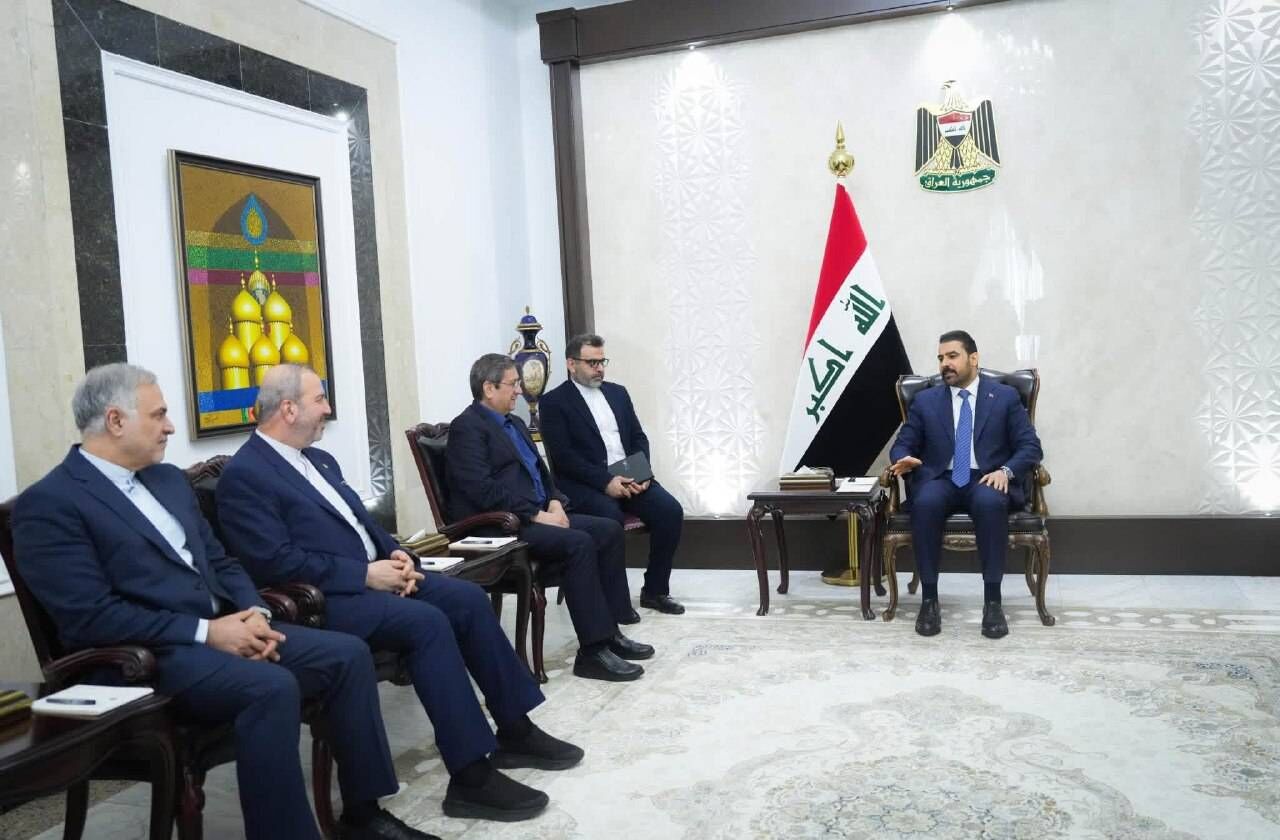


Alwaght- While the US with economic and political pressures tries to put the skids under Iranian-Iraqi trade relations, Tehran and Baghdad are still pursuing expansion of their trade based on the past agreements. Within this framework, Central Bank of Iran Governor Abdolnasser Hemmati traveled to Iraq on Sunday at the head of a high-ranking economic delegation for talks with senior officials on financial and economic issues.
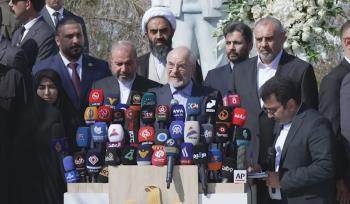
In Baghdad, Hemmati met with his Iraq counterpart Nizar Nasser Hussein and Prime Minister Ali Faleh al-Zaydi to discuss bilateral economic and financial matters. The visit aims to negotiate the release of roughly $11 billion in Iranian assets and claims in Iraq, while also boosting trade flows between the two countries.
According to a statement from the Iraqi prime minister’s office, the two sides reviewed the most pressing monetary and financial challenges facing regional economies in the current climate.
In his meeting with Nizar Nasser Hussein, Hemmati stressed the need to accelerate the removal of banking obstacles and to implement mechanisms for unlocking Iran’s foreign currency reserves.
Both sides expressed satisfaction with the constructive tone of the talks and underscored their commitment to holding further joint meetings to achieve concrete, operational outcomes on accessing and managing these currency resources.
Separately, Hemmati also met with Iraq’s trade minister to finalize preparations for the upcoming session of the Iran-Iraq Joint Economic Commission, slated for Baghdad. Iran’s side of the commission will be chaired by the minister of economy and finance.
Notably, Hemmati’s trip continues the high-level dialogue that began during al-Zaydi’s visit to Tehran last July, when discussions covered debt settlement mechanisms through commodity exports and the establishment of escrow accounts for bilateral trade.
Recovery of frozen funds
Hemmati’s visit to Baghdad is more than a routine economic trip; it is a fresh bid to untangle one of the most intractable financial knots between Iran and Iraq, tied to billions of dollars in Iranian gas and electricity exports that have been largely frozen in Iraqi accounts for years because of US sanctions and banking restrictions.
Iran is pushing for new mechanisms to clear the arrears, which include roughly $7 billion deposited with Iraq’s central bank and another $4 billion owed to Iran’s oil ministry.
Before the recent escalation in regional tensions, Hemmati said, Iran’s non-oil exports to Iraq stood at about $12 billion, and he stressed Tehran’s determination to back the private sector and ramp up two-way trade.
While in Baghdad, he also held meetings with Iranian private-sector contractors, traders and investors operating in Iraq. The parties agreed to directly relay issues related to currency transfers, customs duties and outstanding project payments to Iraq’s prime minister.
By developing alternative settlement arrangements, Tehran is trying to secure essential imports and sustain cross-border commerce with Iraq while navigating international banking restrictions and the liquidity crunch.
From buying consumer goods to bartering crude oil: the multiple way Iran has to recover its funds
Despite the fact that no cash transfer of the $11 billion has been confirmed to date, Hemmati said last month that part of the funds had already been used to purchase essential commodities. But transfer restrictions continue to keep the bulk of the money out of Tehran's reach.
Over the past two years, Iranian officials have been working to expand the scope of what the frozen assets can be used for and to open up more channels to tap them. In that context, talks between Iran's central bank and its Iraqi counterpart, as well as Trade Bank of Iraq, have taken on renewed importance. Iranian official reports have also confirmed negotiations to activate various channels and mechanisms approved by Tehran to utilize the resources parked in Iraq.
One of the most significant moves in the past year to settle Iran's claims was the activation of a barter mechanism involving Iraqi petroleum products. Under the arrangement, companies designated by Iran would receive refined products from Iraqi refineries. Instead of paying the Iraqi government, buyers would transfer funds directly to Tehran-nominated parties, and those sums would then be deducted from Iraq's debt for imported Iranian gas and electricity.
The mechanism was devised precisely because Baghdad, constrained by US sanctions, could not pay its debt directly to Iran. And it was not just theoretical, it was actually implemented. In late 2024, Iraq was delivering significant volumes of heavy fuel oil daily to traders introduced by Iran. According to Iraq Oil Report, the barter volume at times reached around 190,000 barrels per day.
Washington’s roadblocks
In recent years, only a fraction of Iraq's debt has been settled through indirect, restricted channels. More importantly, the energy-related payments themselves are still being recorded and held within Iraqi bank accounts—not transferred out.
In July, Iraqi media outlets including Shafaq News reported that Iraq and the US had reached an understanding on a mechanism allowing Baghdad to settle part of its gas debt not through cash transfers, but by supplying goods such as food and medicine.
The single biggest obstacle to repatriating Iran's funds remains US sanctions. Ahmed Moussa al-Abadi, a former spokesman for Iraq's electricity ministry, said last month that Iraq owes Iran about $2 billion for gas purchases but cannot pay because of American sanctions.
Iraq derives the vast majority of its revenue from oil and is heavily dependent on the U.S.-supervised financial network to manage those earnings and conduct international transactions. Washington has in recent years intensified pressure on Iraqi banks to prevent dollar transfers to Iran.
Against that backdrop, Hassan Hanizadeh, a West Asia affairs analyst, told Alwaght: "The Americans are directly monitoring Iraq's central bank to ensure that the level of economic engagement between Iran and Iraq does not expand beyond their tolerance. They are trying through various means, including security, political and economic, to drive a wedge between Tehran and Baghdad and prevent a meaningful relationship between the two neighbors. From that perspective, Hemmati's visit is especially significant, because a portion of Iran's financial assets are blocked in Iraqi banks, and this trip could help resolve the transfer problem and untie the knot blocking Iran's access to those funds."
On the impact of releasing the frozen assets on Iran's economy, Hanizadeh added: "Iran expects that part of these blocked funds in Iraq will be transferred back, so that in the current situation they can be used to alleviate some economic difficulties. That is why Mohammad Bagher Ghalibaf's visit to Iraq, leading a parliamentary delegation after Hemmati's trip, is also very important; it can help strengthen and elevate relations between Tehran and Baghdad across multiple fronts."
Securing Iran's financial claims from Iraq, amid intensifying economic pressure and continuing US naval restrictions, could become a significant source of resilience for the country's economy.
Even if full cash repatriation is not feasible, access to these resources could boost Iran's capacity to secure essential goods, medicine, raw materials and critical production inputs.
In that sense, collecting on Iraq's debt is not merely about injecting several billion dollars into Iran's economy. Under maximum-pressure conditions, it could serve as a financial buffer to manage foreign-currency shortages, sustain supply chains and reduce the economy's vulnerability to disruptions in maritime trade.
Iraqis want interaction with Tehran
Hanizadeh, in the same interview, also addressed the role of the Iraqi government and people in countering Washington's pressure and preserving ties between Tehran and Baghdad:
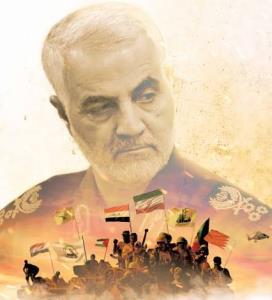
"Given the developments in recent months, including the US failed attacks on Iran and the growing popularity of Iran across the Muslim world because of its steadfastness and resilience against the US and the Zionist regime, the Iraqi people's view of Iran remains positive. The massive turnout of Iraqis at the funeral of the slain resistance leader is a testament to Iran's spiritual and moral standing among Iraqis. Iran has proven itself a powerful neighbor, one that has stood by Iraq's people in difficult times and helped them. At the same time, given the Iraqi public's preference for Iranian goods, the Iraqi government is compelled to respect its people's will. In that vein, the approach of parliamentary blocs, the Iraqi government and the Sudani administration is all aimed at deepening bilateral engagement across every domain."
On the whole, the trajectory of Tehran-Baghdad negotiations suggests that despite Washington's pressure, shared economic interests still have the capacity to open new pathways for settling claims, sustaining two-way trade and mitigating the impact of sanctions.