







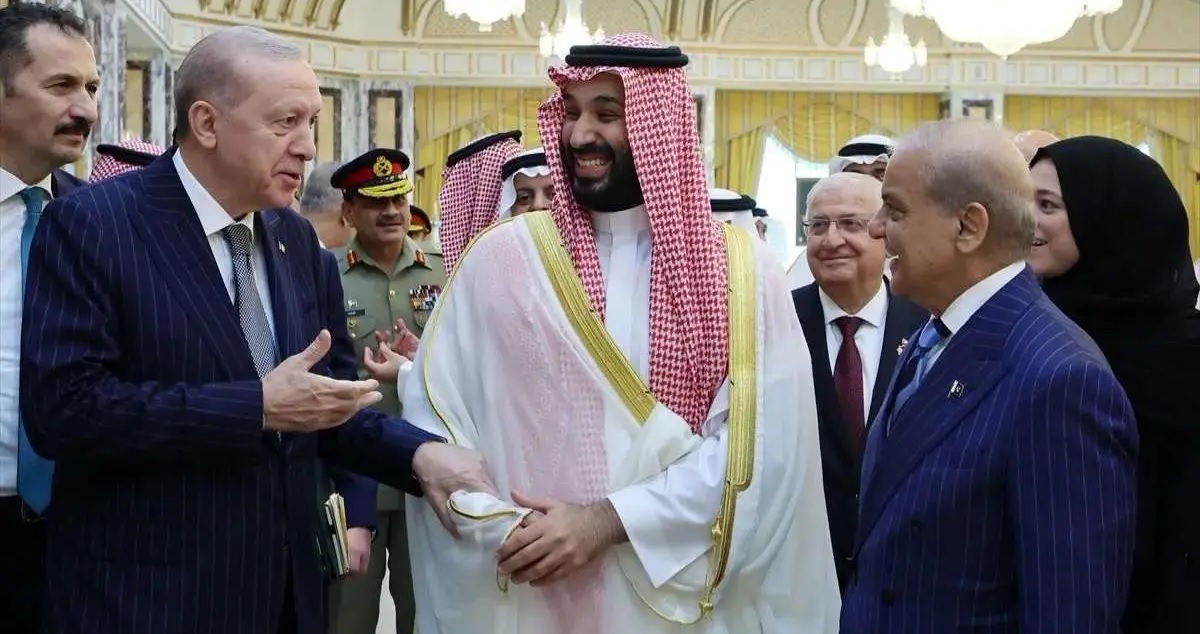


Alwaght- Signing the trilateral defense pact by Saudi Arabia, Pakistan, and Turkey is not just making a military alliance, rather, it can signal rise of a new security formation in West Asia that at the end of the road would seriously challenge the US and Israeli regime's interests and lofty ambitions.
Signed last week by leaders of the three countries in Mecca, the pact rests on the principle of collective defense, meaning that an attack on one is an attack on all. Turkish Defense Minister Yasar Guler said that the structure of this pact technically resembles the article 5 of NATO: An attack on one member will be considered am attack on the whole bloc.
Tel Aviv’s concern
The significance of this pact, from the Israeli perspective, becomes clear the moment you look at who signed it. Pakistan does not recognize Israeli regime. Turkey has emerged as one of the most vocal critics of Tel Aviv’s Gaza policy in recent years. And Saudi Arabia, despite earlier expectations of normalization, has so far refused to establish official ties with this occupational regime.
In effect, the tripartite defense agreement marks one of the most telling signs yet that the region’s security calculus is shifting, and it poses a direct challenge to the Trump administration’s regional strategy. The deal comes at a moment when Washington finds itself stymied on multiple key objectives across the region.
Countries seeking to break free from US dominance
Mecca agreement comes at a time the Israeli hostilities to regional countries have drastically changed the regional security equations. Analyses emerging on the agreement show that one of the outcomes of this pact can show itself in increased security independence of regional states and decreased reliance on the US security guarantees, something that will restrict the Israeli maneuvering space.
The stakes grow even higher when you consider that the Mecca pact is not merely a political arrangement, but explicitly aims to build joint defense capacity among the three signatories. Turkey fields one of the region's most powerful militaries and boasts advanced drone capabilities. Pakistan stands as the only nuclear-armed nation in the Muslim world. And Saudi Arabia brings deep financial reserves and the ability to acquire cutting-edge weaponry. If this agreement coalesces into a coherent military framework, that combination of assets could fundamentally reshape the regional balance of power.
The pact comes as the Trump administration was actively working to reorient the region's security and political architecture more tightly around cooperation with Washington and Tel Aviv. This new alignment, however, signals that some traditional US allies are moving toward more independent security arrangements. Analysts read the agreement as a reflection of eroding trust among regional powers in US security guarantees.
Failure of Trump's normalization plan
Israeli media have not dismissed the Mecca pact as just another defense agreement; they view it as a factor that cuts directly into Israel's security calculus and its normalization drive with Arab states. The Jerusalem Post reported that the deal could complicate, and perhaps even derail, Tel Aviv's hopes of advancing normalization with Saudi Arabia.
To be sure, the published text of the pact does not name Israeli regime as an enemy or target. Yet even Israeli analysts have stressed that the Mecca agreement amounts to a military coalition with latent anti-Israel potential, one that, in the event of escalating regional conflict or expanded membership, could morph into one of the most significant strategic obstacles Tel Aviv faces in West Asia.
In essence, the pact's real significance lies not in naming a specific adversary, but in forging an independent Muslim security bloc outside Washington-led security architectures, a bloc whose three members, each for their own reasons, all hold critical stances toward Israeli policies. Should the agreement expand in the future, its capacity to upend the region's security equations and constrain Israeli influence would only grow, a trajectory running directly counter to US objectives in the region.
For the Trump administration, one of the foremost goals has been to expand the Abraham Accords and bring Saudi Arabia into normalization with Israel. Trump himself declared in July that a US-Saudi civilian nuclear agreement should be tied to Riyadh's accession to the Arab-Israeli normalization deal. Yet Saudi Arabia continues to condition normalization with Tel Aviv on a clear pathway to an independent Palestinian state.
Now, formation of an independent defense pact by Saudi Arabia, Pakistan, and Turkey shows that Riyadh is diversifying its security options. In other words, instead of tying its security to alliance with Washington and Tel Aviv, the Arab kingdom is concocting a multifaceted security network.
Gaza plan: Trump-Netanyahu dispute
Another driver behind the Mecca pact may well be the failure of Trump's broader strategy in West Asia and Gaza. Washington has been pushing a multi-phase plan aimed at establishing a foothold in the region and locking in a political arrangement on its own terms.
But Netanyahu has planted himself squarely in the way of key components of that plan. The Israeli PM has declared that Tel Aviv will not withdraw its forces from Gaza until Hamas is fully disarmed, a stance that effectively stalls any swift implementation of the Trump proposal.
That rift exposes a fundamental reality and it is that even Israeli regime, Washington's closest ally in the region, is not prepared to automatically fall in line with the US president's wishes on a strategic issue of this magnitude.
Iran war: The bigger test
On the other hand, Mecca pact is signed at a time the US and Israeli regime have failed to beat Iran in their aggression. The anti-Iranian war not only failed to bring Washington a sweeping, decisive victory, but also its impacts have rattled Arab states in terms of security, incentivizibg them to seek independent defense mechanisms.
The trilateral pact was forged precisely in this post-war climate. According to published analyses, the US-Israeli strikes on Iran, and the resulting regional anxiety over spillover effects, were a key driver pushing Saudi Arabia, Turkey, and Pakistan toward closer defense partnership.
Seen through this lens, the war's outcome cannot be measured on the battlefield alone; its political aftershocks matter just as much. If Washington's aim was to bolster its own deterrence and reassure its Arab allies, the emergence of an independent defense pact among three major Muslim powers suggests the opposite. It suggests that Washington's failure in the war against Tehran has eroded trust among its longtime regional partners, nudging them toward a security framework outside US orbit.
Taken together, these developments paint a picture of West Asia that looks nothing like what the Trump administration envisioned at the start of its new term: broad Israeli-Arab normalization, a cemented US role as the region's ultimate security guarantor, and a new order designed to contain Iran.
But today Saudi Arabia has not yet normalized official ties with Israeli regime, the US plan for Gaza has faced Netanyahu’s pushback, and after Iran war, three Muslim powers have embarked on an independent military structure.
So, Mecca pact should not be seen just as a military agreement, but a sign of the erosion of the US capability to set the security terms of the new West Asia. From this perspective, the most urgent message of Mecca agreement for Trump’s administration may be that the region is drifting from the US-designed order to one set forth by regional powers themselves.