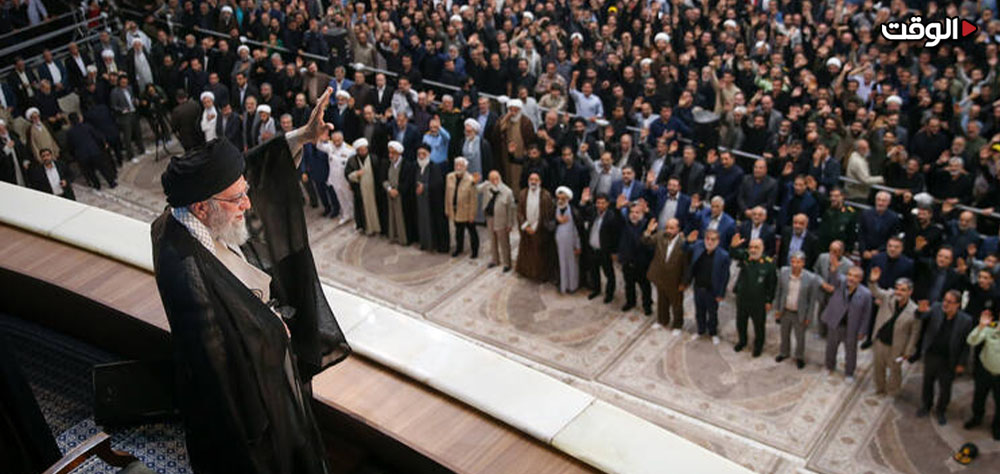







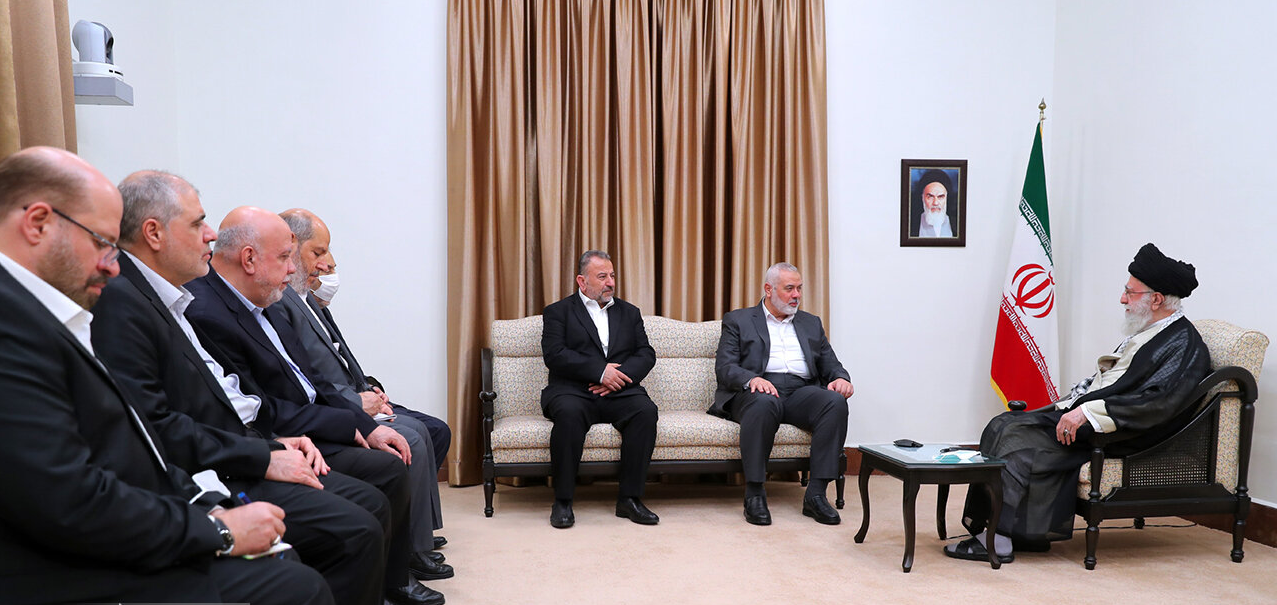


Alwaght- The martyrdom of Iran's Supreme Leader Ayatollah Sayyed Ali Khamenei has not only immersed Iran into mourning, but also the resistance groups from across the region, especially the Palestinian public and leaders, find themselves in loss of a man who over decades supported the Palestinian cause, inspired resistance, and provided a reliable backing to the Palestinian fighters against the Israeli occupation.
The record of his meetings with the Palestinian resistance leaders show that Palestine was not a simply political or geopolitical case in the martyred leaders' worldview, but also had a an ideological and strategic place, something emphasized by many Palestinian leaders in their account of relations with the Islamic Republic and the martyred Leader himself.
In this regard, Osama Hamdan, a prominent member of Hamas's political bureau, spoke with Al-Ahed website on the sidelines of the funeral ceremony for the martyred Imam, reviewing key turning points in Hamas-Iran relations and revealing aspects of the movement's leadership meetings with the martyr.
In describing the martyred leader's character, Hamdan's first highlight is his faith-based view of Palestine.
"The martyred Imam saw Palestine as a matter of faith and a struggle between right and wrong," Hamdan said, adding: "He never treated it as a political issue open to bargaining or expediency-driven calculations." Backing up the Hamas official's remarks, the martyred Imam himself emphasized in March 2017 during a meeting with participants of the sixth International Conference on Supporting the Palestinian Intifada: "The Palestinian issue for the Islamic Republic is not a tactical or temporary matter, but a principled and ideological one."
This very outlook exposes the fundamental difference between Ayatollah Khamenei's approach and that of most world political leaders, because in his thinking, Palestine was never an issue that shifted with changing governments, regional developments, or international pressure; it was, rather, part of a religious and humanitarian duty.
Palestinian cause a uniting factor for Muslims
In his remarks, Hamdam pointed to the special place of Palestine in the thought of the martyred leader, saying that he considerd Palestine as belonging to all of the Islamic ummah and it stood as a uniting factor against divisive projects. This description aligns with the Ayatollah Khamenei's repeated stances on making Palestine the "axis of convergence" for the Islamic world, a view he has underscored over the years in Quds Day speeches and meetings with Palestinian delegations.
The martyred Imam said on numerous occasions that "the Palestinian issue is the primary issue of the Islamic world. We must never neglect the importance of political support for the Palestinian people. Muslim nations, regardless of their leanings or approaches, can unite around the axis of Palestine." On this basis, defending the Palestinian people was never contingent on political conditions but stemmed from a permanent duty.
Hamdan later pointed to another key trait, one that many resistance leaders believe was the secret behind Iran's enduring support for Palestine.
"The positions that Hamas leaders witnessed in every meeting with the martyred Imam Khamenei showed an unparalleled commitment to Palestine. That commitment was not confined to traditional forms of support; he was constantly pursuing new ways to strengthen the resilience of the resistance groups and the Palestinian people", Hamdan said.
These remarks offer a clear picture of how Ayatollah Khamenei managed this important case. Under his leadership, support for the resistance never remained limited to political stances or solidarity statements and evolved into an ongoing process of bolstering the resistance's capabilities. The Supreme Leader consistently emphasized in meetings with Palestinian leaders that the Islamic Republic would back any Palestinian faction fighting occupation, and that this support would continue because he viewed Palestine's victory as beneficial to the entire Muslim ummah.
In October 2014, during a meeting with Ramadan Abdullah Shallah, the former secretary-general of Palestinian Islamic Jihad, the martyred Imam stated: "The Resistance front must constantly increase its readiness and build up its power reserves in Gaza. We must ensure that the Zionist regime feels the same concern about the West Bank that it feels about Gaza." These remarks affirm Osama Hamdan's account that Iran's support was never limited to one faction and all Palestinian resistance movements enjoyed the backing of the Islamic Republic and its late leader.
By the admission of Palestinian leaders themselves, the outcome of such an approach was a dramatic boost in the resistance's capabilities across multiple domains. Once reliant on limited operations, the resistance has now reached a level of deterrence that forces the Israeli regime to deploy its full military and security apparatus to counter it. Resistance commanders have repeatedly stressed that this transformation would have been impossible without Iran's unwavering support throughout Ayatollah Khamenei's leadership.
Another crucial point in Hamdan's remarks is the martyred Imam's transnational view of Palestine. "The martyred Imam Khamenei saw Palestine as the cause of the entire Muslim nation, not just the Palestinians," Hamdan said. "In every meeting, he stressed that this issue must serve as a unifying force for Muslims against projects of division and fragmentation."
This perspective was deeply rooted in his consistent positions. He repeatedly warned that the enemies of the Islamic world were trying to push Palestine off the Muslim agenda and replace it with sectarian and ethnic divisions, insisting instead that Palestine must remain the axis of convergence and unity for the Islamic nation.
The martyred leader initiated Islamic Republic’s relations with Hamas
Hamdan went on to address a pivotal chapter in his interview, which was the launch of formal ties between Hamas and the Islamic Republic. "The first official contact between the Hamas movement and Iran came on the direct orders of the martyred Imam Khamenei," he said. The late leader personally delineated the framework for this relationship, a framework that, despite three decades of regional upheaval, has remained remarkably consistent.
This account lays bare the centrality of Palestine in the martyred Imam's strategic thinking. Iran's relationship with Hamas was never ad hoc; it was built on a long-term strategy. That is precisely why, even through periods of complex regional crises, the core principle of supporting the Palestinian resistance never wavered.
Martyred leader was attentive of even trivial problems of resistance
One of the most telling parts of Hamdan's remarks was his account of the martyred Imam's direct, hands-on involvement in resistance affairs. He revealed that during a 2018 visit, resistance leaders raised a technical problem with Ayatollah Khamenei that had been hampering certain operations, and the Imam immediately ordered it resolved. The issue was swiftly fixed.
This account underscores that the Supreme Leader's support was never confined to high-level policymaking; he tracked the granular details of the resistance's needs. That kind of hands-on stewardship unlocked new capabilities for Palestinian factions and accelerated the resistance's upward trajectory.
Alongside this material support, one of the martyred Imam's most steadfast principles was the independence of Palestinian decision-making.
"The martyred Imam Khamenei always dealt with resistance groups as independent allies, not as executive tools. The Islamic Republic provided support, aid, and counsel, but political and military decisions remained firmly in the hands of the groups themselves," Hamdam held.
These remarks serve as a clear rebuttal to the recurring Israeli claims about Palestinian resistance being entirely subordinate to Iran. The martyred leader himself, in meeting after meeting with resistance leaders, consistently affirmed the Palestinian people's right to self-determination and made it clear that the Islamic Republic would back any decision Palestinians themselves made to defend their rights. He repeatedly stated: "We defend Palestine because we see it as our duty to defend an oppressed nation", while insisting that the resistance's decisions and will belong to the Palestinians alone.
Charishing unity of fronts
Hamdan also highlighted the martyred Imam's integrated vision for regional resistance, stating that Ayatollah Khamenei "never viewed support for Hezbollah as separate from support for the Palestinian resistance, and he treated both as two fronts in a single unified battle." From the Hamas leadership's perspective, Hezbollah's backing of Gaza was thus the direct outcome of years of the martyred leader's intellectual and strategic efforts to forge resistance unity and prevent any single front from being isolated.
Ayatollah Khamenei himself repeatedly stressed the need for resistance front cohesion, believing that the security of regional countries is interlinked, and that any weakening of Palestine would threaten the security of all Islamic nations. This very outlook laid the groundwork for the broad coordination among resistance groups that has taken shape in recent years.
Supporting Operation Al-Aqsa Storm
The Palestinian figure also addressed the Islamic Republic's extensive backing for Palestinian resistance operations in the recent confrontation with the Israeli regime, noting that the martyred Imam praised Operation Al-Aqsa Storm from its very first days. The leader consistently lauded the resistance's achievements, framing them as milestones in shattering the Israeli army's invincible image, and stressed that willpower and faith have the power to shift the balance of power.
In a speech on the anniversary of Imam Khomeini's passing onJune 3, 2024, Ayatollah Khamenei called Al-Aqsa Storm operation a turning point in regional dynamics, stating: "Al-Aqsa Storm ushered the region into a new phase. This operation was carried out at a critical historical moment, upended the US's key roadmap for the region, and halted the normalization process with the Israeli regime." Militarily and intelligence-wise, the Israeli regime suffered an irreparable blow in Al-Aqsa Storm."
The influence of the martyred leader's stance on Palestine and resistance is also evident in the assessments of other Palestinian leaders. Sheikh Hussein Mohammed Qassem, head of the Palestinian Scholars Council, who attended the funeral ceremony in Tehran, described Ayatollah Khamenei as the "father of the world's oppressed" and stressed that he remained faithful to the Palestinian cause and the resistance until his final moments, paying a heavy price to support the resistance movements.
These statements from Palestinian leaders show that they did not view the martyred Imam merely as Iran's leader, they saw him as a strategic and moral backbone for the resistance. In their eyes, much of the resistance's progress on military, political, and deterrence fronts was achieved under the shadow of the Islamic Republic's unwavering support throughout his leadership, support that propelled the Palestinian resistance beyond a phase of limited defense and transformed it into a decisive player in the region's equations.
Given this far-sighted vision that the wise and sagacious leader brought to supporting the resistance, Palestinian leaders are not concerned that his absence will create any gap in the Islamic Republic's decades-long backing. Osama Hamdan confirmed as much, stating that all cooperation and coordination with Tehran has continued unchanged since the martyrdom of Imam Khamenei, with no reduction in the level of support or commitment. This Hamas leader expressed confidence that the Islamic Republic, under its new leadership, will carry this path forward and that the Axis of Resistance will remain united.