














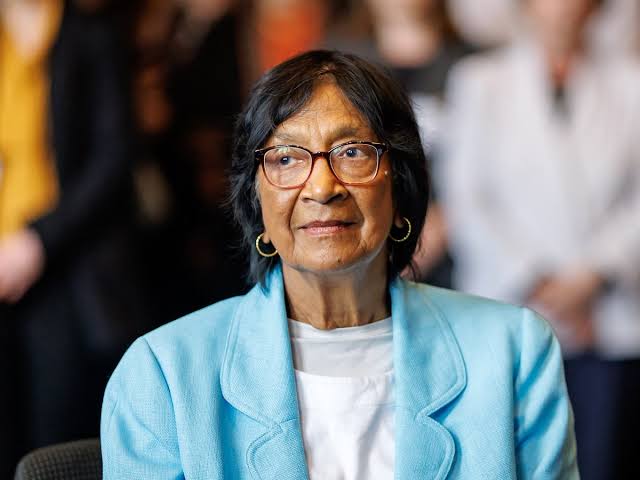


Alwaght- This year, Nobel Peace Prize was awarded to Navanethem Navi Pillay, a prominent South African jurist and former UN High Commissioner for Human Rights. This choice has become the latest flashpoint between Israeli regime and international institutions.
Responding to the awarding, Israeli Foreign Ministry fired back on X, calling the award a bid to legitimize what it termed "anti-Israeli hatred and bigotry," unleashing sharp rhetoric against both Pillay and the Nobel Committee.
Israeli Prime Minister Benjamin Netanyahu also weighed in, declaring the Nobel Committee had "lost its moral compass" and attacking Pillay in derogatory terms.
Taking aim at the committee, he said: "I admire President Trump and Secretary of State Rubio for their resolute decision to impose sanctions on the International Criminal Court."
From fighting apartheid to distinguished place in international law: Who is Navi Pillay?
Pillay, a South African jurist born in 1941, grew up in Durban in a family of Indian Tamil descent. She launched her legal career defending opponents of apartheid, South Africa's system of racial segregation, an experience that profoundly shaped her legal philosophy on equality, human dignity and state accountability.
In 1967 she opened her own law practice, and in the years that followed, particularly while representing anti-apartheid activists and political prisoners, she became one of the most recognized figures in South Africa's legal community. In 1995, she became one of the first non-white women appointed to South Africa's High Court, a milestone in the country's transition from apartheid to a new political order.
Her career then shifted to international criminal justice. She served as a judge, and later president, of the International Criminal Tribunal for Rwanda, established to prosecute the 1994 genocide. Her role in handling cases of sexual violence, including cementing the legal principle that rape under certain conditions can constitute a crime against humanity and genocide, ranks among the most significant chapters of her judicial record.
In 2003, she was elected as a judge to the International Criminal Court, and from 2008 to 2014 she served as UN High Commissioner for Human Rights. In that role, she took stances on human rights abuses across the globe and stressed that governments and officials must be held accountable for violations of fundamental human rights.
That record explains why the 2026 Nobel was not awarded solely for her positions on Palestine; the Nobel Committee cited her decades of work in international law, criminal justice and the pursuit of war crimes as the basis for its selection. Still, her role in the Gaza case has become one of the most potent political and media flashpoints driving Tel Aviv's reaction.
Gaza case, the main clash point of Pillay with Tel Aviv
The core of Israeli officials' fury over Pillay's selection lies in her chairing of the UN Independent Commission of Inquiry on the Occupied Palestinian Territory, including East Jerusalem, and Israel. Between 2021 and 2025, the commission examined developments in the occupied territories, Israeli policies and their consequences for Palestinian rights.
In its statement, the Nobel Committee said this year's award honored Pillay's efforts to advance peace and international law, stressing the need to defend the global legal order and hold perpetrators of war crimes, crimes against humanity and genocide accountable. So while the Gaza report was not cited in the committee's statement as the specific reason for the prize, Pillay's record on that case formed a prominent part of the political backdrop to the backlash over her selection.
In September 2025, the commission stated in a legal report that, based on its findings, Israel had committed genocide in the Gaza Strip. The report cited four acts covered by the Genocide Convention and concluded they were carried out with the specific intent to destroy Palestinians in Gaza, in whole or in part. The commission also examined statements by senior Israeli officials, deeming some of them incitement to genocide.
That conclusion carries weight because genocide is among the gravest charges in international law, not limited to a high death toll, but requiring proof of specific elements, including intent to destroy all or part of a national, ethnic, racial or religious group.
Though the UN commission's report is a documented legal assessment by an investigative body and does not itself constitute a final ruling by an international court, its findings played a significant role in the International Criminal Court's ruling against Israeli leaders, chief among them Netanyahu.
Four areas of anti-Israeli criticism
1. Massive destruction of miserable living conditions of Palestinians
The commission examined the widespread destruction of residential areas, critical infrastructure and resources essential to the survival of Gaza's civilian population. According to its report, these actions must be assessed within the legal framework governing genocide and other international crimes.
2. Collapse of Gaza health system and denying humanitarian aid
The commission's report pointed to the systematic destruction of medical capacity, restrictions on humanitarian aid imports and the consequences of those policies for the civilian population. These issues figured into its assessment of living conditions for Palestinians and its examination of the legal elements of the genocide charge.
3. Forced migration and demographic change
It warned about the forced displacement of Palestinians, the creation of buffer zones and military corridors, and statements by some Israeli officials about relocating Gaza's population. In the body's assessment, carrying out plans to forcibly expel a population can constitute a crime against humanity.
4. Remarks of senior Israeli officials and intent to commit genocide
Beyond examining the war's on-the-ground impact, the commission also assessed statements by Israeli political and military officials. It deemed some of those statements evidence of genocidal intent or incitement to commit genocide, a finding that played a central role in the case's legal analysis.
Defending Palestinian right to self-determination: Going beyond Gaza war
Her positions on Palestine are not confined to developments after the October 7 attack. Even before the Gaza war began, the commission she chaired had examined Israeli policies in the West Bank, settlement expansion, the demolition of Palestinian homes and measures leading to the entrenchment of permanent control over the occupied territories.
In the commission's reports, the expansion of Israeli settlements, the shrinking of Palestinian living space and the fragmentation of West Bank geography were assessed as factors undermining the right to self-determination and the viability of an independent Palestinian state. The commission had also warned of the risk of de facto annexation of parts of the West Bank.
One of Pillay's clearest positions has been her insistence on protecting the Palestinian people's right to self-determination and the establishment of an independent Palestinian state. In her address to the UN General Assembly's Third Committee in October 2025, she cited the scale of destruction in Gaza and urged member states to use every reasonable tool at their disposal to sustain the cessation of hostilities and uphold the right to self-determination and Palestinian statehood. It was against that backdrop that last year, on the sidelines of the 80th UN General Assembly session, 11 European countries, including Britain, Spain and Belgium, announced at a meeting titled "International Conference for the Peaceful Settlement of the Question of Palestine and the Implementation of the Two-State Solution" that they would recognize an independent Palestinian state, a major political and diplomatic blow for Tel Aviv.
She has also stressed the need for judicial follow-up on international crimes, support for International Criminal Court investigations and the use of universal jurisdiction by states to pursue allegations of such crimes.
What makes these positions significant for Tel Aviv is that Pillay's criticism has not remained at the level of political condemnation of military operations, it is tied to demands for legal mechanisms to hold responsible officials accountable. Such an approach could increase legal and diplomatic pressure, though its practical consequences depend on decisions by judicial bodies, governments and international enforcement mechanisms.
From South Africa to the Hague: Start of legal domino actions against Israeli regime
In grasping the depth of Israeli fury over Pillay's selection, one should not gloss over her South African nationality. A country that itself endured decades of apartheid and racial discrimination filed a case against Israel at the International Court of Justice on December 29, 2023, one of the most significant international legal actions over the Gaza war. In its filing, Pretoria alleged that Israel's actions and policies in Gaza violated its obligations under the Genocide Convention, and asked the court to issue binding provisional measures to prevent irreparable harm to Palestinians.
After Pretoria's move, other countries stepped in to join the proceedings or support the case. Nicaragua, Colombia, Libya, Mexico, Palestine, Spain, Turkey and Chile all pursued intervention or participation in the South Africa v. Israeli regime case at various stages.
Nobel Peace Prize under the shadow of US pressure on international judicial institutions
This year's selection came as the International Criminal Court and other international legal bodies face considerable political pressure.
On the day the prize was announced, the US unveiled fresh sanctions against the ICC, a move set against Washington's escalating tensions with the court and its opposition to its actions against Israeli officials. That timing lent new dimensions to the debate over the independence of international judicial bodies and state pressure on accountability mechanisms.
Later in September, Washington also announced it was formally withdrawing from the UN Human Rights Council, accusing the body of promoting what the State Department called "anti-American rhetoric" and of appeasing repressive regimes. Washington had previously sought to stifle the voice of justice through international legal channels by imposing sanctions on ICC judges and lawyers and on human rights activists, using intimidation and pressure.
Yet, despite all these attacks and pressures, Pillay's selection showed that the global will to hold perpetrators of Israeli war crimes accountable has not stalled, and has laid bare, more than ever, the gap between the West's human rights claims and Washington's political backing of Tel Aviv.
Indeed, in terms of its political messaging, awarding the prize to Pillay goes beyond honoring one jurist's record. Actually, at a moment when international judicial bodies face mounting political pressure, the choice has thrust back to center stage the question of accountability for war crimes, support for the rights of the Palestinian people and the relationship between political power and the rules of international law.










