

















Alwaght- It was Wednesday and the first day of school which is known in Iran the "First of Mehr", the day "back to school" bell sounded across the country. A ceremony was about to start and it was 7:00 a.m. Students accompanied by their parents and teachers stepped in the school yard and the eyes went, since the first moment, to a corner that looked more like a park than a school. A playground with swings and slides and play equipment meant for children. But no one went near it.
The yard remained empty at first. The girls and boys glanced sideways at the slides and swings, as if they were still too shy to be the first to set foot there. This shyness did not last more than half an hour. After that, the yard filled with children chasing each other, pushing one another on the swings, and laughing out of sheer joy.
Not all of them were in the mood to play, of course. Some clung to their mothers, and the stress of the first day of school would not let them even think about playing. In another corner, a stall was giving children and families cold drink; in the heat of southern Iran, a drink that seemed refreshing. Some kids took two at a time and carried them to their friends.
If you saw only this corner, it was the first day of Mehr at any other school. But this school has a name that would not let this impression last long: Shajareh Tayyebeh.
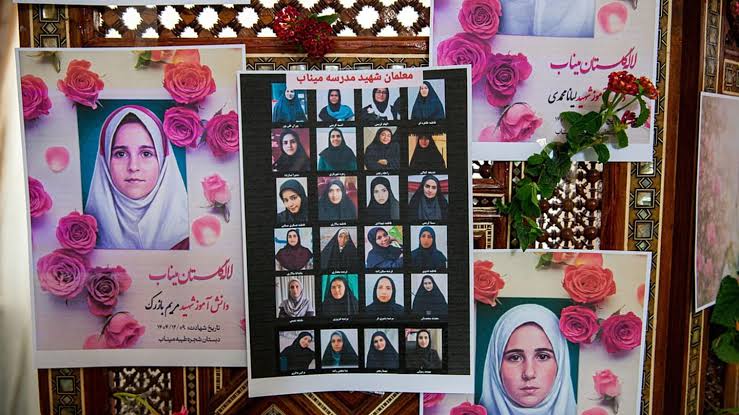
On February 28, the building of Shajareh Tayyebeh School, an elementary one, in Minab town of Hormozgan province south of Iran, was bombed, in a merciless attack by the two child-killing regimes, the US and Israeli regime. In this attack, 168 people were martyred, including students and teachers and educational staff, and a number of parents who had come there to collect their children.
The building collapsed, but the school did not give up. Through the efforts of provincial and national officials and the help of donors, and with the participation of Hormozgan Steel Company, this school was moved to a new place; a temporary building for a two-year period, until the larger complex, which is still under construction, is ready. In the school year 2026-2027, 120 male students and 107 female students are to study there, in two separate complexes.
The children who were entering through the gate of the new school this morning, most of them are the survivors of that same famous Shajareh Tayyebeh school.
Some were wounded or stuck under rubles, some were absent that day or had left the school before the US attack was carried out. But no one went without impact. Each of the students and staff lost something or someone, some lost their health and some a teacher and classmate.
In the midst of this, however, the worries still stand firm. A mother was saying that sending children off to a school that went through that last year is hard for any mother. Some of the children were truly happy that school was reopening, but anyone who set foot in this ceremony became aware of the ceremony's dual atmosphere. In that morning, two numbers sat side by side: the 168 who are not there, and the 227 students who are supposed to be. A strange feeling for those present, who did not know whether they should be happy or sad.
But the main question of this morning was something else: when you rebuild a school for its survivors, what exactly does "returning to normal" mean? The people in the yard each had a different answer.
Officials talked of resistance and sacrifice
Tehran's Mayor Alireza Zakani, Hormozgan Province Governor Mohammad Ashour, and a number of other state and provincial officials joined the ceremony of First of Mehr at the school.
The governor talked about the "campaign to upgrade educational infrastructure" which is meant to increase the per capita of Hormozgan's educational space, adding that the Municipality of Tehran is set to assist the province in establishing Shajareh Tayyebeh memorial.
He emphasized that this movement is not limited only to education and schooling, but encompasses the entire chain of education, and it will not move forward without the cooperation of all institutions. According to him, this school has become a symbol of the students' oppressedness and the resilience of the Iranian people, and its capacity must also be used to promote sacrifice and the pursuit of knowledge.
First of Mehr and renewed grief of parents of Minab school
But what came to the focus more than the speeches of officials were the people who did not address.
Mothers and fathers of several martyrs were walking through the school with their children's photographs in hand, looking around. There was turmoil in their hearts, but they smiled at their martyred child's classmates. They were happy that the school was back on its feet and that there were those who were going to continue their children's path.
The school yard was shared between girls and boys. In one corner, children were laughing on the swings, and in another corner, parents were walking with picture frames. These two images did not interrupt each other; they simply sat side by side. Perhaps the smiles of those parents were part of that same answer: if there is a school where children play, then something of what their martyrs loved still remains.
One phase repeated: Empty place
For the families of Minab, the first day of Mehr is no longer just a date on the calendar; it is a day when absence is more visible than on any other day. Every morning, school begins with little details that this time have no audience: a school uniform no one wears, a shoelace no one ties, bags that will never be carried to school again.
Among those who are not here today are several teachers as well. Women who considered the school their second home, who flipped through notebooks and talked to the children about the future, and who were supposed to stand behind those same desks this year too. Now, in one school, both the student's place and the teacher's place were empty. In the homes, this emptiness takes another form: a mother who pauses over her child's belongings while tidying the room, a father who still listens for the sound of the door for his child to come home, a brother and sister who feel one person's absence at the dinner table.
For some families, the mourning is not yet complete. The name of Makan Nasiri, one of the students, is still on the list of the missing; nothing remains of Makan. Another mother was speaking with a reporter, saying she is still waiting for something of her child to be found, even if it is a few pieces of bone. She spoke of mothers who still have no place to lay their heads on their children's grave. Of course, in recent months, through efforts made, wherever facial identification has not helped, clothing and belongings have been examined and DNA samples have been matched with first-degree relatives; but the search operations are still ongoing.
And for a family that is waiting, receiving an answer means the end of waiting and the beginning of mourning all over again.
One of the mothers was saying that with their own hands they packed the children's bags and sent them off to class; for her, sending her child to this very school was itself a kind of answer. One of the students also said that now that his classmates are not there, he picks up the pen on their behalf. According to him, the targeting of the school has not only not made the children weary of studying, but has strengthened their determination to study more.
And a fifth-grade student was recounting that when he entered the classroom, on the bench beside him, instead of his classmate, he saw a bouquet of flowers and a framed photograph. This year's class has become emptier, and the place of their kind teacher is empty too. Still, he had decided to study harder this year than ever before.
In Minab, life does not stop; the children must study and the teachers must run the class. But in the families' telling, continuing is one thing and forgetting is another. Behind each of those 168 numbers was someone who had many hopes and dreams.
Of course, the new school's love is not going to last long either. These children change schools twice in one year: from a building that collapsed to a temporary building, and then to a new building that is not finished yet. Alongside all of this, a memorial is also supposed to be built, which, as was said, Tehran Municipality has a share in developing.
The classrooms of the new school were ready to welcome the children, and everything was well equipped. A room was also dedicated to a library, intellectual activities, and board games suitable for children.
At the end of the ceremony, the students sent 168 doves into the sky in memory of their classmates. Of course, not all of them did this willingly. Some playfully refused to release the birds and wanted to take the doves home with them.
And then the bell rang. One of the fifth-grade students said the sound of the school bell reminds him of the laughter of his martyred friends. The children went to their classes in groups, and the hallways became crowded, with students, officials, and journalists who had come to prepare reports; I was one of them. Some children were looking for their teacher, and some for a friend to sit beside.
I asked one of the students why he had come back to Shajareh Tayyebeh.
He said: "I did not want to forget the memory of my martyred friends and our school."
To me, his answer seemed more like a decision than a response. For him, coming to school was not just going to class; it was a kind of loyalty. The officials spoke of standing firm, the families spoke of continuing the path, and this student spoke of not forgetting. They were three languages for one shared promise: the path of Shajareh Tayyebeh and the school's martyrs must not be lost.
In official narratives, this day was mostly recorded with words like resistance and standing firm. Alongside this narrative, the children were living with their own words: play, running, teacher, and friend.
A little later, when the children had become familiar with the school's interior and their teachers, they came out of the classes in groups. I asked a third-grade boy why he was so happy.
He said: "Our classes have gone virtual. We're going home now."
The reason was a decision made by education officials: because of the sensitive conditions of Hormozgan Province, the painful memory of Shajareh Tayyebeh, and the worries of families, for now the province's schools are continuing online. That day, and at least for an unknown period, the newly established school, the new classrooms and benches, the book and board-game room that had been arranged with all that care, for now they would have to wait. Until the students can once again attend school in complete safety and away from the anxieties of their parents and teachers.
On a First of Mehr at Shajareh Tayyebeh school, that third-grade boy, without intending to, had given the most precise definition of that morning. For a child whose school was bombed and then rebuilt, perhaps returning to normal life is the truest thing; being happy that class is canceled. The mourning is not over, nor have the 168 names been forgotten. There is just a third-grade boy who wants to go home early.










