













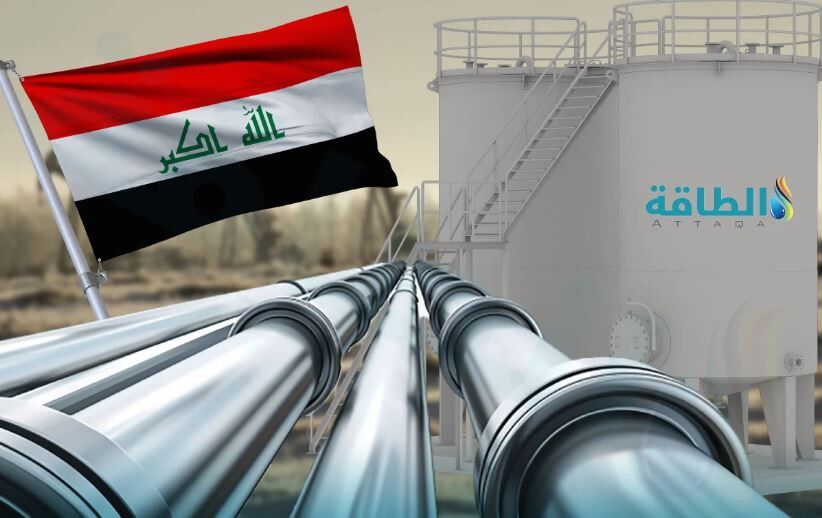


Alwaght- Closure of Strait of Hormuz following the joint American-Israeli aggression against Iran has left Iraqi economy grappling with one of toughest shocks. This vital bottleneck, through which over 20 million oil barrels cross to the global markets, was closed to the Iraqi oil exports all of a sudden. A country whose budget relies 90 percent on the oil revenues suddenly found itself in a strategic dead end for energy exports.
Before the crisis, Iraq was exporting roughly 3.4 million barrels of oil per day, most of it passing through the Port of Basra and the Strait of Hormuz. But once that international waterway was shut down, Iraq’s exports plummeted to less than one-third of their previous level within days, and production collapsed to around 1.3 million. Experts estimate daily losses at between $260 million and $280 million.
In response, the Iraqi government was forced to halt production at major fields including Rumaila and West Qurna 2, and offered customers discounts of up to $33 per barrel to sell whatever oil remained.
Unlike Persian Gulf monarchies such as Saudi Arabia, the UAE, and Qatar, Iraq had done little to reduce its dependence on the Strait of Hormuz before the closure. Years of foreign and internal wars had effectively robbed Iraq of any chance to invest in alternative infrastructure. But the moment the crisis hit, Baghdad realized it had virtually no backup route for its energy exports. That shock, it seems, has pushed Iraqi politicians to finally shelve old dreams of development via the Persian Gulf and seriously pursue alternative energy corridors. In response to the strait crisis, Iraq has now adopted a two-pronged strategy.
The first and most urgent track is reviving the old Kirkuk–Ceyhan pipeline to Turkey. After months of political wrangling between Baghdad and the Kurdistan Regional Government (KRG), the two sides struck a deal in mid-March 2026 and reactivated the northern route. The current goal is to boost its capacity to 770,000 barrels per day, roughly triple current levels. Meanwhile, overland truck exports via various routes have at times reached 350,000 barrels per day.
The second track is more strategic, but also far more ambitious and expensive: building new, higher-capacity pipelines. Two major options are on the table.
First is the Basra–Ceyhan pipeline, effectively a new line from southern Iraq to Turkey’s Mediterranean coast proposed officially by Fatih Birol, executive director of the International Energy Agency, in mid-April 2026. In an interview with Hurriyet, Birol warned that “the vase has already been broken,” making it hard to fix the Hormuz route again. He called the project not a routine infrastructure initiative but a strategic necessity, for Iraq, for Turkey, and as a vital asset for Europe’s supply security.
The second option is an alternative east–west pipeline connecting Basra to Yanbu, a port on Saudi Arabia’s Red Sea coast. For now, this remains speculative. But it does offer certain advantages over the Turkish route.
Executing any of these plans would be an uphill battle for Baghdad. First, the trust deficit between Baghdad and Erbil remains unresolved, and exports through the northern route could halt at any moment. Second, the required investment for a new pipeline is estimated in the tens of billions of dollars and would take years, directly demanding a joint commitment from at least two countries. Third, political and security threats remain high. Iraq’s new prime minister faces one major political challenge above all and it is resolving the status of the country’s militias and integrating them into the national army. These forces have real operational capability, but also varying political loyalties, meaning each could end up advancing its own faction’s interests. That internal reality is fundamentally at odds with launching large-scale, strategic projects.
In the end, Iraq now seems to stand at a historic crossroads. Either it invests immediately in northern and western routes and gets on a path to reducing export risk, or it lets the new government get bogged down in internal political infighting, and loses the window for joint investment entirely.
Experience of the past three months shows that we should not be very much optimistic about the region restoring its calm in the short run. So, now that all Persian Gulf countries are seeking new energy corridors, the Iraqis are not seeing themselves no exception.










