
















Alwaght- The two-day clash between Iran and the Israeli regime after a two-month truce was, more than a temporary confrontation, an effort by the two sides to change the dynamics of the fragile ceasefire that has put the region in a state of no war, no peace. Both of them tried, through new attacks, seize the initiative and foist their conditions on the opposite side.
Over the past few weeks, Israeli regime officials, who had been trying to separate the Lebanon case from the Tehran-Washington dialogue, assumed that Iran would not directly retaliate for an attack on Beirut’s southern suburb of Dahiyeh. Their calculation was that Tehran would want to avoid undermining the ceasefire and complicating diplomatic efforts, especially while Pakistan’s envoy was shuttling between political factions in Tehran.
Based on that very calculation, the Israeli army launched strikes on parts of Beirut's southern suburbs on Sunday, aiming to establish a new rule of the game: attacking Beirut would become a routine, repeatable response to strikes on northern occupied territories.
Over recent months, Hezbollah has zeroed in on a key vulnerability of Tel Aviv’s security cabinet: its inability to secure a safety guarantee for northern settlements and bring back displaced residents. The ongoing lack of security in the north of occupied territories, and the ghost towns left behind, has put more pressure on Netanyahu’s cabinet than even rocket barrages on Haifa and Tel Aviv.
Despite advances south of the Litani River and attempts to create a buffer zone along Lebanon’s border, the Israeli military has still failed to change the security situation in the north. Hezbollah’s attacks continue, and displaced settlers have yet to return home. This failure and growing desperation led Netanyahu to see only one option left: expand the threat shadow over Dahieh to force Hezbollah to halt its attacks.
Conditions worsening for Netanyahu
But developments did not go as Tel Aviv officials had predicted.
In support of Lebanon, the Islamic Revolutionary Guard Corps (IRGC) launched two carefully calibrated missile strikes on occupied territories, one Sunday night and another Monday morning, effectively shattering Tel Aviv efforts to establish a new equation on the ground.
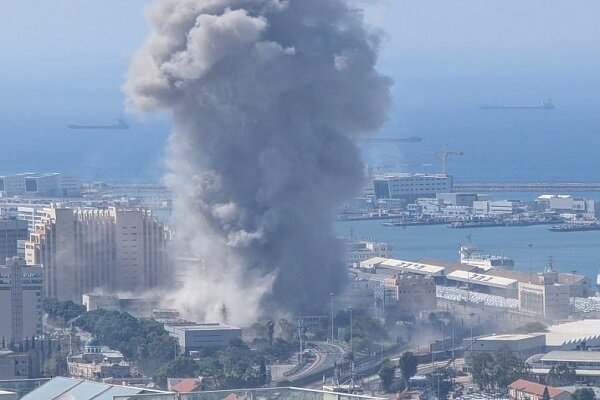
These strikes, carried out with reported 30 missiles and a number of drones, hit several key military sites and energy facilities in the occupied territories, including the Nevatim and Tel Nof airbases, as well as petrochemical plants in Haifa, causing significant damage.
The heavy strikes not only prevented the equation Netanyahu sought to cement in southern Lebanon from taking shape, but also made the situation for Tel Aviv more complicated than ever. Iran focused its attacks on the northern areas, precisely the Achilles’ heel of Tel Aviv’s security cabinet. As a result, insecurity in the northern occupied territories has now worsened, and fears over the future of those areas have grown.
In the aftermath, Ben Gurion Airport shut down again after two months. Schools and educational centers were closed indefinitely, Israeli hospitals went into full emergency and high-alert mode, and millions of people were evacuated to shelters for hours. According to Al Jazeera, the situation was so severe that large parts of the occupied territories were effectively paralyzed.
These strikes made clear that Iran is fully determined to enforce a ceasefire equation across all fronts, and that Lebanon must be included under the security umbrella of any ceasefire.
Upsetting Trump's calculations
Iran's missile response not only shattered Tel Aviv’s calculations, but also dealt a working blow to Trump's plannings.
Over the past two months, the strategy of the US government rested on maintaining controlled tension with Iran, meaning that Washington will keep economic and political pressures on Tehran while avoiding a large-scale military clash, to steer clear of higher oil prices, turbulent financial and energy markets, and also discontentment of the Arab countries. Meanwhile, Trump wants to run the FIFA World Cup games smoothly with least challenges.
But IRGC’s missile strike has now thrown Washington’s strategy of controlled escalation into serious disarray, and makes it clear that Tehran has read Trump’s mind, and is moving to impose its own terms for a ceasefire on the enemy.
Under these circumstances, if the Israeli regime resumes its attacks on Beirut, Iran will have the justification it needs to step up its strikes even more forcefully. And if the US backs any Israeli military action, the region could see tensions return to pre-ceasefire levels, especially in the Strait of Hormuz and with attacks on US bases in Arab countries. So, it is fair to say Iran’s missile operation has completely upended Trump’s calculations. The first sign was oil prices spiking.
In a post on social media, Iran’s parliament speaker, Mohammad Bagher Ghalibaf, made it blunt: “We shattered the ceasefire equation that existed on paper but was repeatedly violated on the ground.”
All in all, the Islamic Republic has used this missile strike to cement a new equation in favor of the Axis of Resistance. For the first time in this short confrontation, Iran was the one to go on the offensive, showing that if enemies try to break ceasefire agreements in the region, Tehran is ready to stage a higher level of conflict. The strike also sent a clear message, saying that Tehran will not leave its allies stranded on the battlefield, and that “unity of fronts” strategy, which says an attack on one branch of Axis of Resistance draws responses from other branches, is very much alive.










