














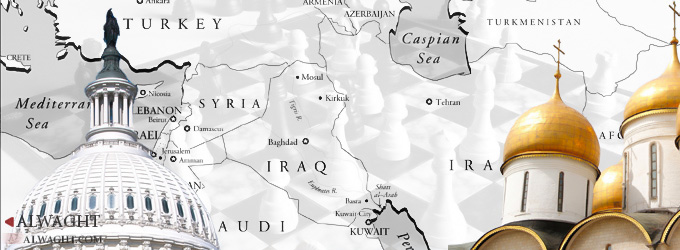


Alwaght- The direct Russian military presence in the Syria’s crisis came after when the US intervened the region directly. Apart from to what extent the Russian interests are involved in resolving the crisis in the region, the military presence indicates that Russia is rivaling the US and it is not intending to fall behind from a rival which is less exposed to the threat than Russia in the current conditions. Undoubtedly, the Russian military presence in Syria reflects this power’s interests in West Asia region. Suppressing ISIS as an insurgent force with a power to influence other extremist forces in other places has made Russia concerned about its Muslim community. It is for this reason that the Russian President Vladimir Putin in a comment about the war in the headquarter of the Russian Defense Ministry has said that the operation to destroy ISIS terror group was a Russian war but out of own borders.
On the other hand, the future of the Syrian developments is one of the significant worries of Moscow. The anti-Assad forces’ presence in the region shows that this old friend and Russia’s ally would be removed from power if it is not supported and on that case Syria could join the opposite block of Russia. On the other hand, preserving the Syrian unity and sovereignty is of significance for Russia more than it is for the US or Europe. Because the fragmentation of the country would tense up the regional condition and destabilize it over a period of time, and countries which are directly in continuous touch with Syria, like Iran, some of regional countries and Russia, would be more vulnerable to new developments. Therefore, Russia’s military attendance in the crisis-hit West Asia is adequately justified. But the question is that how long would this presence last? In fact, the question is that To what extent and how Russia would stand against West while having regional interests in direct conflict with them?
The fact is that concluding the ISIS' crisis depends on a cohesive unity between the regional and the international powers. This is while the Russia, Iran, Syria and Iraq alliance and the opposite side the US, Europe, Turkey and Saudi Arabia coalition are fighting against a shared enemy while they are holding different goals. Meanwhile, if the major objective, given the two sides are honest in their objectives, is to uproot the terrorist groups and restore stability to the region, the outcome would necessarily be reaching a unanimous conclusion about Syria’s future and the President Bashar al-Assad as well. Among the international forces, Europe demands a speedy action to obliterate the enemy because it had to deal with a lot of problems like the influx of the refugees, the waves of extremism and the terrorist attacks as a result of the crisis. Based on this ground, France is seeking coalescing all of the powers specifically Russia and the US. This issue was highlighted in the French President François Hollande’s visit to Moscow, as he reiterated it recently in his meeting with President Obama. The Washington’s precondition for forging such an alliance was to agree with Russia to make President al-Assad step down from power.
Among the two vital choices around the Syria’s future, saving Syrian unity and removal of the al-Assad, Syrian president, to Moscow the first choice is of significance while Washington looks forward for the second choice. Therefore, a situation in which Washington would reach a deal with Moscow over al-Assad could be imaginable. This condition is completely dependent on Washington’s way of making concessions. Actually, it should not be ignored that President al-Assad could turn to an important bargaining chip in the hands of the Russians. Following the Ukraine’s and Crimea Peninsula’s crisis, by imposing a set of sanctions on Moscow, the West has tried to punish Russia and isolate it. But Russia has managed to prove its role and power by taking part in Syria’s military equations and joining the Axis of Resistance beside Iran. Pursuing its highly significant interests in West Asia and evading the regional isolation, Moscow has been able to stage an important role in the eyes of the global public opinions. The incident of shooting down the Russian warplane by the Turkish fighter jets, following which Moscow posed as a rightful force which has come under the Western coalition’s assault, helped improve the Russian conditions. Therefore, now that Moscow’s cards won it concessions, scoring more privileges from the West could be on Russia’s agenda. The intended privileges could cover an array of goals. Improvement of the bilateral ties, further Russian de-isolation, lifting the Western sanctions on Moscow, ignoring or easing up on Russia concerning the Ukraine crisis and obtaining direct leverage in Syria’s future to ensure that its interests are not endangered could make up the main lines of Moscow’s demands. In exchange, de-escalation with Turkey, reviewing ties with Iran, specifically in military aspects and acceding to replacing the al-Assad’s government with a new government which guarantees the Syrian unity and Moscow’s interests could be the possible Russian concessions.
It seems that Europe and particularly France, due to the need of forming a cohesive international coalition and to uproot the radical terrorism’s threat, are ready to mediate a Moscow-Washington deal over Syria’s political future. Meanwhile, Iran’s role as a regional country, whose interests lie with preservation of the Syrian government and President al-Assad, is to watch the issue’s developments very closely and draw up its alternative scenarios. Although, the Syrian political future without Bashar al-Assad is not a favorite choice for Iran, predicting any possibility regarding Syria would help (Tehran) design alternative plans and develop the ability to influence Syria’s future. Besides the possible scenarios, Iran’s opportunity is to walk Russia in the region, try to obtain concessions, and boost and deepen ties with Moscow as a current ally, while performing conservatively in case of any change in Russian plan about the regional issues.










