













Alwaght- Yemen war is changing fast and witnessing a dramatic turn, so much so that not only the geography of internal balance of power has transformed, but also the type of tension equation between Sana'a and Riyadh is nothing like the past. For example, in a major development, while the Saudis by their insisting on maintaining the air embargo on Yemen and attacks on Sana'a airport have terminated the ceasefire and resumed war, things have gone so wrong to the Arab kingdom in a matter of a few weeks that Ansarallah resistance movement is seeking to impose an air blockade on Saudi Arabia.
In this connection, and as Sanaa's leaders had warned, Ansarullah has adopted a "infrastructure for infrastructure" rule in response to Saudi strikes, a strategy that has now turned Saudi airports into prime targets for Yemeni missile and drone attacks.
Yahya Saree, spokesman for Yemen's armed forces, announced on Thursday that Yemeni forces had simultaneously struck King Khalid Airport in Riyadh with two cruise missiles, Najran Airport with a ballistic missile, and Khamis Mushait Air Base with another ballistic missile. Saree stressed that the airports had sustained damage and that air navigation activity there had been disrupted.
Saree also threatened that humanitarian flights to and from Riyadh airport would only be permitted if they received authorization from the humanitarian operations coordination center in Sanaa.
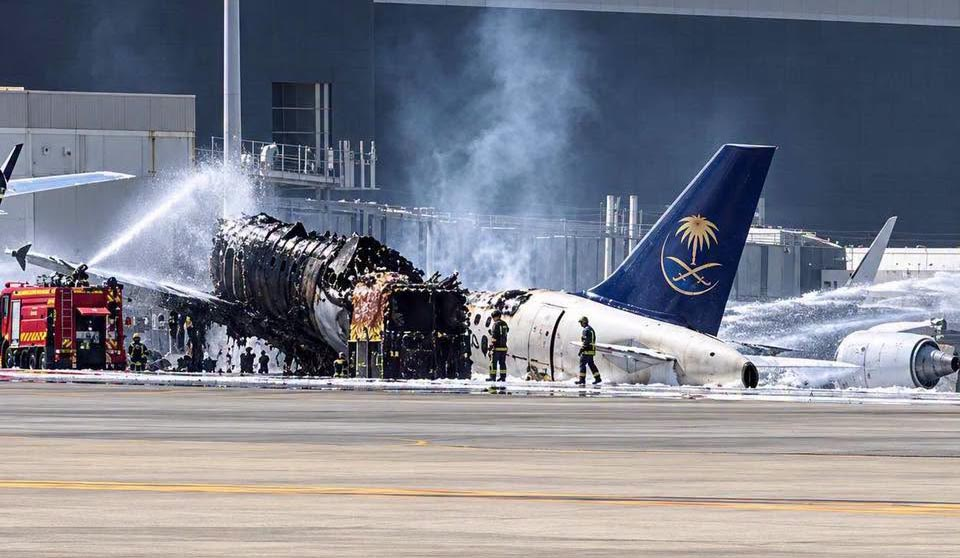
Saudi Arabia's General Authority of Civil Aviation also confirmed that two separate attacks had targeted King Khalid Airport, the first striking airport facilities and the second hitting an aircraft belonging to Saudi Airlines.
Abha and Aden airports have also been targeted multiple times over the past week in missile and drone attacks, disrupting air transport. In addition, several missiles struck Dammam and Jeddah airports, halting flights and prompting aircraft to refuse landing there.
In the wake of this wave of attacks, Omar al-Bukhaiti, spokesman for the Ansarullah government, declared that Saudi airspace and airports had become part of the operational theater for Yemen's armed forces, and urged airlines to steer clear of Saudi airports to protect themselves and their passengers—a stance that effectively amounts to the start of an air blockade against Riyadh.
Airports closed
Having in mind that airport operations depend on security, Ansarullah's missile strikes have thrown Saudi air traffic into serious disarray, with flights grinding to a near standstill.
The European Union Aviation Safety Agency (EASA) on Friday advised airlines against operating in Saudi airspace following the latest attacks on Riyadh airport.
The data analytics firm Cirium also reported that roughly 300 scheduled arrivals and departures at King Khalid International Airport had been canceled. Lufthansa, for its part, suspended its flights to Saudi Arabia.
At the same time, two Indian airlines have suspended their flights to Riyadh. Flydubai announced it had canceled flights to Riyadh, Yanbu, and Abha through October 10. Despite Pakistan's plans to send troops and military equipment to Saudi Arabia, it too has halted flights to the kingdom because of the insecure airports.
What's behind Ansarullah's strikes at airports?
The ongoing missile attacks against its airports has left Saudi Arabia in a stranglehold, with no apparent way out of the crisis.
Ansarallah's recent strikes on Saudi airports can be viewed through the lens of escalating regional tensions and the Sana'a-Riyadh confrontation. Sanaa's leaders have framed the operations as retaliation for attacks on Yemeni infrastructure, above all Sana'a airport, and for the restrictions imposed on the country's flights. From Ansarallah's standpoint, the strikes aim to establish a reciprocal equation and raise the cost of continuing military operations and air restrictions against Yemen.
In this regard, al-Bukhaiti had earlier stressed that if Saudi Arabia continued restricting flights and besieging Yemen, Sana'a would respond reciprocally. In this telling, striking Saudi airports is not merely a military act but a tool to bolster Sana'a's deterrence and pressure Riyadh into changing its behavior toward Yemen.
Such positions show that Ansarullah is seeking to expand the pressure campaign from the military domain into air transport and economic activity, a move that could impose further costs on Saudi Arabia.
The suspension of flights at Saudi airports following Ansarullah's missile and drone attacks, if sustained, could carry significant economic consequences for Riyadh. Cancellations and reroutings, along with ticket refunds, deal a direct financial blow to airlines.
The damage does not stop at the aviation industry. The tourism sector, dependent on foreign visitors, will also take a serious hit. The more flights are canceled and travel-safety concerns mount, the more likely tourist numbers are to fall, a trend that could hit local business revenue, related jobs, and foreign investment.
Concerning security, the disruption to airport operations lays bare the vulnerability of Saudi Arabia's critical infrastructure and could heighten concerns about the kingdom's ability to protect its airspace and strategic facilities.
Such a situation also forces the Saudi rulers to devote more resources to strengthening air-defense systems, countering drones, and protecting airports. Rising military spending, at a time when Saudi Arabia faces falling oil revenues and flight disruptions, could pile further pressure on Riyadh's budget.
In general, Ansarullah's focus on airports is part of a strategy to drive up the costs of conflict for Riyadh, one in which the vulnerability of critical infrastructure becomes a lever to alter the adversary's security and political calculations.