





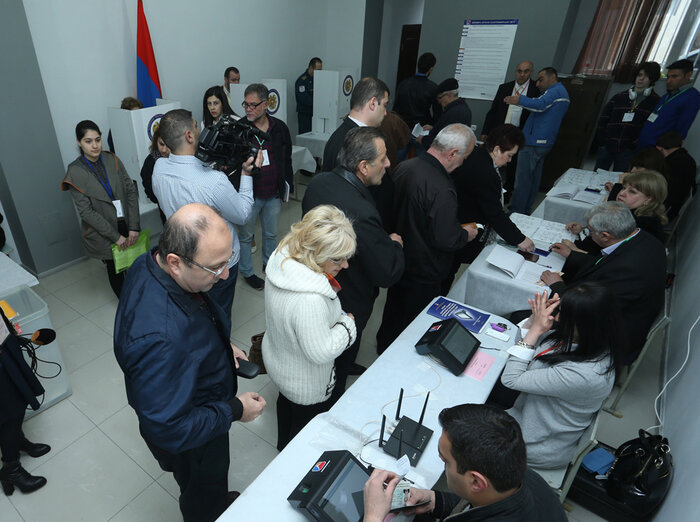


Alwaght- Armenia that has been facing an array of political and security challenges after defeat in Azerbaijan war and losing disputed Karabakh region is to hold its first parliamentary elections since all these developments. As West Asia is undergoing substantial security developments, Ukraine war is impacting the Russian-Western relationship, and the big powers are escalating their rivalry in South Caucasus, the June 7 election can leave major influence on the balance of power in Caucasus.
Around 15 political parties and coalitions are vying for the 101 seats in Armenia’s parliament in this election. But the real battle has narrowed to three major players: first, the ruling Civil Contract party led by current Prime Minister Nikol Pashinyan; second, the Armenia bloc headed by former President Robert Kocharyan; and third, the Powerful Armenia party led by Samvel Karapetyan. The latter two are widely seen as pro-Russia forces and stand in political opposition to the current government.
Civil Contract is fighting to hold onto power for a third consecutive term. For Pashinyan, this election is about far more than an ordinary political victory. In recent years, he has pursued a gradual shift in Armenia’s foreign policy, moving away from its traditional dependence on Russia and toward closer cooperation with the US and the European Union. The outcome, therefore, will be seen as a public referendum on whether Armenian society endorses or rejects that path.
Pashinyan leading in polls
Poll results published in recent weeks put the ruling party at the top, suggesting that it has a high chance to win the largest number of parliamentary seats, though support for Pashinyan has dropped compared to that in 2018 election.
Some polls estimate the support for the Civil Contract at 40-45 percent, with parties of Kokharyan and Karapetyan coming next.
In effect, the core debate driving this election comes down to one fundamental question: Should Armenia move toward the West, or remain within Russia’s strategic orbit?
Parties aligned with Pashinyan argue for deepening ties with the EU, expanding cooperation with the US, and reducing dependence on Russia. The opposition, by contrast, warns that drifting away from Russia could seriously jeopardize Armenia’s security and economy, and is pushing to rebuild traditional relations with the Moscow.
Credible polls over the past year show Armenian public opinion steadily leaning toward closer cooperation with the EU. According to a recent survey by the International Republican Institute (IRI), 72 percent of citizens support the possibility of Armenia joining the EU, and E51 percent say they would vote in favor of EU membership if a referendum were held. Armenian society is clearly trending westward, a shift that could boost Pashinyan’s chances of winning another term.
Cold and frayed Russian-Armenian relations
Given the anti-Russian sentiments building in Armenia, relations between Yerevan and Moscow are facing mounting challenges, fueling deepening mistrust on both sides.
Russia is closely watching Armenia’s political developments, especially the upcoming election. The outcome could shape Moscow’s future influence in the South Caucasus and determine how fast Armenia pivots toward the US and Europe.
From Moscow’s perspective, Pashinyan’s policies have not just weakened Russia’s standing in Armenia, but they could also set a dangerous precedent for other former Soviet republics, encouraging them to break free from Moscow’s orbit. The Kremlin fears that if this trend continues, Russia’s geopolitical clout in the Caucasus, long considered part of its traditional sphere of influence, will further erode.
That is why, in recent weeks, Russian officials have voiced their concerns to Yerevan openly and bluntly. Foreign Ministry spokesperson Maria Zakharova accused Armenia of being dragged into the “anti-Russian track of the European Union” and warned that moving toward Euro-Atlantic standards could carry political and economic consequences for Yerevan.
Meanwhile, President Vladimir Putin and other leaders of the Eurasian Economic Union (EAEU) made clear at a summit in Astana that Armenia cannot be both a member of Russia-led economic structures and a candidate for EU membership. Putin cautioned that choosing the European path could come with a heavy economic price tag.
A few days ago, Russia also recalled its ambassador from Yerevan for consultations. And observers see recent restrictions on Armenian agricultural imports to the Russian market as part of this mounting pressure campaign.
West seizing opportunity created by Yerevan-Moscow tensions
After three decades of looking for a foothold in the Caucasus, the West is now making the most of the rift between Yerevan and Moscow, launching an all-out push to draw Armenia closer to Western structures.
A landmark moment came in May, when the first-ever EU-Armenia summit was held in Yerevan, with European Commission President Ursula von der Leyen and European Council President António Costa in attendance. The two sides signed agreements on cooperation in connectivity, transport, energy, digital infrastructure, and security, while vowing to deepen political and economic ties. The EU also announced a new civilian partnership mission in Armenia and an expansion of security and defense cooperation. At the same time, Brussels has deployed teams to Armenia to counter information warfare, cyberattacks, and foreign interference in the election process.
On the bilateral front, ties between Yerevan and Washington have also deepened. In recent months, US Secretary of State Marco Rubio signed a new strategic partnership agreement with Armenia. American officials have repeatedly voiced support for Armenia’s political reforms, and the two sides have launched fresh cooperation on energy, infrastructure, and regional transit.
One of those transit projects is the so-called "Trump Corridor", part of a Washington’s strategy to connect Azerbaijan to Nakhchivan and other regional routes across the Caucasus. While Armenian leaders see this approach as simply diversifying their economic partners, Moscow views such projects as a direct tool to shrink Russia’s geopolitical role in the region.
That said, Pashinyan has repeatedly stressed that moving closer to Europe does not mean cutting ties with Russia. Armenia, he insists, still wants to cooperate within the Eurasian Economic Union, but also has every right to expand relations with the EU and the US.
The West’s growing embrace of Armenia is not just driven by Washington and Brussels. Yerevan itself has been sending positive signals westward, actively laying the groundwork for deeper ties.
So, Pashinyan's government has taken further steps in recent weeks to move closer to the West. Deepening cooperation with the EU, expanding security cooperation with the Western countries, purchasing military equipment from France and India instead of relying fully on Russia and suspending active participation in the Russian-led Collective Security Organization are among these moves.
Even in a recent military parade in Yerevan, a major part of the displayed equipment and weapons were non-Russian, something seen by the observers as a symbol of strategic shift in Armenia.
Under these circumstances, Kremlin officials are closely, and warily, watching Armenia’s upcoming election. A continued Pashinyan tenure could accelerate the country’s westward pivot and directly impact Russia’s strategic influence in the Caucasus.
That said, even as enthusiasm for closer Western ties has grown in Armenia and across the Caucasus in recent years, Russia’s deep hold on the region’s security, political, and economic dynamics remains intact. For that reason, even Pashinyan’s government cannot fully break free from Moscow’s strategic orbit, and is forced to maintain a delicate balancing act between East and West.
With Russia-NATO competition intensifying across the post-Soviet space, any hasty lurch toward the West could carry complex security and geopolitical consequences for Armenia, exposing it to even greater tensions.
In general, Armenia election can be one of the most determining political events of this country since its independence from the Soviet Union in the 1990s. The significance of the election is not limited to determining the composition of the new parliament. It is actually a kind of an indirect referendum about the future path of the Armenian foreign policy and in fact the voters will choose between maintaining the newly-adopted policy of drifting to the West and keeping the traditional bonds with Russia. So the vote outcome is of strategic importance not only for Yerevan but also for Moscow, Brussels, Washington, and other influential players in South Caucasus.