













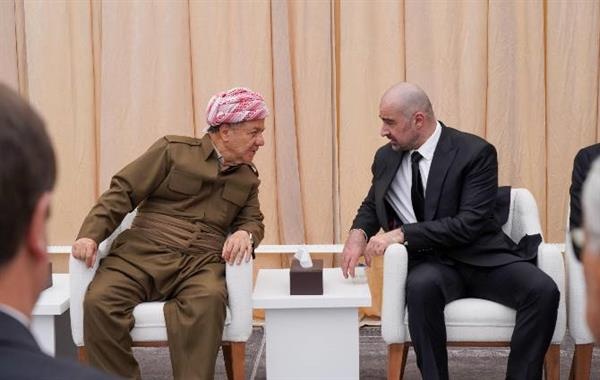


Alwaght- The Iraqi election of president which according to the constitution should be the middle ring in the government formation not only these days is moving at a extremely slow pace but also it is showing signs of a full halt, one that even the efforts by prominent figures of the ruling Shiite Coordination Framework (SCF) for mediation between the leading Kurdish parties, Kurdistan Democratic Party and Patriotic Union of Kurdistan (PUK), have failed to stimulate. The recent visit to Erbil of SCF delegation led by the caretaker Prime Minister Mohamed Shia al-Sudani has not only done nothing, but also disclosed the inter-Kurdish structural and erosional disputes.
According the mechanism established since 2005, the Iraqi government formation process has a chain nature. First, electing a parliament speaker from the Sunnis, then a president from the Kurds, and then a prime minister from the Shiites. Though the Sunnis and Shiites have done their parts with Haybat al-Halbousi and Nouri al-Maliki, the deadlock in the election of a president has put the brakes on the whole chain. As long as Kurdish dispute does not end, none of these relative advances can lead to government formation.
Kurdish stalemate: a deal that exists no more
The core issue in the Kurdistan Region is the absence of a valid agreement framework between the KDP and the PUK. For years, political, administrative, and financial crises have been piling up in the semiautonomous region without any solution. Fifteen months after the regional elections, a local cabinet still has not been formed. The biggest problem is the delay in paying the salaries of employees who have not received their last two salaries for 2025 and more than 30 months of salaries over the past decade. Since the establishment of the legislative and executive branches in 1992, Iraqi Kurdistan has never experienced such a delay in forming its local government, a government whose birth has been awaited since October 2024.
The traditional post-Saddam agreements, which granted the Iraqi presidency to the PUK in exchange for the presidency of the Kurdistan Region going to the KDP, have long lost their political validity. The Kurdistan Democratic Party, citing its greater number of seats in the Iraqi parliament, considers itself worthy of assuming the Iraqi presidency. However, it has currently declared its readiness, if the PUK agrees to reactivate the Kurdistan Regional Parliament and elect Masrour Barzani as Prime Minister and Nechirvan Barzani as President of the Region, to withdraw from presenting a candidate for the Iraqi presidency so that the PUK can present its preferred candidate, Nizar Amidi.
But the PUK finds this deal insufficient. The party not only insists on retaining the Iraqi presidency but also demands a balanced distribution of positions in the Erbil-based local cabinet. It is unwilling to hand over the internal power scene to its longstanding rival in exchange for one major concession.
These two parties together hold 62 out of 100 local parliamentary seats and the distribution of the key posts— the prime minister, president and interior minister— in the new local government makes their main sticking point. Other disputes include management of ministries, some organizations, foreign missions, oil revenues, border crossings, and salaries.
This issue gains critical importance when considering that a significant portion of the Kurdistan Region’s oil and gas resources lies within the so-called “green zone,” areas traditionally under the influence of the PUK. These areas have recently gained greater political and economic weight following the party’s success in securing the key position of Kirkuk’s provincial council.
Baghdad, the new center of Kurdish decisions
The inability of Erbil and Sulaymaniyah to resolve their internal disputes has had consequences far beyond a mere partisan conflict. It has effectively shifted the center of Kurdish decision-making from the semiautonomous region to Baghdad. Today, the fate of the most important position allocated to the Kurds is being determined not in internal Kurdish party meetings, but in the calculations of the federal parliament and cross-sectarian coalitions in the capital. This shift has weakened the Kurds’ bargaining power and given Shiite and Sunni political forces more room than ever to play the role of mediator, and sometimes, arbiter.
Amidst this, the PUK, which traditionally has closer ties with Shiite political currents through the SCF, hopes these connections will help it retain the presidency without granting the concessions expected by its rival, the KDP.
However, the surprising move of KDP chief Masoud Barzani to form a tactical alliance with Nouri al-Maliki has altered the political calculus to the PUK’s disadvantage. While the KDP may have a smaller chance of pushing its own candidate past the required two-thirds parliamentary majority, the PUK also faces a serious challenge securing the position for its nominee. It may be forced to settle for an alternative candidate, such as Abdul Karim Rashid.
Inter-PUK gap, a KDP opportunity
Such a scenario in the eyes of the KDP makes a strategic chance. The KDP believes that strengthening such figures as Abdul Karim Rashid can upset the power balance within the PUK and raise the weight of old guard against the party’s president Bafel Talibani, something seen with clear examples in the past. Power gain of Barham Salih and then his defection from the PUK, expulsion of Lahur Sheikh Jangi, and even the older example the defection of Nawshirwan Mustafa and formation of Change Party all show that the PUK is chronically subject to internal gaps, ones that have gradually eroded its power to bargain against the KDP.
A crisis beyond names
The current deadlock over picking a president is no longer just an overdue legal duty. It has developed into a symbol of a deeper crisis marked by the lack of consensus, the failure of the ethno-sectarian quota system, and the erosion of political legitimacy. This situation unfolds against the backdrop of growing American pressure to speed up the formation of a government independent of resistance groups opposed to American military presence in Iraq, with international support being conditioned on establishing a cohesive executive branch. In such circumstances, every day of delay means the continuation of a caretaker government, a deepening executive vacuum, and the deterioration of the country’s administrative, economic, and security paralysis.










