















Alwaght- Since Sunday, Iran's IRGC launched its "smart control of the Strait of Hormuz" military drills under watch of the force’s commander General Mohammad Pakpour in the strategic Strait of Hormuz in the Persian Gulf. These military drills are seen not as a military showoff, but a multi-layer message at domestic, regional and international levels.
Amid escalating tensions in West Asia's security environment, particularly in the regional waters surrounding Iran, fueled by extensive US military amassment in the Persian Gulf, the IRGC Navy's latest drill in these strategic waters has taken on significance far beyond a routine annual exercise. It has become an arena where the battle of narratives, the clash of wills, and the war of calculations carry as much weight as physical combat.
The official objectives of the drill have been announced as assessing the readiness of the IRGC Navy's operational units, reviewing scenarios for countering potential threats, practicing swift and decisive responses, and intelligently leveraging the Islamic Republic's geopolitical advantages in the Persian Gulf and the Sea of Oman. However, beyond these stated goals, what truly matters is the redefinition of the concept of "control" at a vital global energy choke point, control defined not as reckless blockage, but as the intelligent management of the arena in conjunction with diplomacy.
Reality on the ground different from media headlines
In recent weeks, Western and aligned media have amplified reports of the US aircraft carrier movements and military deployments to the region, crafting a narrative of absolute American naval supremacy in the waters around Iran. The clear aim was to intimidate public opinion and project an image of overwhelming pressure on Tehran.
But the IRGC Navy's latest exercise effectively shatters this one-sided portrayal. The reality of the Persian Gulf bears little resemblance to those media headlines. This is not a vast ocean offering open maneuverability for aircraft carriers. It is a semi-enclosed, shallow, island-dotted, and complex waterway, an environment where the rules of engagement differ fundamentally from classical naval doctrine.
IRGC Navy Commander Rear Admiral Alireza Tangsiri drove this point home yesterday, declaring that Iran's islands in the Persian Gulf and the Strait of Hormuz are "impregnable fortresses" and part of the nation's honor. This was not mere rhetoric. It was a pointed reference to a multi-layered defensive architecture that has transformed these islands into permanent, strategic operational hubs, working in concert with mobile naval assets.
Iran's naval power in the Persian Gulf is not built around costly, colossal warships. Its foundation rests on swift attack craft, missile-launching corvettes, a decentralized operational structure, and an integrated network of radars, drones, surveillance systems, and coastal-to-sea missile batteries. This is the essence of "asymmetric naval warfare", a doctrine widely recognized in military literature as significantly more effective in the unique geography of the Persian Gulf than the classic deployment of heavy fleets.
The Persian Gulf's natural geography, its shallow waters and numerous islands, offers more than just a backdrop. It provides the perfect cover for rapid-attack craft to maneuver and, if necessary, execute surprise strikes. But these vessels are not lone operatives. They function as nodes within an expansive command-and-control network that integrates surface, subsurface, and aerial domains.
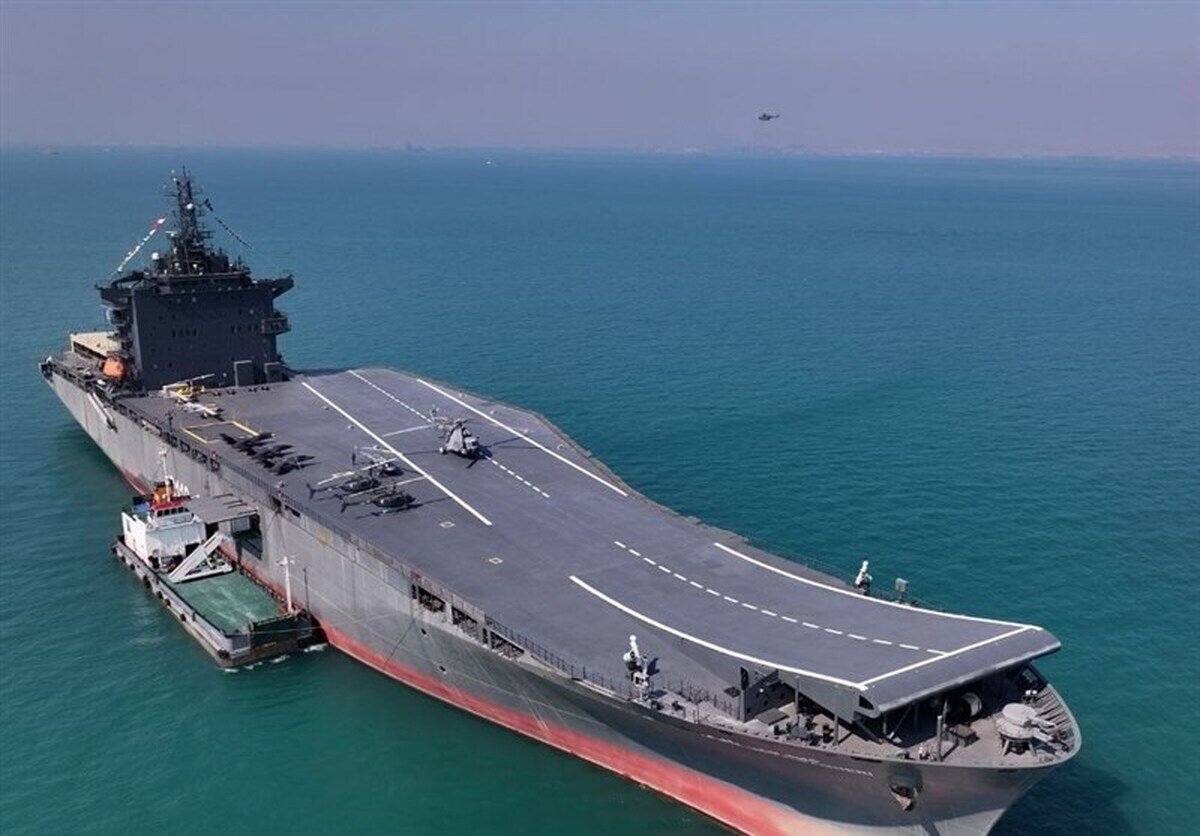
This layered capability extends well beyond fast boats. Vessels like the missile-armed catamaran Shahid Soleimani, the helicopter-carrying Shahid Nazeri, and the drone-carrier Shahid Rudaki form critical links in the IRGC Navy's power chain, a chain that now seamlessly connects operational capacity in the Persian Gulf to the Sea of Oman and even the Indian Ocean.
The message embedded in this military architecture is unmistakable: Iran is not projecting force for the sake of aggression. It is cementing a doctrine of deterrence at the very point where the global economy is most vulnerable.
From the Persian Gulf to Geneva: Field supports diplomacy
The Smart Control of the Strait of Hormuz drills cannot be analyzed in isolation from the current diplomatic climate and ongoing negotiations. Past experience has shown a consistent pattern: whenever Iran enters a dialogue phase with the West, it simultaneously moves to maintain, or even strengthen, its position on the ground. This is the essence of the "field accompanying diplomacy" strategy.
In effect, the latest military exercises represent a parallel game. Washington, by deploying naval assets and amplifying reports of its military moves, seeks to bolster its negotiators' leverage. Tehran, by displaying operational readiness in the Hormuz Strait, is sending a clear signal: any return to maximum pressure will be met with a commensurate response on the ground.
Meaningful negotiation requires both sides to possess real sources of leverage. For Iran, the Persian Gulf is precisely a strategic lever. The military exercise in the Strait of Hormuz should therefore be viewed as an integral part of a broader bargaining equation, one that stretches from the warm waters of southern Iran to the negotiating tables of European capitals.
Seen through this lens, the drill is not a sign of a tilt toward war. It is a demonstration of readiness to prevent war from a position of strength. The message to Washington is clear: if diplomacy is the chosen path, the security of the Strait is assured. If the military option is activated, the arena will provide the response.
What does "smart control" mean?
The keyword in this military exercise is "smart." And smart control is a far cry from outright closure. The Strait of Hormuz is the world's most critical energy artery. Every day, dozens of oil tankers and commercial vessels transit its narrow waters, carrying a significant portion of global energy supplies. A large-scale disruption would not just hurt Iran, it would send oil prices skyrocketing, roil financial markets, and trigger a full-blown global economic crisis.
Tehran has repeatedly warned that any direct attack by the US or Israel would be met with a regional response, not a limited one. And the Strait of Hormuz has long been viewed as a potential pressure point in such a scenario. But "smart control" refines that threat. It suggests any future action would be targeted and discriminatory, not indiscriminate and chaotic.
For example, during the Gaza war, Yemen's Ansarallah resistance movement demonstrated the ability to manage maritime traffic selectively in the Bab-el-Mandeb Strait, striking vessels linked to one party to the conflict while leaving other shipping lanes open.
This logic can apply to the Strait of Hormuz. Smart control would mean real-time monitoring of national interests, distinguishing between hostile and non-hostile actors, and applying calibrated pressure. Take China, for example. Beijing relies on West Asia oil far more directly than Washington does, an estimated 80 percent of its crude imports pass through this waterway. A smart strategy preserves Iran's deterrence leverage without alienating major economic partners who depend on the Persian Gulf energy.
Rear Admiral Tangsiri underscored that the IRGC Navy maintains round-the-clock domain awareness in the Strait; on the surface, in the air, and below it. That intelligence dominance is the backbone of smart control. Without knowing exactly what vessel is where, who owns it, where it is headed, and what it is carrying, targeted management is impossible.
To put it simply , smart control is the conversion of geography into policy. It is the use of geopolitical advantage not to create chaos, but to manage crises in a way that serves national interests.
Who is in charge?
With this military drill and power projection of its navy, the IRGC translated words into actions about who really is the boss in the Persian Gulf. This is a geopolitical reality that in a waterway the world economy relies on heavily, the actor that holds geographical position, intelligence, and operational readiness together plays the determining game.
The IRGC’s smart control of the Strait of Hormuz drills demonstrate that Iran is not seeking to close the door, but it wants to show it holds the key. This is a fundamental difference. In a world where war and diplomacy move together, holding the Strait of Hormuz key means securing a considerable share in the world energy security equations.










