










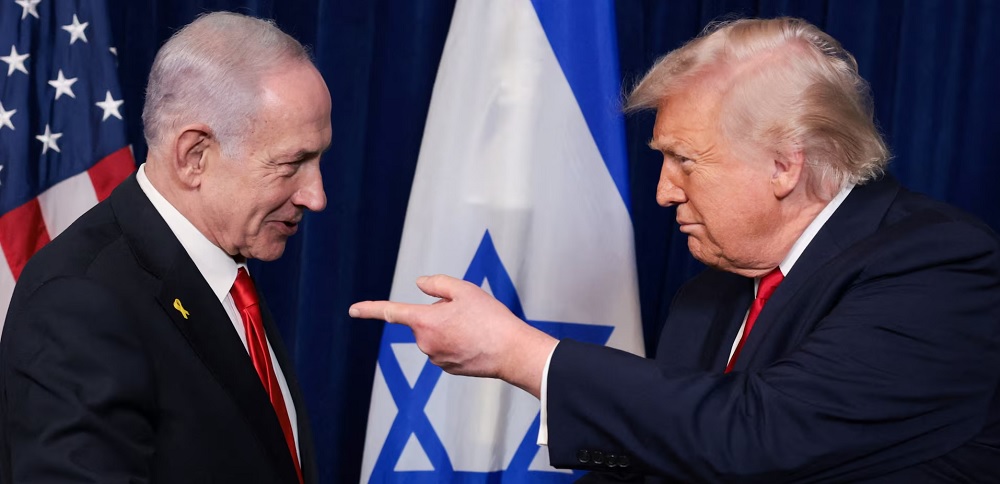


Alwaght- The meeting of the US President Donald Trump and Israeli Prime Minister Benjamin Netanyahu was held on Wednesday, with Iran taking a center stage in the talks of the two allies. Following the meeting, Trump in a post on his social media site, Truth Social, said he favored further negotiations with Iran, but he maintained other options on the table.
However, the key point of Trump after meeting Netanyahu was the following statement: "There was nothing definitive reached other than I insisted that negotiations with Iran continue to see whether or not a deal can be consummated."
Netanyahu’s visit to Washington is the seventh since Trump's comeback to power in 2024. But the tone of the US president after the bilateral with Trump and media reports suggest that the outcome was totally different from previous ones.
Divided on the surface
Trump's emphasis that he could not make any certain decision in his meeting with Netanyahu may reveal a difference with Netanyahu on the surface, but it seems that this is just a show rather than a reality.
Netanyahu’s overriding aim in meeting Trump was to influence the US-Iran negotiations, yet there is no indication he achieved that. Idan Koller, an Israeli journalist with Walla based in Washington, reported that Netanyahu sought both to amplify opposition to talks with Tehran inside the White House and to gather intelligence on the scope of the US-Iran dialogue.
“It was vital for Netanyahu to make sure Trump wasn’t hearing only Witkoff’s line” on the need to engage Iran. Within Tel Aviv’s right-wing camp, there is a belief that Witkoff and Kushner are naive and that Netanyahu needed to get fully read into every dimension of the Iran file," Killer said.
Aaron David Miller, a former senior US negotiator, also weighed in: “Clearly, neither Trump nor Netanyahu stood to gain anything beyond a warm meeting and a show of unity. That said, both are consummate politicians, masters of deception and political maneuvering. Netanyahu’s problem is that it’s no longer 2015. You can’t outflank a president who is the absolute master of the Republican Party.”
Netanyahu’s push to break isolation
After weeks of hesitation, Netanyahu shifted course and joined Trump-backed Gaza “Peace Council”, a body including Turkey and Qatar that he had previously rejected outright .
Experts suggest the decision reflects Tel Aviv’s strategic calculations regarding Gaza and Iran, describing it as an option for Netanyahu to align himself with regional powers rather than remain isolated. In reality, Tel Aviv is currently seen as an isolated actor in the region, and by announcing his participation in the Peace Council, Netanyahu sought to demonstrate that Tel Aviv is not alone.
Beyond this, Netanyahu’s move to join Trump’s Peace Council appears to signal a concession by Tel Aviv to Washington, aimed at persuading Trump to support Israel’s policies toward Iran. At the same time, the apparent outcome of Netanyahu’s recent talks with Trump suggests that the meeting, at least, yielded no tangible gains for Tel Aviv.
The absence of a press briefing with journalists, typically held after previous Netanyahu-Trump talks, further indicates that Netanyahu, at least on the surface, failed to achieve his objectives in Washington. His early departure from the White House following the three-hour meeting also suggested a tense atmosphere in the discussions between Israeli and American officials.
Trump hesitant about war against Iran
Despite Netanyahu's push to involve the US into a war against Iran, Trump's emphasis on diplomacy with Iran suggests the president is yet to decide certainly on a military action against Iran. Vice President JD Vance said on Wednesday that the mission given by Trump to them is talking to Tehran.
Even before the latest tensions, voices across the US political spectrum had warned against war with Iran. Among them, American analyst Jeffrey Sachs was blunt: saying “war with Iran would be extremely dangerous and harmful to the US. Israel has a very powerful voice with Trump and in UD policy, and it undoubtedly wants war. Iran has a population of 90 million, extensive missile capabilities, and a determined populace. Trump isn’t a particularly intelligent man; he should listen to the advice of regional states. Iran is a strong country in its own right, and it has strong allies.”
Iran’s missile arsenal, the prospect of retaliation, and the likelihood of regional resistance factions targeting USvinterests and personnel have injected deep skepticism in Washington about the wisdom of military action. Moreover, Trump faces no groundswell of public support for war with Iran. Even his own MAGA base remains firmly opposed to another US entanglement in West Asia war.
Other regional developments suggest that Washington is walking back from its anti-Iranian threats. Yesterday, Turkish Foreign Minister Hakan Fidan told the Financial Times newspaper that Washington is ready for compromises on uranium enrichment. This is the latest sign of Washington’s departure from its language of threat against Iran regarding the nuclear case.